South Africa · Comparable consumption

Most Fuel-Efficient Cars in South Africa 2026

Turn confusing fuel figures into one simple question: how many litres might this car use over the distance you actually drive?
Plain-language review5 checked visualsReviewed 2026-07-22
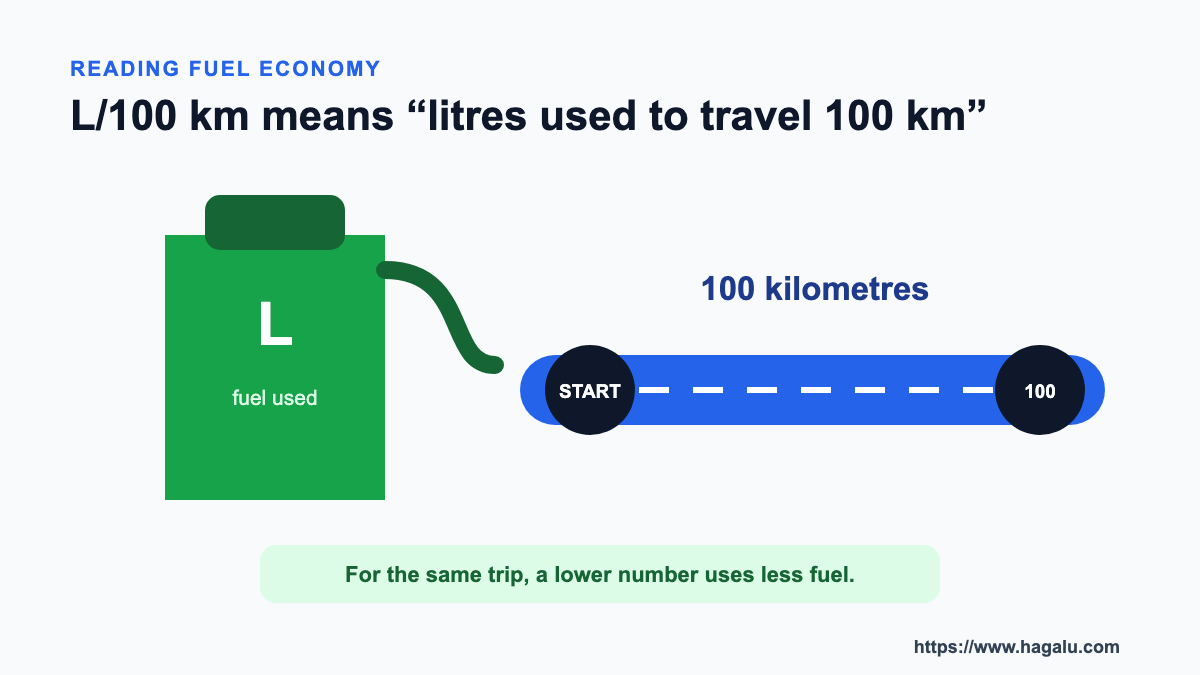
Simple road and fuel-can diagram explaining that a smaller L per 100 km number means less fuel used over the same 100 kilometre journey
Think of L/100 km as the number of fuel cans a car empties over the same road. Smaller is better when the test basis is comparable. On a phone, swipe the diagram sideways to read it at a larger size. Open full-size image · Hagalu Editorial Studio · image usage terms
Visible, checked shortlist

Lowest comparable liquid-fuel consumption

The ranking accepts conventional petrol, diesel and non-plug-in hybrid derivatives only when the stored units are clear enough to compare. It rejects ambiguous values rather than turning a copied km/L number into a false L/100 km winner.

Five useful pictures, not decoration

See the decision before reading the fine print
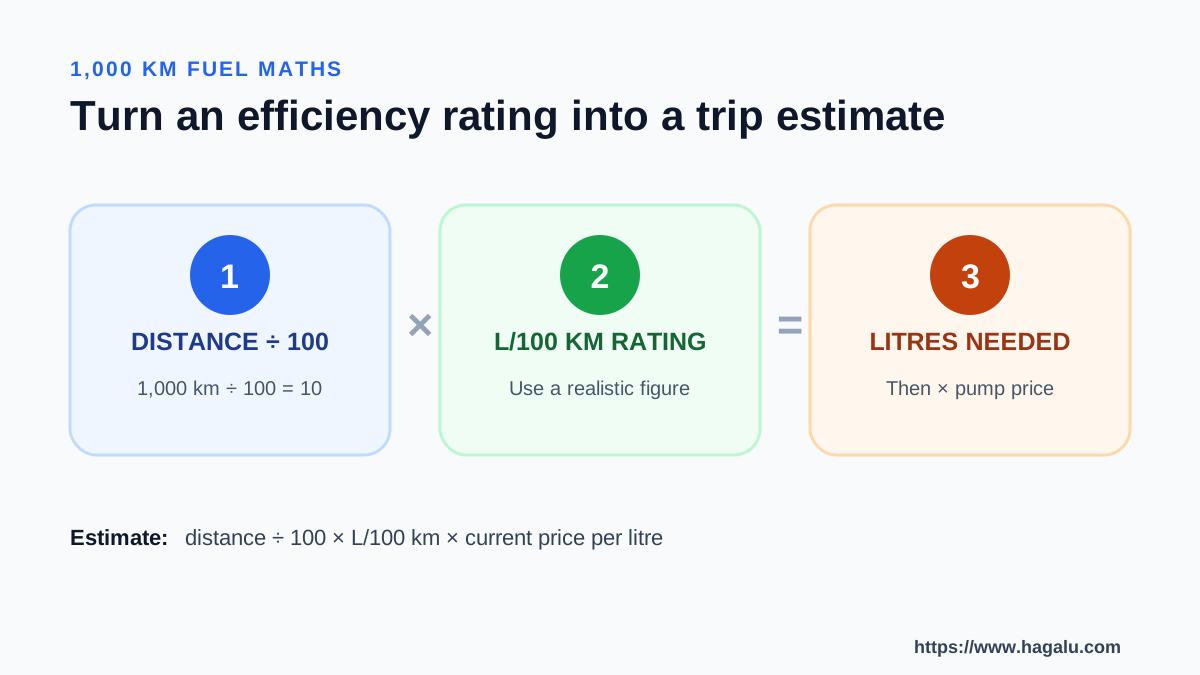
Step-by-step formula multiplying litres per 100 kilometres by ten and then by the current rand-per-litre fuel price
For 1,000 km, multiply L/100 km by ten to estimate litres, then multiply by your current local fuel price. On a phone, swipe the diagram sideways to read it at a larger size. Open full-size image · Hagalu Editorial Studio · image usage terms
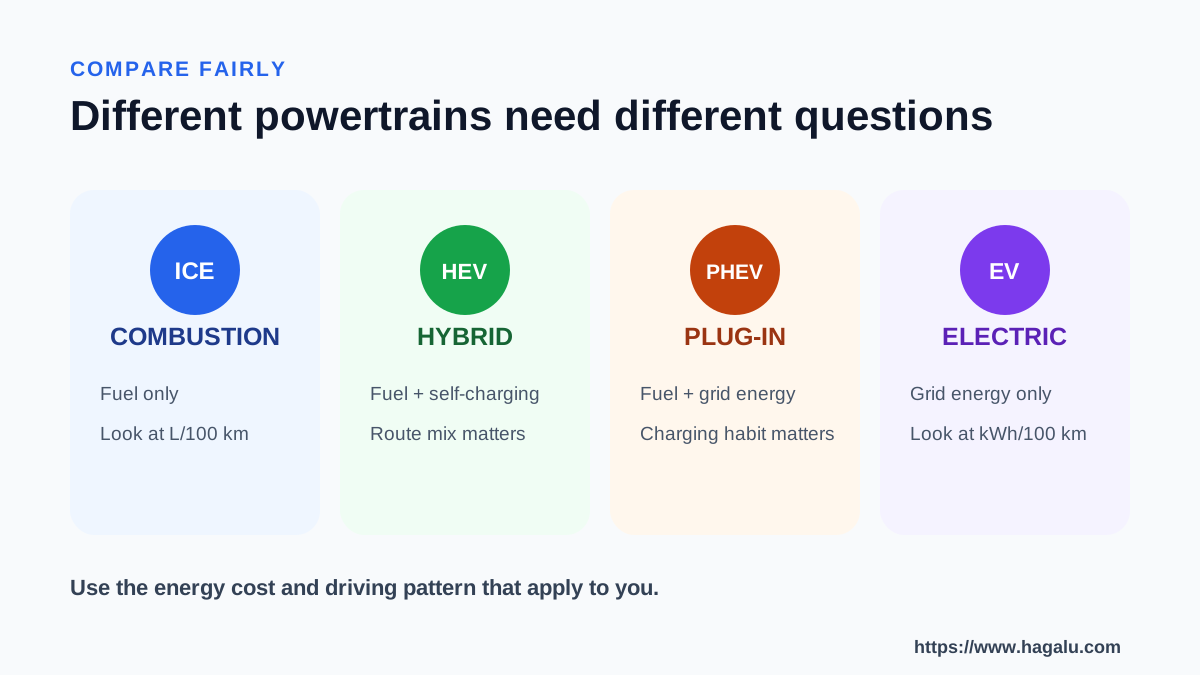
Four lanes separating petrol or diesel, non-plug-in hybrid, plug-in hybrid and electric vehicle energy comparisons
Do not crown an EV at 0 L/100 km or compare a charged PHEV test directly with an ordinary petrol car. Use the right unit for each lane. On a phone, swipe the diagram sideways to read it at a larger size. Open full-size image · Hagalu Editorial Studio · image usage terms
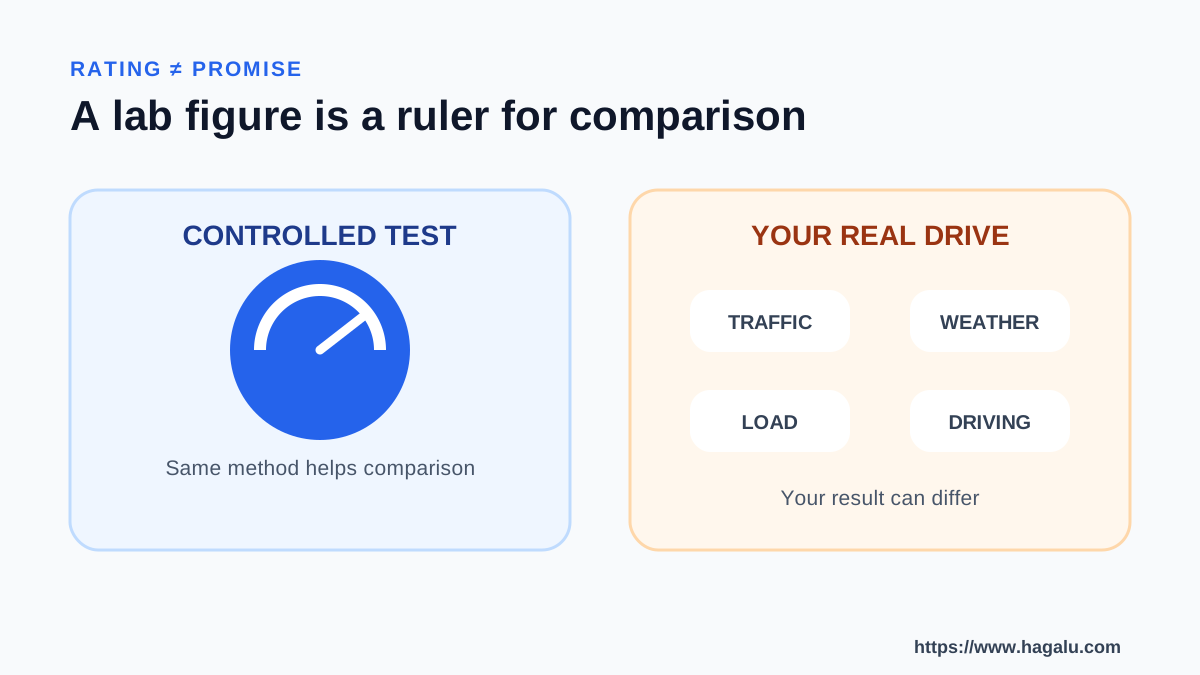
Split illustration showing a controlled official test beside traffic, hills, wind, passengers and air conditioning in real driving
Official figures help compare cars under one test. Your traffic, speed, load, weather and tyre pressure decide what happens on your road. On a phone, swipe the diagram sideways to read it at a larger size. Open full-size image · Hagalu Editorial Studio · image usage terms
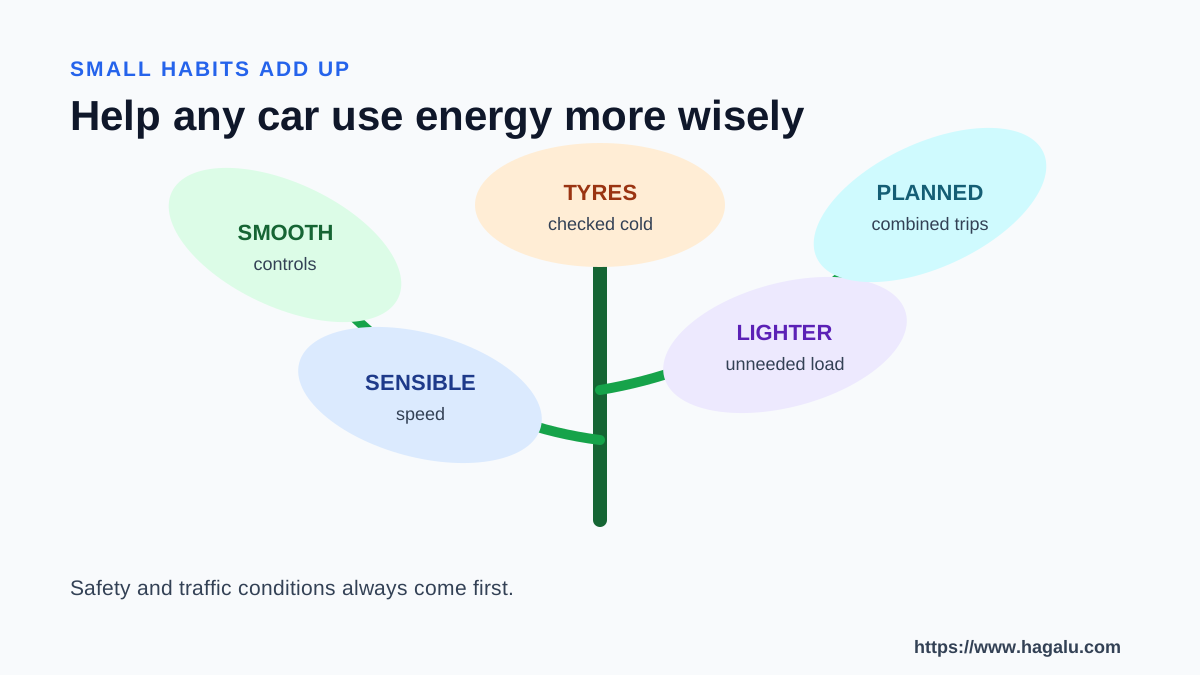
Five simple habits covering smooth acceleration, sensible speed, tyre pressure, lighter loads and trip planning
The cheapest litre is the one you do not burn: smooth driving and correct maintenance can matter every day. On a phone, swipe the diagram sideways to read it at a larger size. Open full-size image · Hagalu Editorial Studio · image usage terms
One unit at a time

How to read L/100 km without a calculator

Litres per 100 kilometres asks how much fuel is used to travel the same distance. A car rated at 5 L/100 km uses five litres in the official test to cover 100 kilometres. A car rated at 8 L/100 km uses eight. When both figures come from a comparable test, the smaller number is more efficient.

Kilometres per litre runs the other way: a larger number is better. Convert it with 100 divided by km/L. Because copied databases sometimes place a km/L number in an L/100 km field, Hagalu cross-checks available units and rejects suspicious values instead of publishing an impossible ranking.

  • Lower L/100 km is better; higher km/L is better.
  • Compare the exact engine, gearbox and drivetrain derivative.
  • Treat every official number as a comparison result, not a promise.
Money from distance

Estimate your own monthly fuel bill

Write down your normal monthly kilometres. Divide by 100, multiply by the car's L/100 km figure, then multiply by the fuel price you actually pay. Repeat with a slightly worse consumption number so the budget is not built on a perfect test result.

South African fuel prices are adjusted monthly and can differ by fuel grade and inland or coastal zone. That is why this guide teaches the formula instead of freezing one pump price into a long-lived article.

  • Monthly litres = monthly kilometres ÷ 100 × L/100 km.
  • Monthly fuel cost = monthly litres × current rand per litre.
  • Add a realistic margin for congestion, short trips, hills and load.
Efficiency with context

A low fuel number is not the whole car

A highly efficient car can still be wrong if it cannot safely carry your passengers, tow the required load or reach places you use. Conversely, paying much more for a tiny fuel saving can take years to recover. Compare the total ownership cost and the car's real job.

Hybrids can save strongly in stop-start driving because they recover some braking energy and assist the engine. Diesel can suit long-distance and load-heavy use, while repeated short trips may not suit every modern diesel emissions system. The exact vehicle and journey matter more than a badge.

  • Calculate rand saved per month before paying a price premium.
  • Check warranty and service requirements for the exact powertrain.
  • Keep PHEV and EV energy claims in separate, clearly labelled comparisons.
Take this with you

Before trusting a fuel-economy claim

Tick each item before deciding

  • Confirm whether the unit is L/100 km, km/L or kWh/100 km.
  • Match the figure to the exact engine, gearbox and driven wheels.
  • Check whether a PHEV figure assumes a charged battery.
  • Calculate cost using your monthly distance and current local fuel price.
  • Add a real-driving margin for traffic, hills, load and air conditioning.
  • Compare the saving with the purchase-price and finance difference.
No jargon test

Words on this page, made simple

Derivative
The exact version of a model—its engine, gearbox and equipment—not merely the badge on the boot.
ESC
Electronic stability control. It can brake individual wheels to help the car follow the driver's intended path during a skid.
ISOFIX
Built-in metal anchor points used by compatible child seats. The vehicle and child-seat manuals must still agree.
Payload
The combined weight the vehicle may carry, including people, bags and accessories.
Braked towing limit
The heaviest trailer the vehicle may tow when that trailer has its own working brakes.
Tow-ball limit
The most downward weight the trailer may press onto the vehicle's towbar connection.
Gross combination mass
The highest allowed total weight of the loaded vehicle and loaded trailer together.
PHEV
A plug-in hybrid: it has a battery that can be charged from an external plug as well as an engine.
Principal
The money borrowed before interest and finance fees are added.
Balloon payment
A large part of the debt deliberately left for the end of the finance agreement.
Annualise
Turn an irregular cost into a yearly amount, so monthly and occasional bills can be compared fairly.
How the list was built

Method, eligibility and limits

  1. Variant-level consumption values only; one best qualifying derivative per model.
  2. Conventional petrol, diesel and non-plug-in hybrid results are compared in L/100 km.
  3. km/L values are converted only when the source field and cross-check are credible.
  4. Ambiguous, zero, implausible or contradictory values are excluded.
  5. PHEVs and EVs are excluded from the simple liquid-fuel ranking and explained separately.
Straight answers

Questions people actually ask

Which car uses the least fuel in South Africa?

The first live card is the lowest accepted comparable L/100 km result in Hagalu's active variant data. Confirm the official figure for that exact derivative because model-year and gearbox differences matter.

Is a lower L/100 km number better?

Yes. It means fewer litres used to travel 100 kilometres in the stated test. For km/L, the direction reverses and a higher number is better.

Why are plug-in hybrids not mixed into the ranking?

Their very low official petrol figures normally assume the battery starts charged and follow a particular test cycle. A driver who rarely charges can use much more petrol, so a direct ranking can mislead.

Why are electric cars not shown as 0 L/100 km winners?

An EV uses electricity rather than liquid fuel. Compare EVs using kWh/100 km, charging price, range and charging losses instead of pretending they consume zero energy.

Will I achieve the official fuel figure?

Maybe, but it is not guaranteed. Traffic, trip length, speed, hills, temperature, wind, tyres, load and driving style all affect real use.

How do I convert km/L to L/100 km?

Divide 100 by the km/L number. For example, 20 km/L equals 5 L/100 km. Use unrounded source values when doing a serious comparison.

Evidence before excitement

Sources and checking method

  • DMRE fuel-price structureDepartment of Mineral and Petroleum Resources · Checked 2026-07-22

    Official explanation of the factors and monthly process behind South African fuel prices.

  • naamsa 2026 Automotive Trade Manualnaamsa · Checked 2026-07-22

    Official market context for South Africa's model choice, affordability and 2025 new-energy vehicle sales.

Prices, equipment and availability can change after publication. Ranked model cards link their recorded vehicle source when one is available; the broader sources above explain market, legal or calculation context. Always verify the exact derivative in a current OEM document and written dealer quotation.

Guide library Choose another plain-language guide
Browse 23 guides
Buying Cheapest New Cars in South Africa A live price-ranked shortlist that separates the advertised car price from the complete monthly cost. Buying Cheapest Automatic Cars in South Africa The least-expensive qualifying automatic derivatives, with gearbox type and exact variant price kept together. Running Costs Most Fuel-Efficient Cars in South Africa Comparable petrol, diesel and non-plug-in hybrid consumption with clear unit checks and fuel-cost maths. Family Cars Best SUVs Under R500,000 Live-price SUV candidates assessed for family fit, safety checks, road use and whole monthly cost. Family Cars Best 7-Seater Cars in South Africa Verified seven-seat derivatives with honest third-row access, luggage and child-seat trade-offs. Finance How Much Car Can I Afford? An inverse affordability calculator that subtracts real ownership costs before estimating a safe car-price ceiling. Ownership Total Cost of Owning a Car in South Africa A complete monthly and annual ownership calculator for finance, fuel, insurance, tyres, service and licensing. Buying Best First Cars in South Africa A beginner-first starter list with recorded safety basics, visibility checks, easy controls and personal insurance quotes. Launches Upcoming Toyota Cars: Confirmed vs Rumoured A fact-checked Toyota tracker separating global reveals from confirmed South African launches. Budget Best Cars Under R400,000 Budget picks linked to live model prices and EMI calculators. Finance Car Finance Guide EMI planner, yearly interest breakdown and model finder by monthly budget. Prices Car Prices South Africa Full new-car price guide by budget, brand and body type. Market SA Car Sales 2025 Official full-year market totals, sector movement, exports and practical buyer lessons. Technical Drivetrain Guide FWD, RWD, AWD, 4x4, monocoque and ladder-frame explained for SA roads. Engine Technology Engine Technology Library Plain-language engine badges, diesel systems and ownership basics for any market. Engine Technology CRDe Engine Explained Common-rail diesel fuel flow, benefits, drawbacks, fuel care and warning signs. Engine Technology TDCi Engine Explained How turbocharging and common-rail injection work together in Ford TDCi engines. Launches Suzuki South Africa 2026 Tracker What actually launched, what is already on sale and what remains unconfirmed in South Africa. Comparison New 4th-Gen Swift vs Old 3rd-Gen Swift Used-versus-new Swift decision guide for South African buyers. Suzuki Is the Suzuki Fronx a Hybrid? Local Fronx hybrid fact-check, official prices, fuel-use maths and a confirmed Suzuki alternative. Launches Upcoming Ford Cars in South Africa Everest Tremor and Ranger Super Duty timing checked against Ford South Africa's own announcements. Launches Upcoming Volkswagen Cars in South Africa The second-generation T-Roc launch window and T7 Multivan Caravelle pre-order status, without treating them as the same step. Launches Upcoming Chery Cars in South Africa Chery Q launch facts and the Tiggo V's official local preview kept separate from unannounced timing and prices.