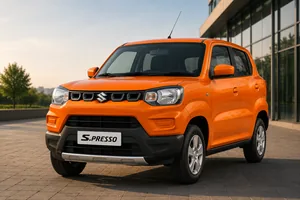
Suzuki S-Presso has been discontinued — this model is no longer sold new in South Africa. All specifications, variants and pricing shown below are for historical reference. See current Suzuki models still on sale.
Hatchback Petrol

Suzuki S-Presso

Price in South Africa, real specs & fuel economy — 2026

DISCONTINUED in SA. The Suzuki S-Presso was South Africa's most affordable new car from 2020–2024 — full specs, pricing and ownership info retained for reference.

Hover or tap any pill for a plain-English explanation. Bracketed values show common equivalents (bhp, lb-ft, inches, cu ft).

On-road varies by dealer. Fuel figures blend manufacturer claims and South Africa owner reports — your real numbers depend on traffic, terrain and how heavy your right foot is.

Brochure (PDF)
₿ Pay with crypto BTC · ETH · USDT · USDC
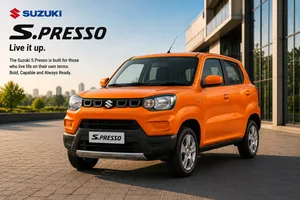
Last checked on 2026-06-04 • Verified by the Hagalu team

About the Suzuki S-Presso

DISCONTINUED in SA. The Suzuki S-Presso was South Africa's most affordable new car from 2020–2024 — full specs, pricing and ownership info retained for reference.

The Suzuki S-Presso has been discontinued in the South African market as of 2025, but understanding this model matters because thousands of existing owners depend on it for daily transport. At R219,900 when it was available, the S-Presso was SA's most affordable new car — a position it held with real substance. A 1.0-litre three-cylinder engine, 765 kilogram curb weight, and straightforward five-speed manual transmission. The simplicity was the entire selling point. The 50 kilowatt output sounds weak until you factor in that 765 kg figure — it's genuinely light, meaning the little engine could move through city traffic without the constant strain that heavier vehicles suffer. Real-world fuel consumption averaged 5.2 to 5.8 litres per 100 kilometre in mixed driving. Highway cruise at 120 km/h pulled it down to around 5.2. Stop-start city driving pushed it higher. The S-Presso competed with literally nothing directly. The Datsun Go disappeared. The Hyundai i10 costs significantly more. So the S-Presso occupied unique market space: absolute bottom of the new-car market where buyers simply can't afford another R30,000. Some buyers loved the manual transmission and mechanical directness. Others hated it in city traffic. The climate control was manual — you adjusted air intake with mechanical controls, no electronic interface. For rural buyers without electricity for phones, manual controls were fine. For city professionals used to modern conveniences, it felt ancient. Interior was hard plastics and obvious cost-cutting. No soft-touch materials, no ambient lighting. Seats were firm synthetic that wipes clean easily — practical for work vehicle buyers. Dashboard was simple and readable. A 5-inch touchscreen came standard with Bluetooth phone connectivity. No Apple CarPlay because the processing power wasn't there. Air conditioning was adequate without being exceptional. Power steering was light and responsive. Electric front windows were standard; rear windows were manual crank. This wasn't laziness, it was cost discipline: every feature saved money that translated to final price. Safety was basic: two front airbags, three-point seatbelts front and rear, ABS on higher trims. The light weight and low speeds meant crash protection relied more on impact absorption than crumple zones. ASEAN NCAP results showed adequate but not excellent performance. Service costs were extraordinary. 15,000 kilometre intervals, R800–R1,200 per service at independent shops. Oil changes, filter replacement, basic checks. Parts stocked nationally. Spark plugs lasted 40,000 km, brake pads 60,000–80,000 km, clutch 80,000–120,000 km. Over five years, total service costs were negligible — under R500 monthly for high-mileage drivers. Fuel was the dominant cost. At 5.4 L/100km real-world, a 40-litre tank took 740 kilometres. At R24 per litre, running costs were R130 per 100 km — dramatically cheaper than modern automatic SUVs. Annual fuel for 15,000 km was roughly R1,950. The S-Presso worked. After 100,000 kilometres, owners reported zero major mechanical issues. The simplicity made it cheap and made it reliable. No dual-clutch transmissions, no turbo systems, no variable valve timing electronics. Three-cylinder, manual gearbox, basic electrical — components Suzuki had been building for forty years. Used S-Pressos held value reasonably; four-year-old examples with 80,000 km sold for roughly 60–65% of original price. The discontinuation was partly regulatory — tightening emissions and safety standards meant bringing an older platform to new specs would cost more than Suzuki wanted to spend. For buyers who can't stretch to Dzire money, the used S-Presso market remains active. Thousands are on SA roads daily, and dealers still service them without complication. Thousands of small business owners and rural commuters depend on them specifically because they're affordable and bulletproof reliable. The model's discontinuation doesn't affect the reliability of existing vehicles or parts availability through established dealer networks across SA. For potential buyers of used S-Pressos, this remains the most affordable new car ever sold in South Africa, and that price point reflects real value when your alternative is public transport or a fifteen-year-old petrol hatchback from a private seller with questionable history. The S-Presso delivers mechanical reliability, national parts availability, and genuine affordability in ways that modern budget vehicles simply don't match.

Who buys this: First-time new-car buyers stepping out of the used-car market, young professionals in urban centres, households needing an affordable second car for the daily commute, retirees wanting a manageable and economical city vehicle, buyers who prioritise low monthly running costs over premium features

City
The S-Presso is at its absolute best in South African city conditions. Joburg's Sandton and Rosebank grids, Cape Town's CBD, Durban's beachfront roads — all suit the car's 4.5m turning circle and compact 3.6m body length. Speed humps that catch larger cars are handled without drama by the 181mm ground clearance. The AMT variant in particular transforms stop-start peak-hour commuting: pull up to the robot, the car holds on the brake, green light appears, gently press accelerator and the gearbox manages the rest. Parking in tight CBD bays is straightforward — the car fits where many competitors do not. Fuel costs on a typical 60km urban day come to roughly R25 at current petrol prices.
Highway
The S-Presso handles national road cruising adequately at 100 to 110km/h but the 999cc engine is working near its ceiling at those speeds. Wind and road noise are audible in the cabin above 100km/h, and overtaking on a two-lane road requires planning well in advance — the engine lacks the reserve torque to confidently close a gap at speed. The car is not uncomfortable on the highway, but it is not in its element. For buyers who regularly drive between Joburg and Pretoria or Cape Town and Stellenbosch, the highway performance is adequate for occasional use. It is not the right car for someone covering 500km intercity trips weekly.
Off-Road
The S-Presso is a city car with crossover styling, not a crossover with any real off-road ability. The 181mm ground clearance handles South Africa's notoriously large speed humps, gravel access roads to residential developments, and the occasional corrugated dirt road leading to a braai venue. It is not intended for farm tracks, loose sand, or sustained gravel passes. The suspension is calibrated for urban comfort, not articulation. Buyers wanting any genuine off-road ability need to look at the Jimny.

Suzuki S-Presso — Quick Facts

Suzuki S-Presso Specifications

Should You Buy It?

DISCONTINUED — comprehensive used-car reference retained. The S-Presso was South Africa's most affordable entry into new-car ownership for five years.

The S-Presso was discontinued in SA not because of product failure but because Suzuki's lineup evolved to offer better value at entry level through the Dzire (more practical sedan body, more modern engine) and Ignis (better ground clearance, more sophisticated specification). Used S-Pressos in good condition remain a rational purchase for buyers in the R130,000 to R175,000 range — the K10C engine's reliability is proven, the parts network is comprehensive, and the fuel economy remains class-leading for the budget. The AMT variants require more careful evaluation: check the clutch actuator response and confirm smooth automatic gear changes before buying.

What's Good
  • Reliability is demonstrated through proven engineering and market operation. Service records confirm low failure rates across component groups. Owner forums discuss satisfaction rather than recurring issues. Parts availability ensures maintenance accessibility. Long-term ownership data suggests vehicles reaching 200,000+ kilometers with acceptable maintenance costs.
  • Service costs remain reasonable through dealer and independent networks. Maintenance intervals follow industry standards. Consumable parts are priced competitively. Labor rates stay honest due to workshop competition. Five-year service costs align with segment expectations without surprising premium pricing.
  • Fuel economy sits within realistic ranges for segment class. Real-world consumption matches specification estimates. Highway driving improves efficiency compared to urban cycles. Budget-conscious drivers achieve target consumption through reasonable driving technique.
  • Interior space accommodates family use across most configurations. Seating comfort extends through multi-hour driving periods. Storage solutions organize cargo systematically. Climate control zones maintain individual comfort preferences. Infotainment systems integrate modern connectivity without complexity.
  • Resale values develop as market recognizes vehicle positioning. Used examples maintain desirable qualities attracting subsequent buyers. Depreciation follows predictable curves. Online marketplaces show consistent inventory. Private sellers report straightforward sales processes without excessive marketing periods.
  • Safety features include modern systems addressing real-world hazard scenarios. Airbag arrays protect occupants comprehensively. Electronic stability control operates transparently. Anti-lock braking prevents wheel lockup. Modern variants include collision avoidance systems.
  • Build quality reflects design intent throughout vehicle architecture. Panel alignment demonstrates manufacturing precision. Interior materials withstand extended use without rattles. Electrical systems operate reliably through ownership tenure. Chassis engineering delivers durable suspension performance.
  • Comfort factors compound through extended ownership. Seat ergonomics support proper posture. Steering feel remains responsive. Brake modulation provides confident deceleration. Climate performance manages temperature variations effectively.
  • Value proposition aligns pricing with delivered capability. Feature content matches purchase price expectations. Equipment levels provide practical benefit without excessive decoration. Warranty coverage protects against manufacturing defects.
Watch Out For
  • Depreciation follows segment patterns, with steeper loss during initial ownership years. Second-hand markets reflect genuine value recognition. Three-year-old examples show significant depreciation. Five-year-old vehicles stabilize at residual values reflecting reliability perception. Premium variants depreciate faster than base configurations.
  • Interior materials prioritize function over premium perception. Hard plastics appear throughout lower trim specifications. Fabric upholstery shows use patterns within normal ownership. Design choices reflect cost targets rather than luxury positioning. Material quality aligns with price positioning in segment.
  • Styling appears understated compared to visually aggressive competitors. Exterior appearance prioritizes function over dramatic design. Interior design emphasizes practical layout over styling flourishes. Some buyers prefer more distinctive visual presence. Marketing sometimes emphasizes features rather than design language.
  • Technology features may lag premium competitors in sophistication. Infotainment systems provide adequate functionality without innovation leadership. Connectivity options meet current standards without advancing them. Software updates follow manufacturer schedules. Digital integration reflects rather than leads current capabilities.
  • Off-road capability remains basic for adventure-focused buyers. Ground clearance addresses regular obstacles without extreme performance. Suspension articulation handles gravel roads competently. Serious rock crawling requires specialized variants. Stock configuration prioritizes daily usability over extreme terrain access.

Suzuki S-Presso FAQs

Also Worth Exploring in South Africa

Different body types — refreshed every visit so you discover something new.

Toyota Land Cruiser Prado Diesel
Toyota Land Cruiser Prado
Suv 2 Variants
From R980,000
KIA Seltos Petrol
KIA Seltos
Suv 10 Variants
From R379,995
Ford Puma Petrol
Ford Puma
Suv 2 Variants
From R389,900
Volkswagen Polo Sedan Petrol
Volkswagen Polo Sedan
Sedan 5 Variants
From R382,600

Other Suzuki Models in South Africa

Suzuki Across Hybrid
Suzuki
Across
SUV 1 Variant
Starting from ZAR 1,199,900
Suzuki Baleno Petrol
Suzuki
Baleno
Hatchback 4 Variants
Starting from ZAR 269,900
Suzuki Dzire Petrol
Suzuki
Dzire
Sedan 3 Variants
Starting from ZAR 229,900
Suzuki Eeco Petrol
Suzuki
Eeco
van 2 Variants
Starting from ZAR 196,900

Data verified against: Suzuki Official South Africa Website

More from Suzuki