CRDe Engine Explained: How Common-Rail Diesel Works
From the fuel tank to the cylinder, see what every part does—without needing to speak mechanic.
Think of a school water bottle feeding tiny spray nozzles
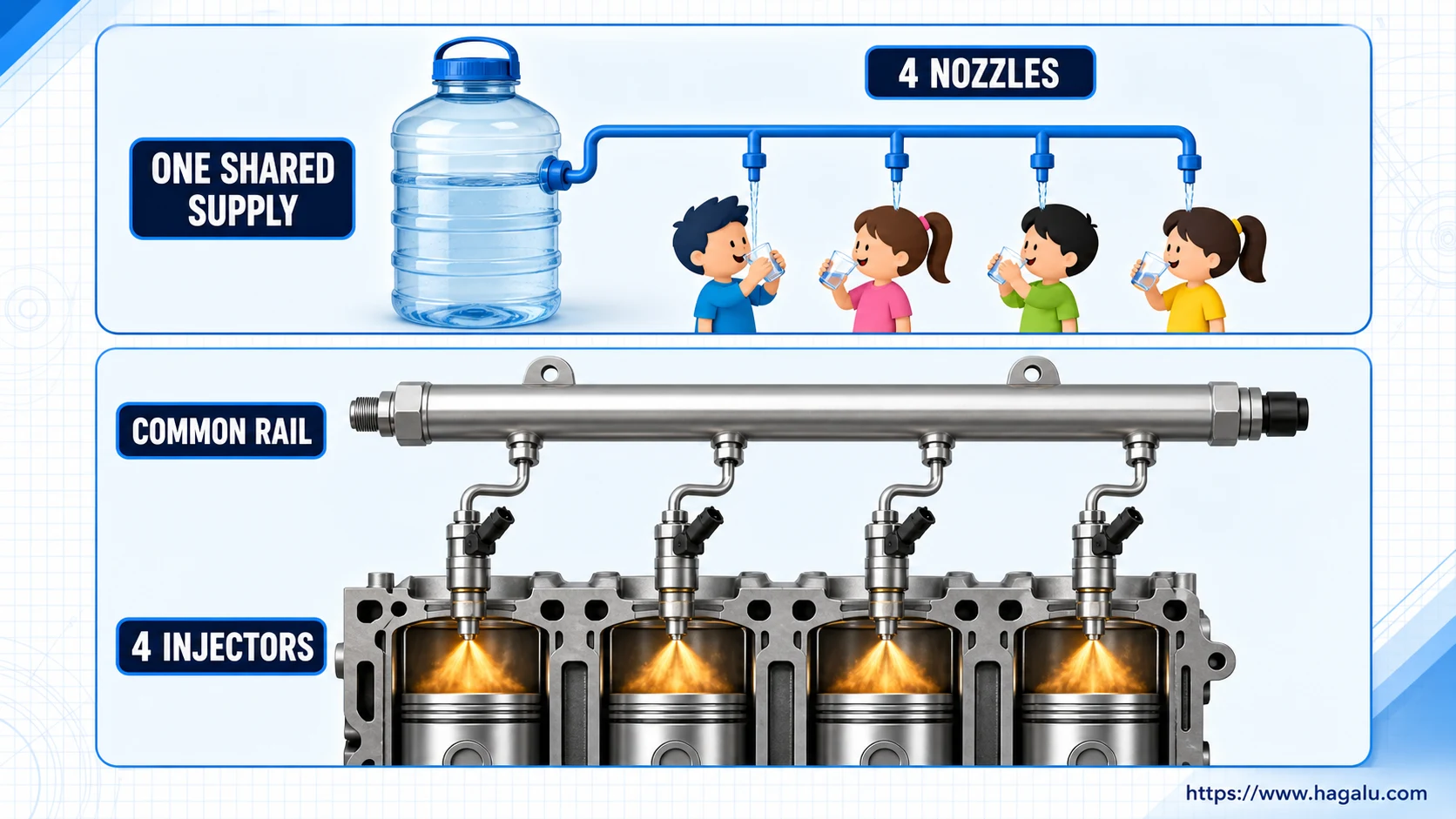
Four children want a small sip of water at the right time. A bucket would spill. One bottle with four little taps would do the job much better. A CRDe engine uses the same big idea for diesel fuel.
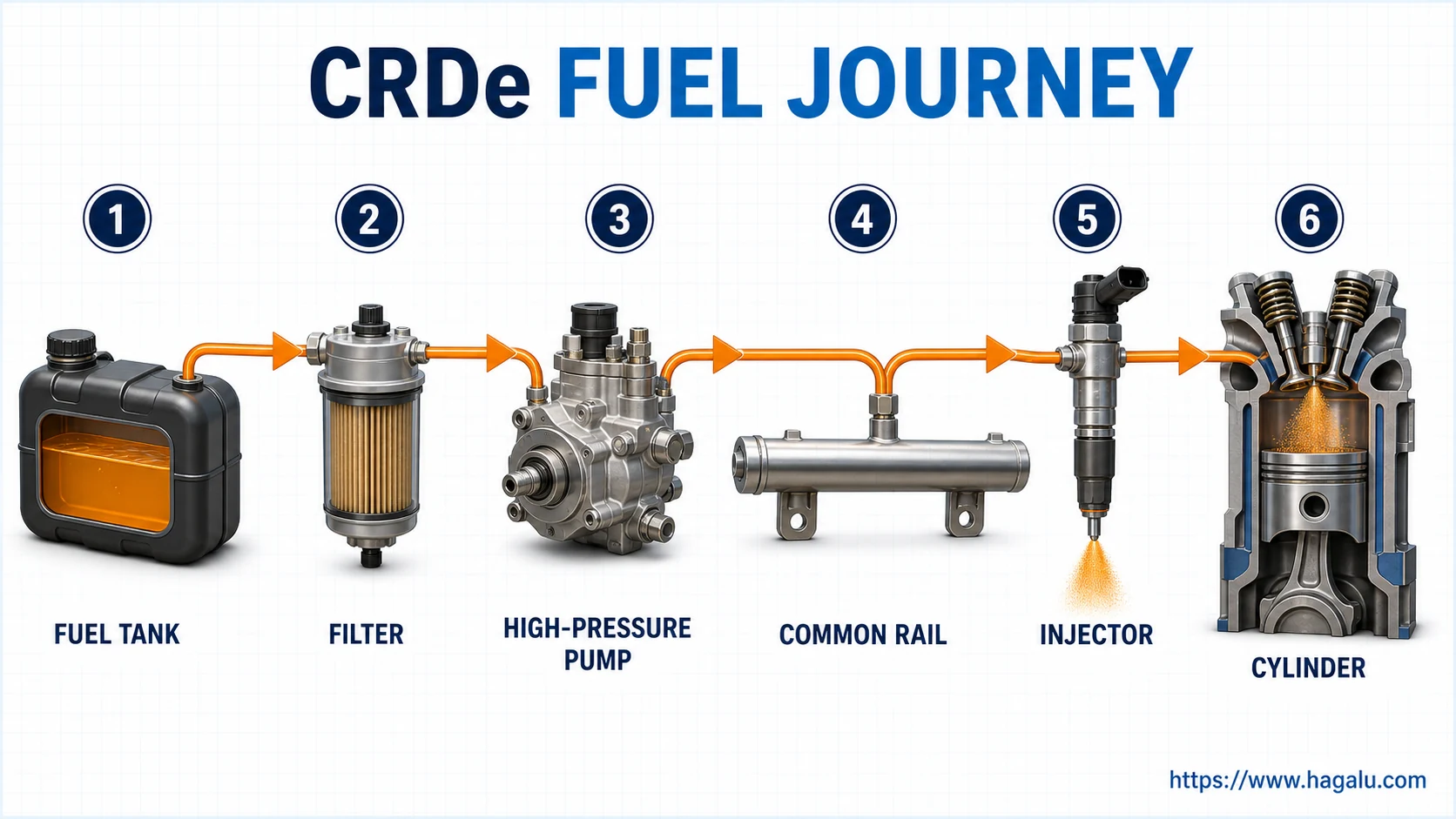
First, a filter cleans the diesel. A pump pushes it into a very strong shared tube called the common rail. Each cylinder gets an injector—its own fast spray nozzle. The engine computer tells every nozzle when to open and when to close.
Inside the cylinder, a piston has squeezed the air until it is very hot. The diesel mist starts to burn and pushes the piston down. The engine uses that push to turn the wheels.
Which part cleans the diesel?
The fuel filter catches dirt. A water separator, where fitted, also keeps water away from the pump.
Which part shares pressure?
The common rail. It is the strong tube that holds high-pressure fuel ready for all the injectors.
What starts the burn?
Heat from squeezing air. A normal spark plug is not needed for diesel combustion.
What does CRDe mean?
CRDe is a Mahindra engine-technology badge. Mahindra has used “Common Rail Diesel Engine” in its own material. One Mahindra corporate report also described CRDe technology as a common-rail direct fuel-injection engine. That wording variation is why expanding every letter is less useful than understanding the hardware.
One shared high-pressure fuel store supplies all injectors.
The injector sprays diesel directly into the combustion chamber.
The engine computer controls fuel quantity and timing from sensor data.
Hot compressed air ignites the fuel; normal combustion needs no spark plug.
How a CRDe engine works, step by step
The tank stores diesel
A low-pressure supply system draws road diesel from the tank. The exact pump arrangement varies by vehicle.
The fuel filter catches trouble
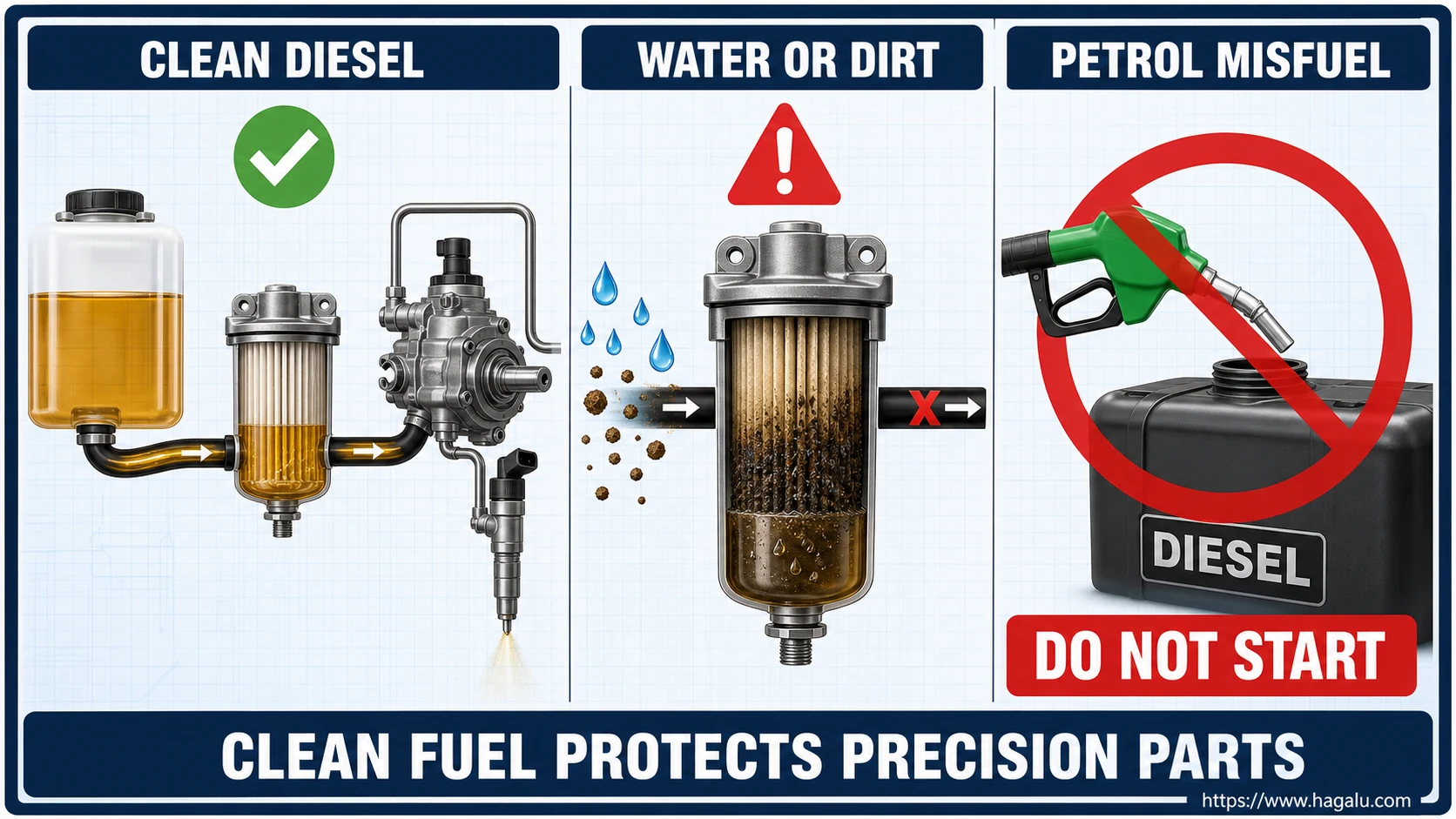
Fine dirt and water can damage precision parts. The filter—and a water separator where fitted—protects the high-pressure side.
The high-pressure pump squeezes the fuel
This pump raises fuel pressure dramatically. It depends on clean, correct diesel for lubrication, which is why contamination or petrol misfuelling can become expensive.
The common rail stores and shares pressure
The rail acts as a pressure reservoir. Because pressure is available to every injector, injection timing is not tied as directly to a mechanical pump stroke.
The computer commands an injector
The electronic control unit reads inputs such as engine speed, accelerator request, temperature and air flow. It can request a small pilot injection, the main injection and—on some systems—later injections for noise or emissions control.
Compression heat starts combustion
The piston has squeezed the cylinder's air until it is very hot. The fine diesel spray ignites in that air, expanding gas pushes the piston down, and the crankshaft turns.
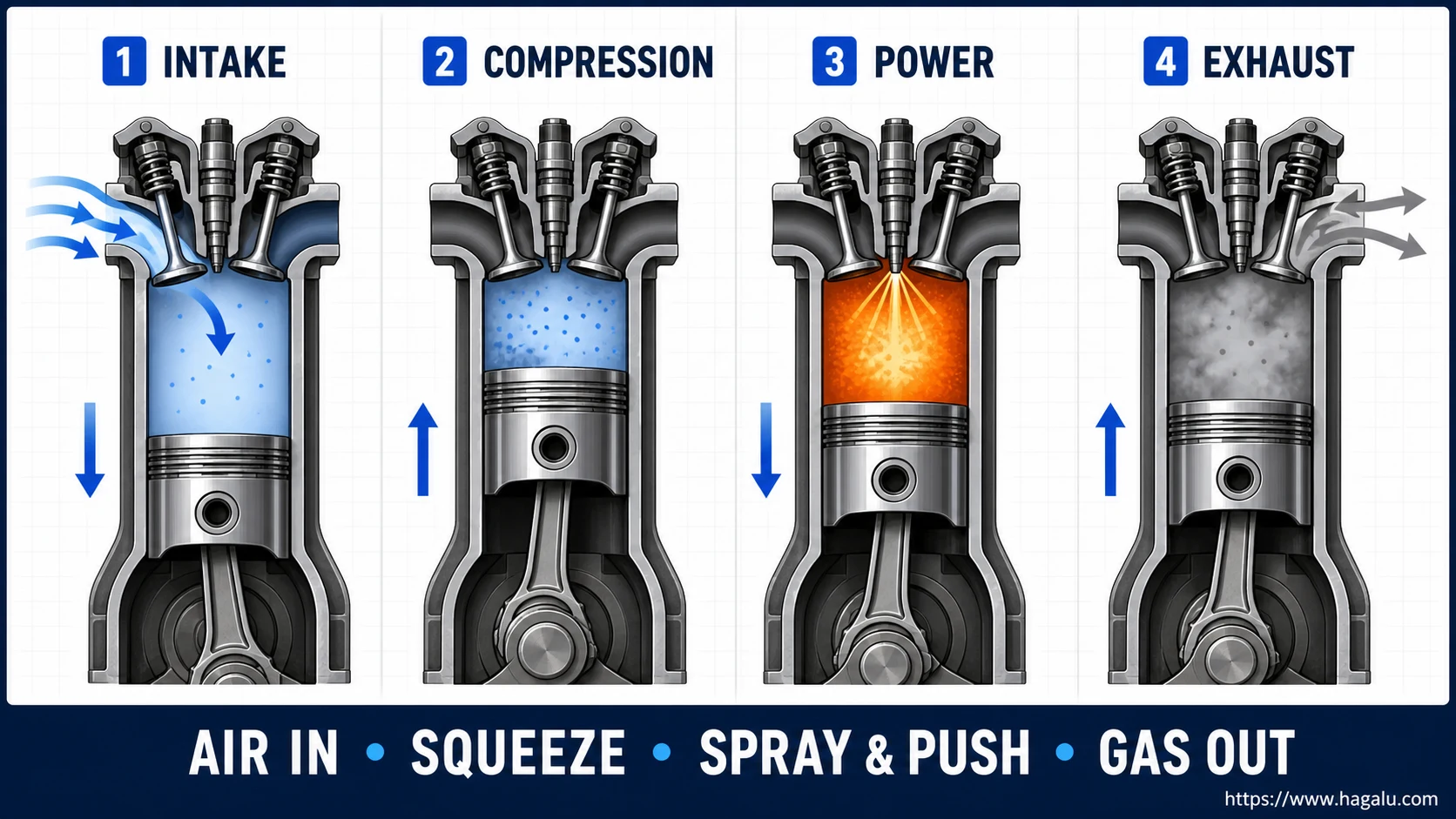
The four strokes, without the textbook headache
The piston moves down and draws in air.
The piston compresses that air until it becomes hot.
Diesel is injected, self-ignites and forces the piston down.
The piston pushes spent gas out through the exhaust.
Glow plugs are helpers, not spark plugs: where fitted, they warm the chamber for easier cold starting. The normal diesel combustion event still starts from compression heat.
Main CRDe parts and what each one does
| Part | Its simple job | What can go wrong |
|---|---|---|
| Fuel tank & supply pump | Store and move diesel toward the engine. | Wrong fuel, debris, air entering the line or running very low. |
| Fuel filter / water separator | Keep dirt and water away from precision parts. | A blocked or overdue filter can restrict supply; trapped water needs the model-specific procedure. |
| High-pressure pump | Create the pressure needed for fine atomisation. | Contaminated or incorrect fuel can cause wear and may spread metal debris through the system. |
| Common rail & pressure sensor | Store pressurised fuel and report pressure to the computer. | Leaks, faulty sensing or pressure-control faults can cause hard starting or reduced power. |
| Electronic injectors | Meter and atomise fuel for each cylinder. | Wear, deposits or electrical faults can produce rough running, smoke, knock or poor economy. |
| ECU and sensors | Calculate injection quantity, timing and safety limits. | A failed sensor or wiring issue can trigger a warning light or limp mode. |
| Turbo & intercooler, if fitted | Supply denser air so more fuel can burn cleanly. | Oil neglect, boost leaks or damaged hoses can reduce power and increase smoke. |
| EGR / DPF / SCR, if fitted | Reduce specific exhaust pollutants. | Use pattern and faults can lead to deposits, interrupted regeneration or warning messages. |
CRDe versus an older mechanical diesel
Both engines compress air and burn diesel. The biggest change is how the fuel is prepared and timed.
| Question | Older mechanical injection | CRDe common rail |
|---|---|---|
| Who controls injection? | Mainly mechanical pump parts. | ECU, sensors and electronic injectors. |
| Is pressure shared? | Usually pressure is generated for each injection event. | A common rail stores pressure for all injectors. |
| Can one cycle have several injections? | Limited. | Possible on many systems for smoother, quieter and cleaner combustion. |
| Refinement | Often louder and coarser. | Can be quieter and smoother when healthy. |
| Repair style | More mechanical and sometimes more tolerant. | More precise, diagnostic-tool dependent and sensitive to contamination. |
CRDe engine pros and cons
Pros
- Accurate fuelling: the ECU can match injection to load and conditions.
- Useful low-speed pull: diesel torque suits loads, hills and relaxed cruising.
- Potentially good economy: especially in a well-matched vehicle on longer, steady trips.
- Better refinement than old diesels: pilot injections can soften combustion noise.
- Cleaner control: precise injection supports modern exhaust-emissions systems.
- Consistent starting and driveability: when the fuel, battery, sensors and injectors are healthy.
Cons
- Expensive precision parts: pumps and injectors are not simple low-pressure components.
- Fuel-quality sensitivity: water, dirt or petrol can cause major damage.
- More diagnostic complexity: one symptom may involve pressure, air, sensors or emissions hardware.
- Short-trip concerns where a DPF is fitted: repeated cold journeys may interrupt regeneration.
- More systems around the engine: turbo, EGR and aftertreatment add potential repair points.
- Noise still exists: common rail reduces diesel clatter; it does not turn a diesel into a silent petrol engine.
What fuel does CRDe use, and how economical is it?
Follow the owner's manual for the required diesel standard and permitted biodiesel content. A generic internet answer cannot safely replace the fuel label or manual for a specific market.
There is no honest “CRDe fuel consumption” number. CRDe describes a fuel system used in vehicles of different sizes and weights. A small utility vehicle, a seven-seat SUV and a loaded bakkie can all return very different results with the same broad technology.
Warm steady journeys, gentle acceleration, correct tyre pressure, sensible speed, correct oil and clean filters.
Cold short trips, heavy traffic, roof loads, towing, under-inflated tyres, excessive speed, boost leaks and injector faults.
Fill the tank, reset the trip, drive normally, refill to the same shut-off point, then calculate litres used ÷ kilometres travelled × 100.
Dashboard estimates are useful for trends, but a consistent fill-to-fill calculation is a better reality check. Compare several tanks, not one unusual trip.
DPF, EGR, SCR and AdBlue: do all CRDe engines have them?
No. CRDe tells you about common-rail diesel injection, not a universal emissions package. Equipment varies by vehicle, market and model year.
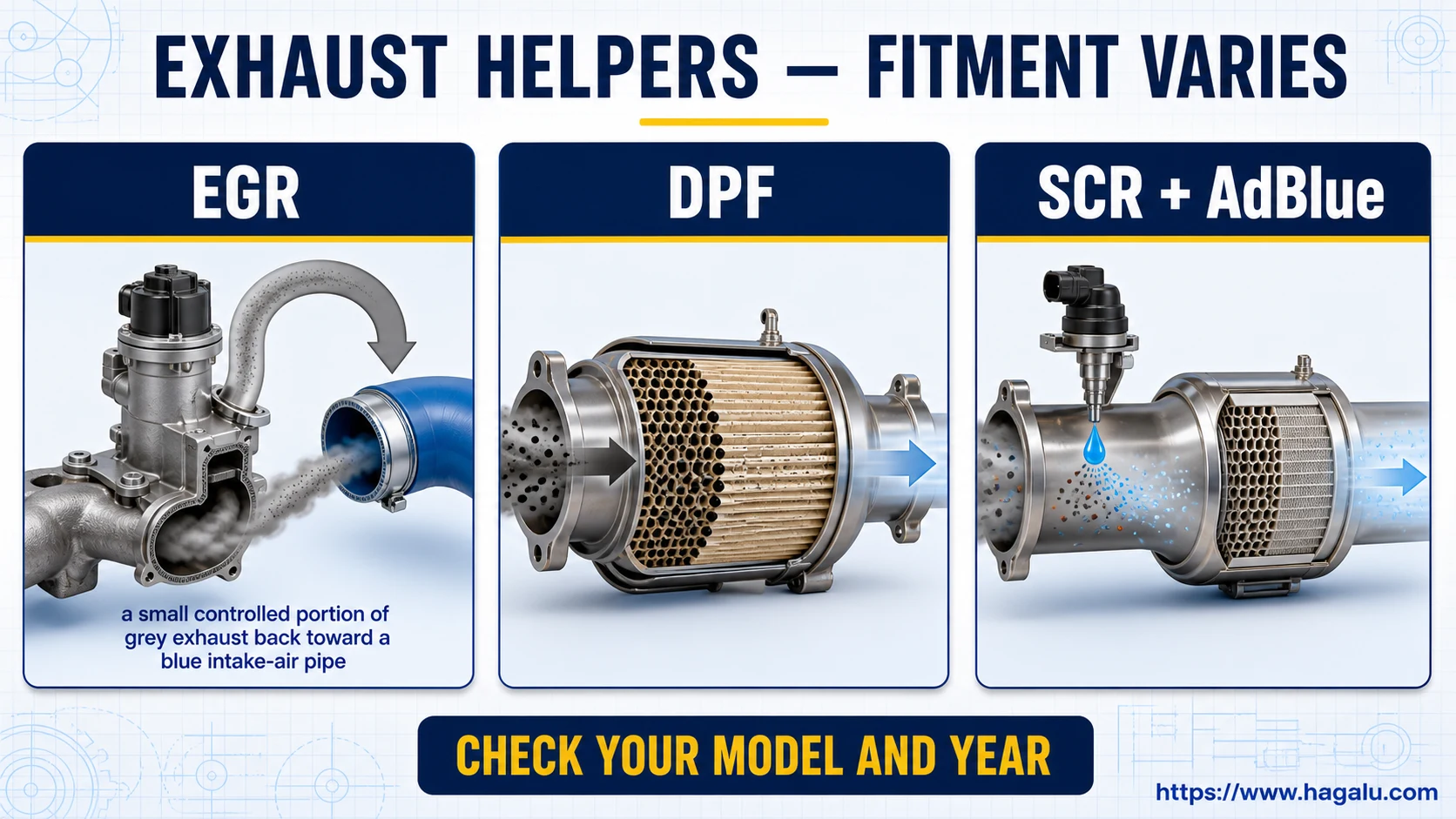
Returns a controlled amount of exhaust gas to help reduce nitrogen-oxide formation. Deposits or control faults can affect airflow.
Captures soot and periodically burns it off during regeneration. Follow the vehicle's warning message; do not copy a drive procedure from a different model.
Where fitted, injects diesel exhaust fluid into the exhaust to reduce nitrogen oxides. AdBlue never goes into the diesel tank.
Who is a CRDe diesel best for?
Often a good fit
- Regular longer journeys where the engine reaches full temperature.
- Drivers who value low-speed torque for hills, passengers or loads.
- Higher annual distance where fuel savings can offset diesel complexity.
- Owners willing to use correct fuel, oil, filters and scheduled servicing.
Think carefully
- Almost every trip is a very short cold city journey.
- The used vehicle has incomplete service history or unexplained warning lights.
- You have no access to clean diesel or competent common-rail diagnosis.
- You expect the badge alone to guarantee economy or reliability.
CRDe maintenance checklist
Buy fuel from a reputable, busy station. Clean, correctly specified diesel is the first line of defence.
Replace the fuel filter on the vehicle's schedule. Do not stretch the interval because the engine “still feels fine.”
Use the exact oil specification. Viscosity alone is not enough; the required performance and aftertreatment compatibility matter.
Respond to water-in-fuel, DPF and engine warnings. The correct action comes from that model's manual.
Inspect intake and boost hoses. A split or loose hose can mean low power, whistle, smoke and poor economy.
Let a hard-worked turbo settle as the manual advises. Normal driving usually cools it naturally; prolonged idling is not a universal rule.
Keep software and repairs standard. Poor remaps can raise cylinder, turbo, clutch and emissions-system stress.
Use model-specific intervals. Do not borrow timing, injector or belt advice from another CRDe engine.
Symptoms: stop now or book a check?
Petrol added to the diesel tank; red oil-pressure warning; overheating; strong fuel leak; runaway engine speed; severe mechanical knocking.
Hard starting, repeated limp mode, persistent smoke, rough idle, sudden economy loss, abnormal injector knock, fuel-pressure or DPF warning.
A one-off regeneration smell, brief fan operation after a drive or a small short-lived change in idle may be normal on some models—check the manual and note whether it repeats.
CRDe vs CRDi vs TDCi vs TDI
These labels sit on boot lids and engine covers, but they are not an international grading system.
| Badge | Usually associated with | What you can safely infer | What you cannot infer |
|---|---|---|---|
| CRDe | Mahindra | Common-rail electronically controlled diesel injection. | Exact engine, turbo, pressure, DPF, output or economy. |
| CRDi / CRDI | Used by multiple manufacturers | Broadly, common-rail direct-injection diesel. | Shared hardware across brands. |
| TDCi | Ford | A Ford turbo-diesel common-rail family badge. | One universal TDCi engine or service plan. |
| TDI | Volkswagen Group | A manufacturer-specific direct-injection turbo-diesel badge. | Interchangeability with CRDe or TDCi parts. |
Five CRDe myths to leave behind
No. Common rail is the fuel system; turbocharging is an air system.
No. The badge spans different engines, calibrations and years.
Persistent smoke means combustion is not as clean as it should be.
Fuel cannot repair mechanical wear or an electrical fault.
Some faults become much more expensive when ignored.
Is CRDe good technology?
Yes—when it is matched to the job and maintained correctly. Common rail gives a diesel engine much finer control over its fuel than an old mechanical system. That can improve driveability, refinement, useful torque, economy and emissions control.
The same precision creates its main drawback: high-pressure components dislike contaminated fuel, neglected filters and guesswork repairs. Buy the condition and history, not the badge. For an existing vehicle, follow its own manual—not a universal “CRDe service schedule” found online.
CRDe engine questions people actually ask
What does CRDe mean in a diesel engine?
CRDe is a Mahindra badge for a common-rail diesel engine. Mahindra material has expanded the letters as Common Rail Diesel Engine and has also described the technology as common-rail direct fuel injection. In practical terms, an electronic control unit meters high-pressure diesel from a shared rail into each cylinder.
Is CRDe the same as CRDi?
They describe the same broad common-rail direct-injection idea, but the badges are not a guarantee that two engines share injectors, pumps, software, output or emissions hardware. CRDe is associated with Mahindra; CRDi is a more widely used industry and marketing label.
Does a CRDe engine use petrol or diesel?
Diesel only. Never add petrol. Use the diesel grade and any biodiesel limit stated in the vehicle owner's manual, because the high-pressure pump and injectors depend on the correct fuel for lubrication and protection.
Why is a common rail called a rail?
It is a strong shared tube that stores pressurised fuel and supplies all the injectors, like a water pipe feeding several taps. The engine computer decides when and how long each injector opens.
Does CRDe always mean the engine has a turbo?
No. Common rail describes the fuel-injection system, while a turbo manages air. Many road-going CRDe engines use a turbo, but the two technologies are separate and the exact equipment depends on the engine and model year.
Are CRDe engines fuel efficient?
They can be efficient because a diesel engine uses high compression and the electronic injectors can deliver very small, accurately timed fuel quantities. Actual consumption still depends on the vehicle's weight, gearing, load, tyres, traffic, speed and maintenance.
What commonly damages a CRDe fuel system?
Water or dirt in diesel, the wrong fuel, a neglected fuel filter, incorrect repairs and running the tank dry can all harm the high-pressure pump or injectors. Follow the model-specific service schedule and investigate a fuel-system warning promptly.
Is black smoke normal from a CRDe engine?
A brief trace on an older diesel under sudden load can occur, but persistent heavy black smoke is not normal. It can point to too much fuel, too little air, an injector problem, a boost leak, a blocked air path or another fault that needs diagnosis.
Do CRDe engines have spark plugs?
No spark plugs are used to ignite the normal combustion event. Diesel ignites in hot compressed air. Many diesel engines have glow plugs to help cold starting, but a glow plug is not a petrol-style spark plug.
Is a CRDe engine good for short city trips?
The injection system can handle city driving, but a vehicle fitted with a diesel particulate filter may need regular fully warmed journeys to complete regeneration. Whether a particular CRDe vehicle has a DPF depends on its model year and market.
Primary sources and editorial notes
We used manufacturer and component-maker material for the technical facts, then rewrote the explanation in plain language. A badge can cover several engines, markets and model years, so your vehicle's owner's manual and VIN-specific service schedule remain the final authority.
- Mahindra: Bolero VLX with CRDe technologyManufacturer description of a 2.49-litre Common Rail Diesel Engine and electronic engine management.
- Mahindra & Mahindra Integrated ReportCorporate glossary describing CRDe as common-rail direct fuel-injection engine technology.
- Bosch Mobility: common-rail system with solenoid injectorsComponent-maker explanation of the high-pressure rail, flexible injection pattern and multiple injections.
- Mahindra Thar owner's manualExample of why fuel, oil and service requirements must be checked for the specific CRDe vehicle.
Illustrations are original Hagalu educational artwork, not an OEM workshop drawing and not a substitute for a repair manual. Component shape and placement are simplified so the flow is easy to see.