Honda Amaze
1.2 Trend Manual
Read this variant's specsA bicycle's low gear makes a steep hill manageable. A car makes the same kind of trade, with very different hardware inside each transmission.
Start hereTurn a small gear against a larger one: the larger gear turns more slowly, with more turning effort.
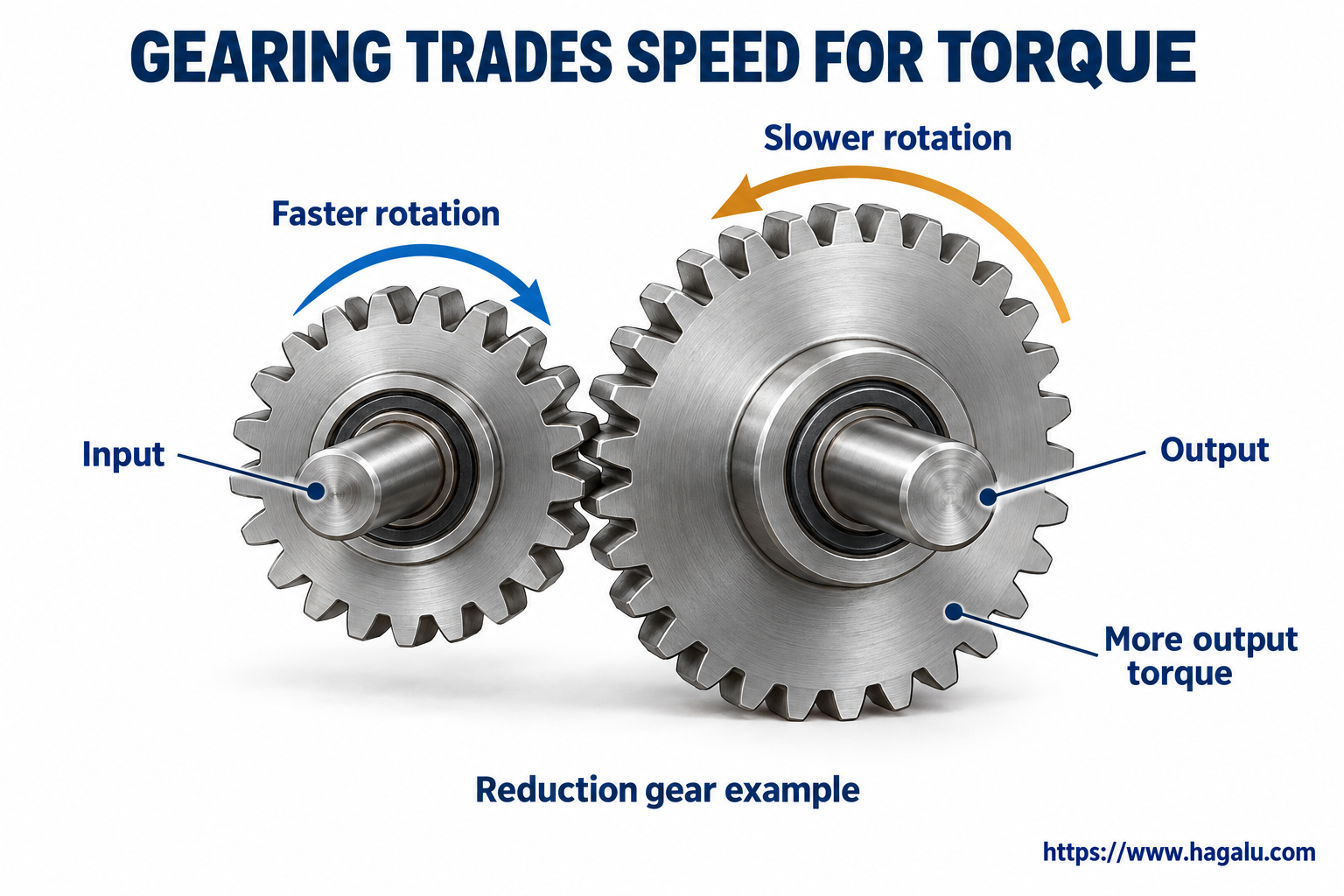
A reduction ratio of 3:1 means the input makes three rotations for one output rotation. Ignoring losses, output torque is three times input torque while output speed is one third. Real transmissions lose some energy through friction, fluid movement and other effects.
Overall gearing includes the selected gear and final drive. Tyre rolling circumference also influences road speed at a given shaft rpm. More gears can help keep the power unit in a useful operating region, but shift strategy and ratio spacing matter more than counting gears.
Start hereFluid lets the engine and gearbox connect smoothly while the car starts moving.
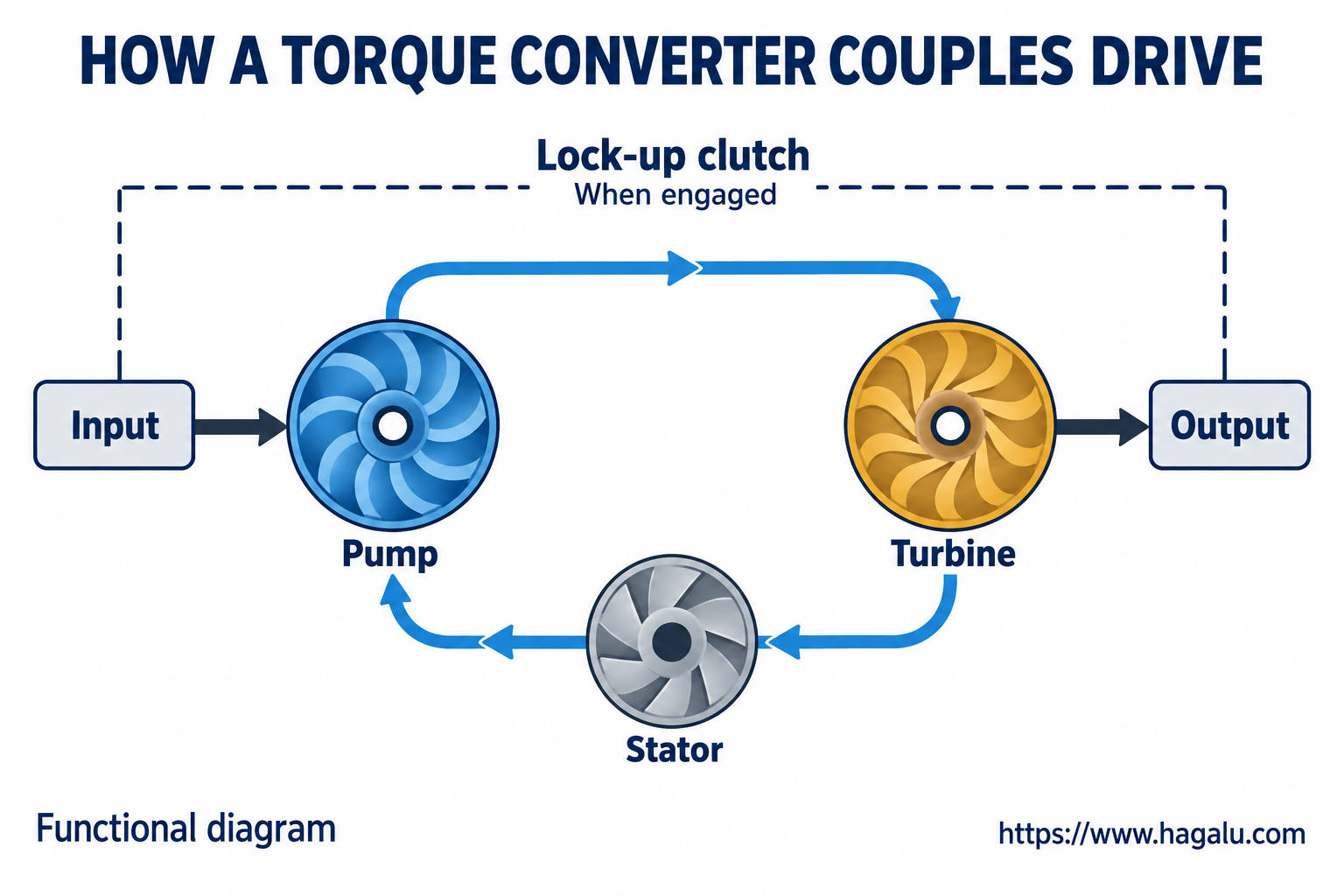
A torque converter has a pump, turbine and stator. It transfers torque through fluid; its behaviour changes with the speed difference between input and output. A lock-up clutch can reduce slip when operating conditions allow. It is wrong to assume a modern automatic always wastes energy through constant converter slip.
Gear changes are commonly managed by planetary gearsets, clutches, brakes and electrohydraulic control. Correct fluid specification, fluid temperature, level-setting method and software matter. There is no universal service interval or fluid that suits every automatic.
Start hereA dual-clutch transmission prepares another gear on a second input path.
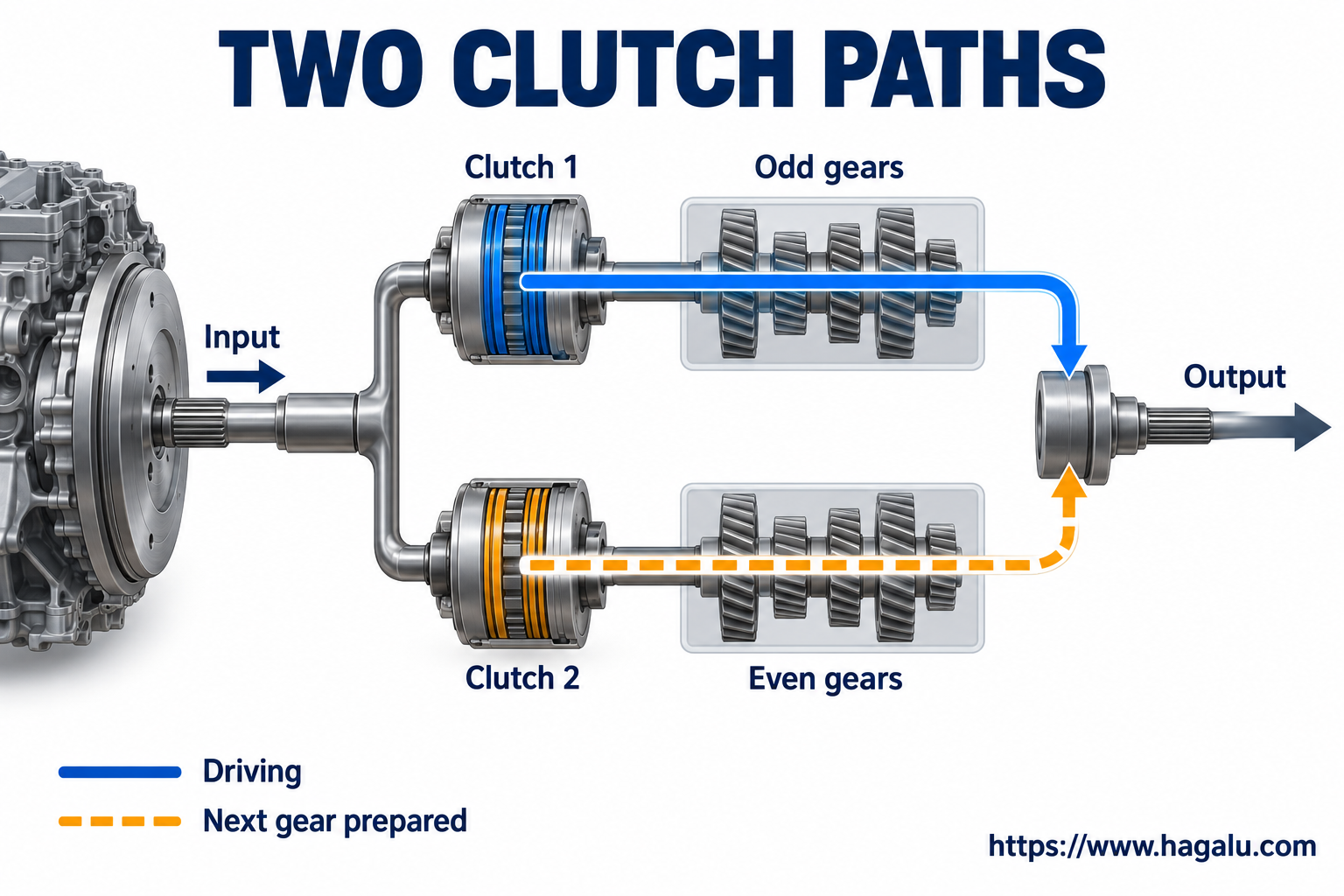
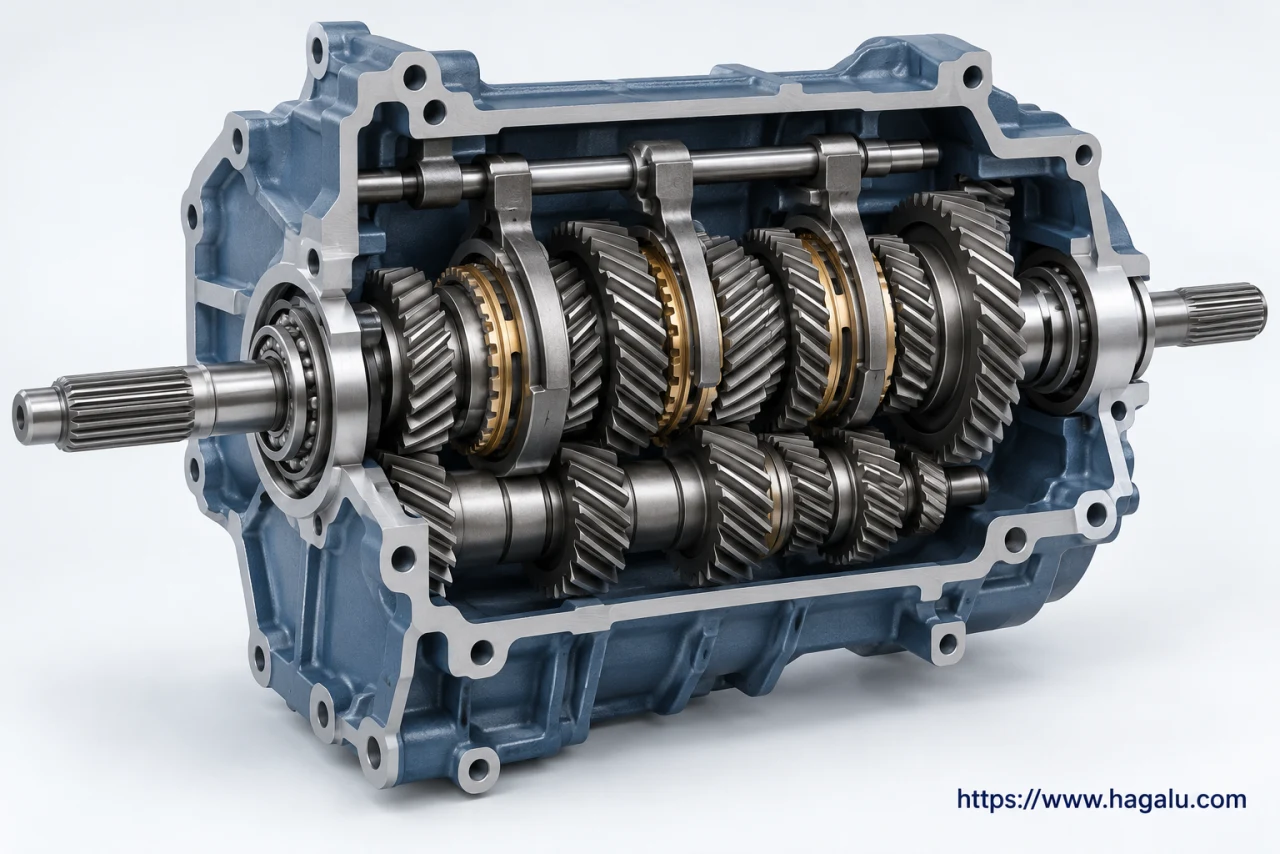
A conventional manual uses a driver-operated clutch and selected gear ratios. An automated manual operates similar clutch-and-gear functions with actuators. A dual-clutch transmission uses two clutch paths, commonly separating odd and even ratios, and can preselect a likely next gear.
DCTs can use wet or dry clutches; cooling, lubrication, control and allowable torque differ. Continuous creeping can involve clutch slip, so the owner's instructions matter. Do not diagnose all low-speed behaviour as a fault, or dismiss harshness as normal without comparison to the exact system.
Start hereA pulley CVT changes its effective ratio without stepping through fixed gears.
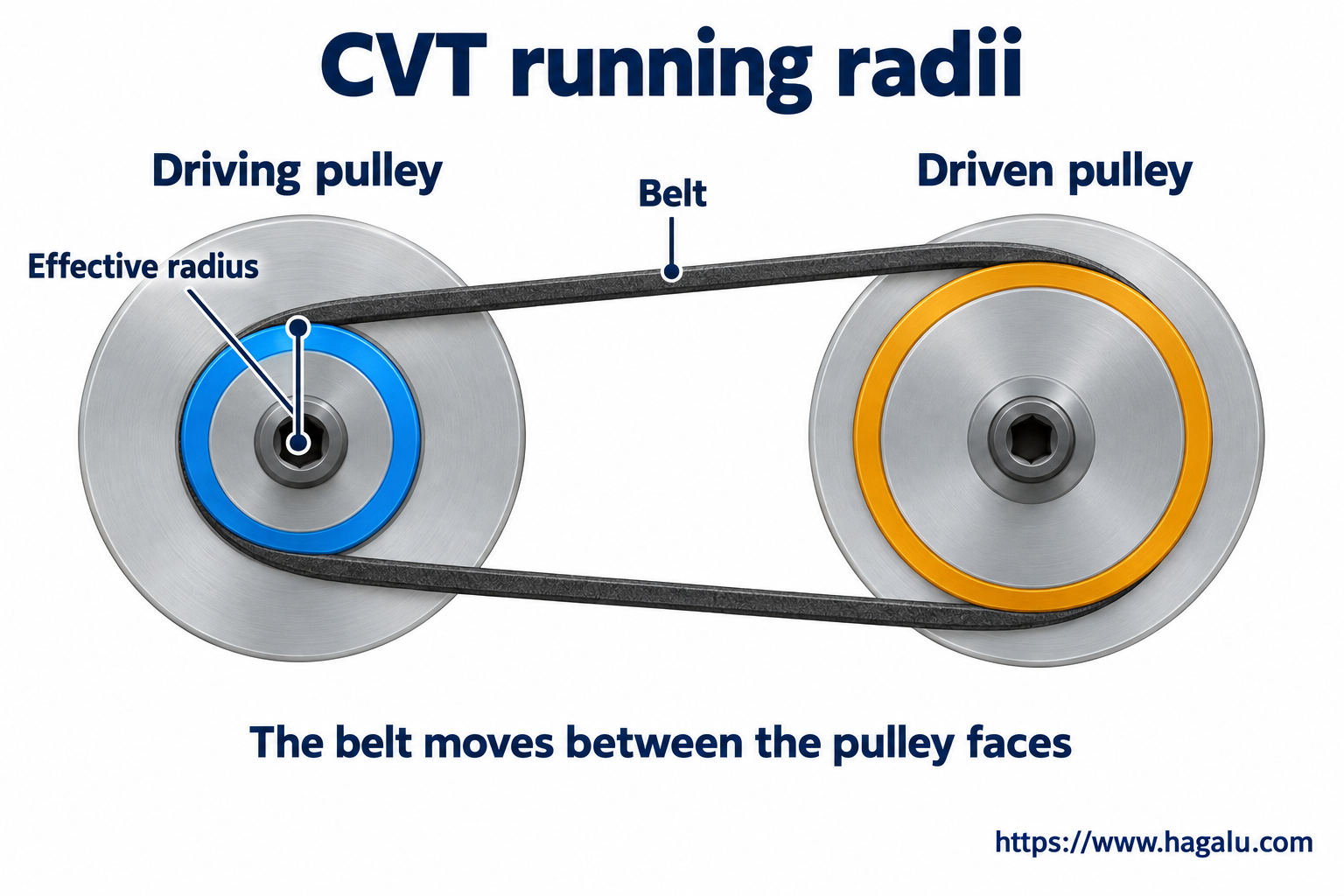
In a belt- or chain-type CVT, changing pulley geometry changes the effective running radii. The driven pulley and driving pulley must change together to maintain the connection. Some systems add launch gears or a torque converter, so a generic diagram cannot describe every CVT.
An e-CVT badge on a hybrid may instead describe a motor-controlled power-split arrangement, not a metal belt between variable pulleys. Judge the architecture, servicing requirements and road behaviour of the exact derivative. A simulated shift is a control choice, not proof that the gearbox contains that many fixed ratios.
Start hereThe outside wheel travels farther around a bend, so the two wheels need different speeds.
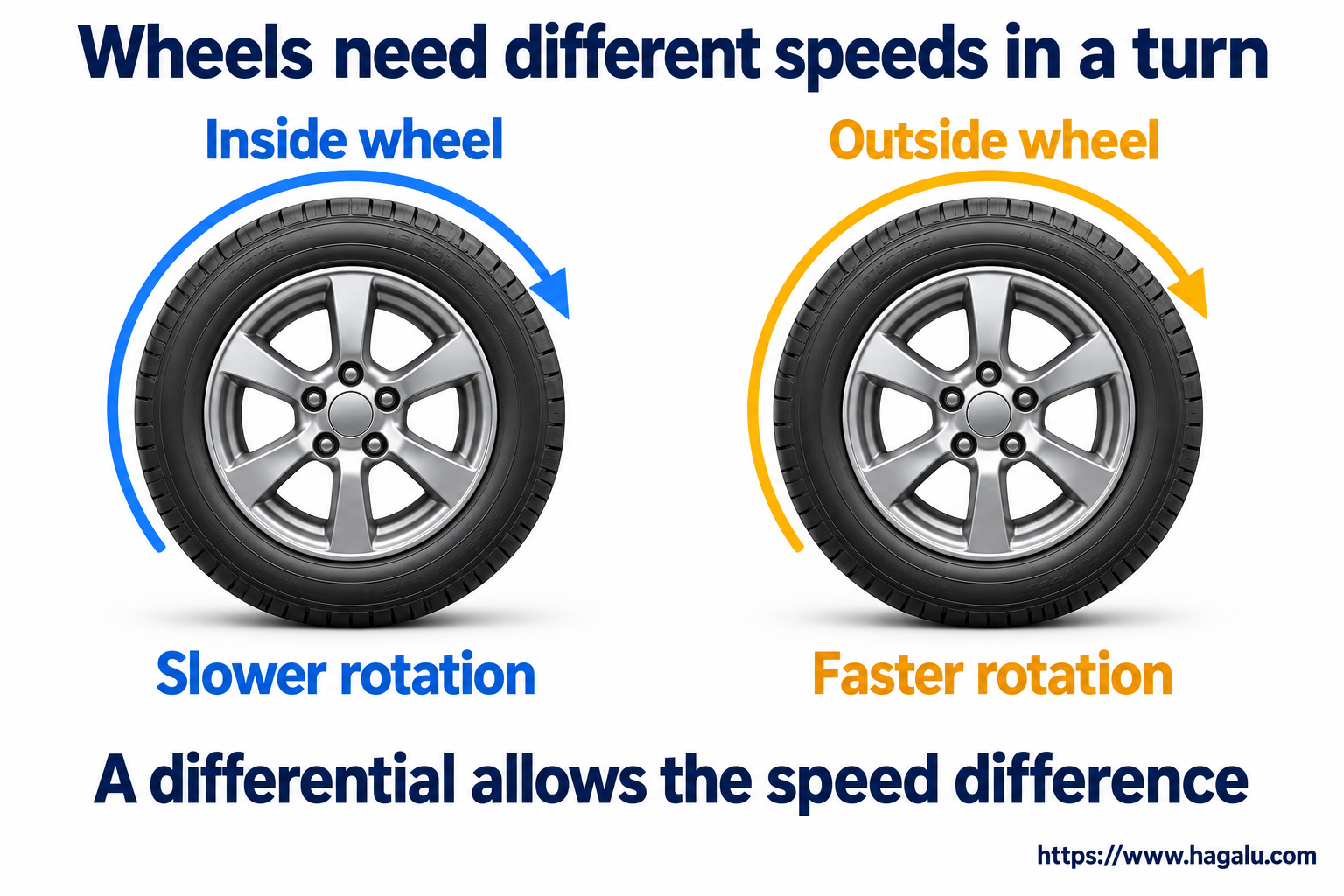
An open differential allows a speed difference between its outputs. In the simple symmetric case it delivers equal torque to the two sides, which can limit useful drive when one tyre has little traction. It does not simply send all torque to the spinning wheel.
A limited-slip differential, a differential lock and brake-based traction control are different solutions. A lock restricts relative speed; an LSD limits it according to its mechanism. Use their actual operating instructions—especially where a lock or part-time four-wheel drive can wind up the drivetrain on high-grip surfaces.
Start hereTwo-wheel drive powers one axle; all-wheel or four-wheel drive can power both, but the connection rules differ.
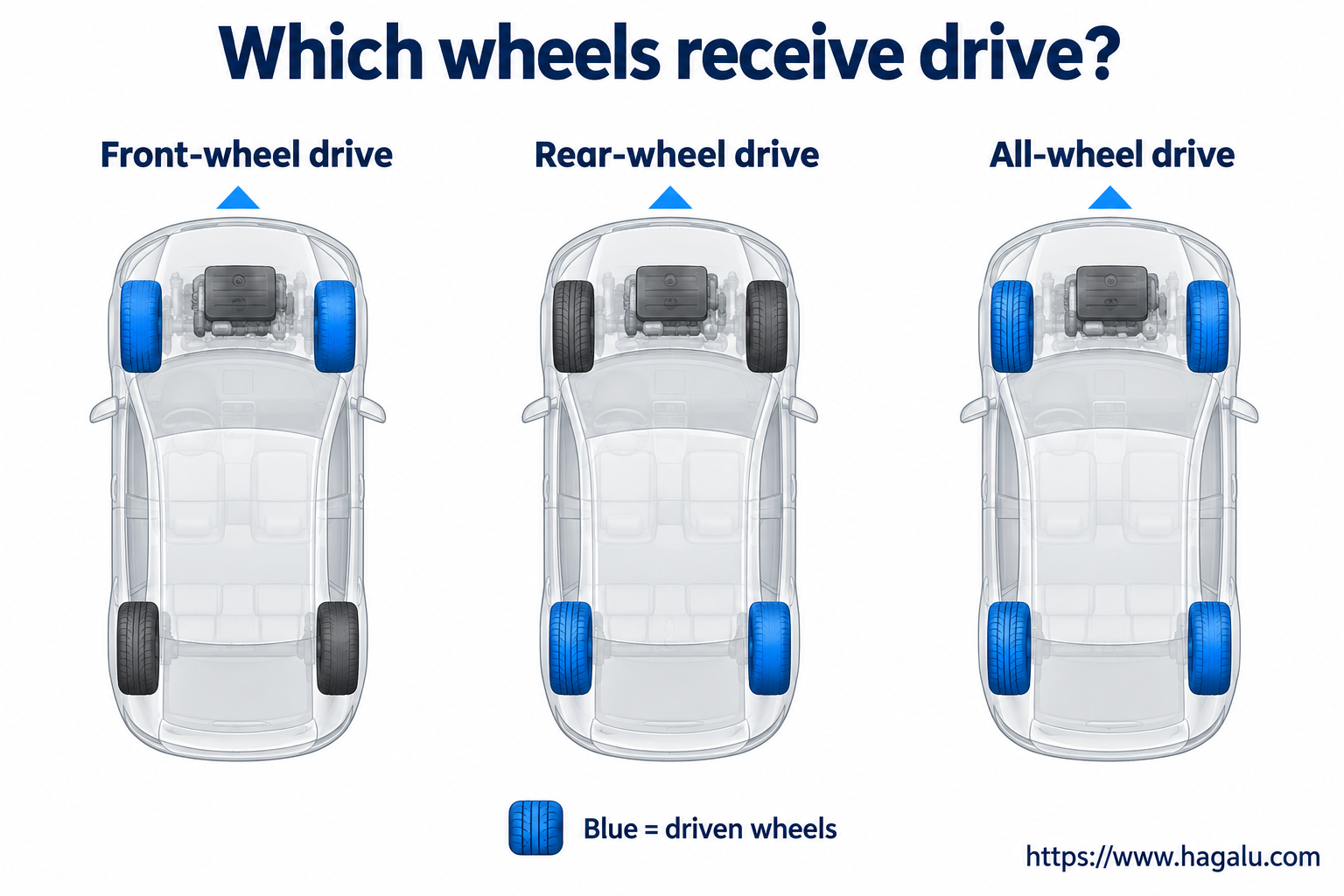
FWD and RWD name the driven axle. AWD may vary the front–rear contribution automatically. A traditional part-time 4WD system can mechanically couple the axles for low-grip use; other systems permit suitable full-time operation. A 4WD label alone does not promise a low-range transfer case or axle locks.
Tyres still set the available grip. Driving four wheels does not create four-wheel-drive-only braking magic: conventional road cars already brake at all four wheels. Compare matching tyre type, suspension, clearance and permitted operating modes before judging off-road suitability.
| Term | Question to ask | Do not assume |
|---|---|---|
| FWD / RWD | Which axle is driven? | A particular grip level |
| AWD | How is torque shared and controlled? | Low range or locking axles |
| 4WD | Which modes are permitted on this surface? | All modes are suitable on dry tarmac |
This is educational context, not an OEM service procedure. Use current instructions for the exact vehicle and market before measurements, repairs or safety-critical work.
These links rotate within your selected country. Open an exact variant to check its recorded specifications; the teaching diagrams above do not represent these models.
1.2 Trend Manual
Read this variant's specs2.2D LX 2WD Double Cab
Read this variant's specs1.6T GR-Four Rally 6MT
Read this variant's specsNaturally Aspirated MT Evolution
Read this variant's specsNeither is universally better. Their mechanisms, calibration, cooling, maintenance and suitability for your driving differ. Compare the exact version rather than a category stereotype.
Names overlap. Read the actual axle connection, permitted modes, low-range availability and locking functions.
No. It can multiply torque while reducing output speed; losses mean the output power is less than the input power.
No. Some hybrid e-CVT systems use motor-controlled power splitting instead of variable belt pulleys.
It does not supply a universal braking advantage. Tyres, surface, brakes, speed and the vehicle's control systems determine stopping behaviour.
These references support the principles, not the specifications of every car. Regional manuals and test protocols have their own scope; never transfer one vehicle's limits or legal rules to another.
All numerical examples in this guide are labelled illustrations. Technical images simplify the mechanism; they are original Hagalu teaching artwork, not manufacturer-approved parts drawings.