Lexus LX
LX 700h Urban
Read this variant's specsA big torque number is not a stopwatch. Follow the journey from a turning shaft to a moving car and the brochure starts to make sense.
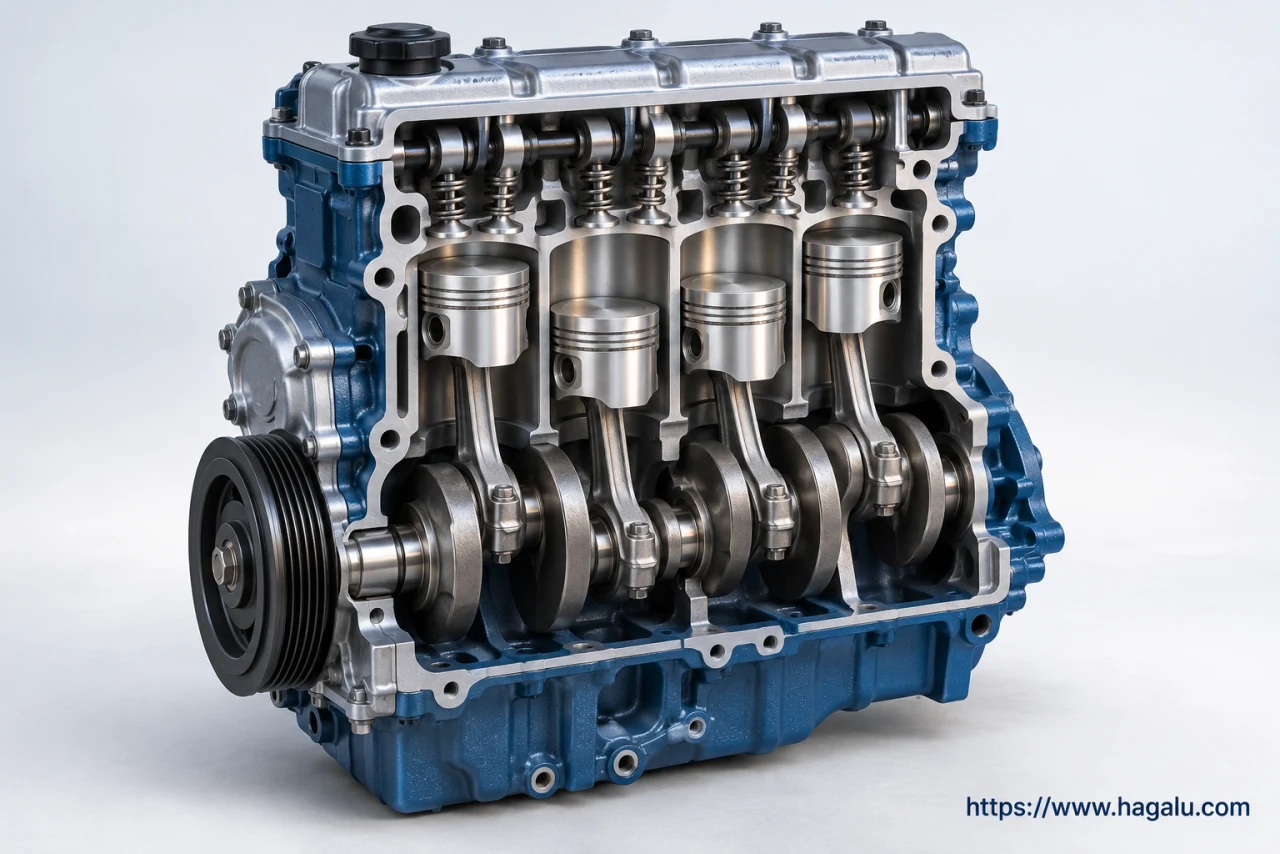
Start hereA piston moves up and down; a connecting rod and crankshaft turn that movement into rotation.
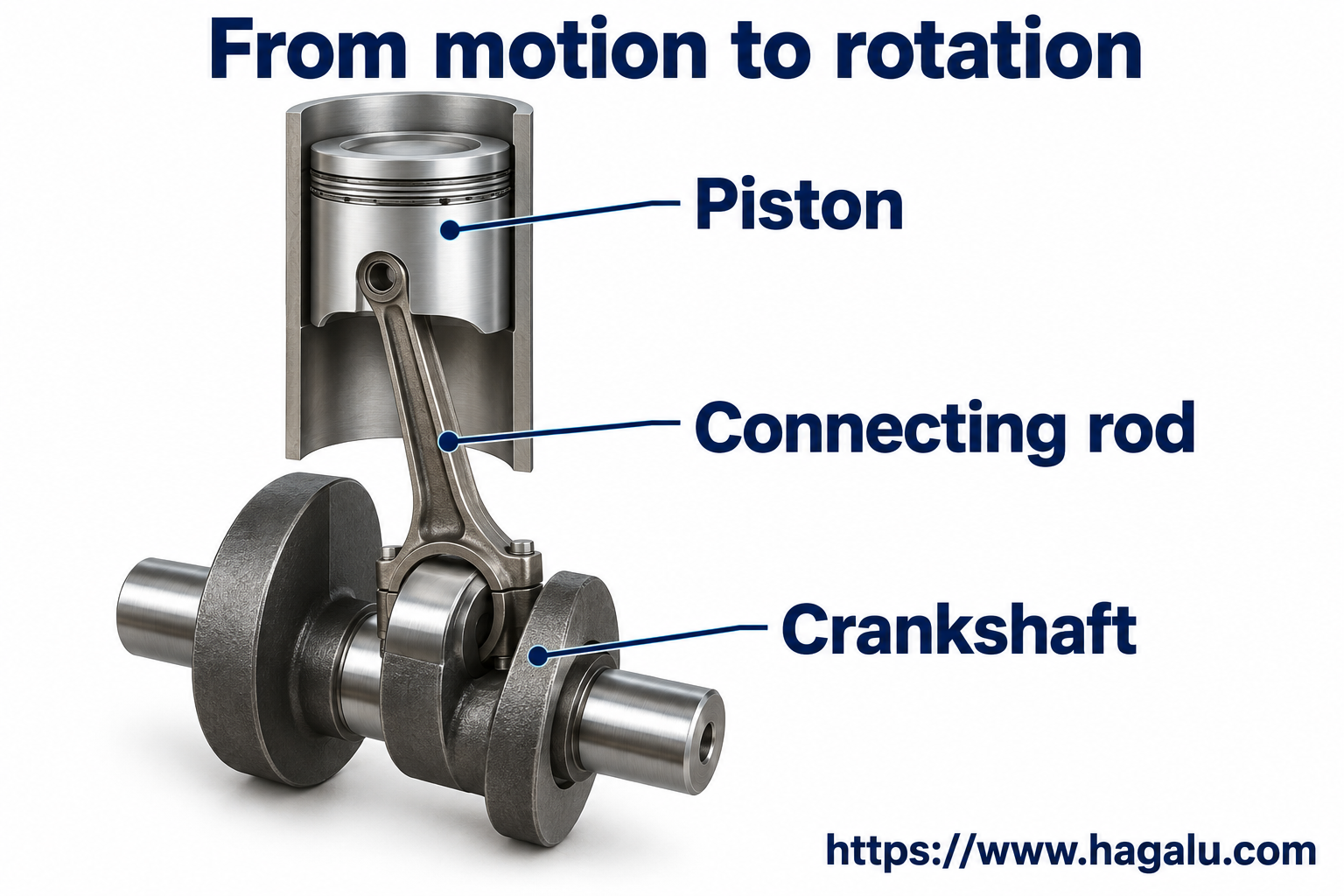
In a piston engine, expanding combustion gases push a piston. Its connecting rod acts on an offset crankshaft journal. Other cylinders, the rotating assembly and stored rotational energy help keep the cycle moving between individual power strokes.
An electric motor makes shaft torque without combustion pistons. Both kinds of power unit still need a route to the driven wheels. Do not mistake engine layout, cylinder count or a badge for a direct measure of the car's acceleration.
Start herePush a door near its handle and it turns more easily than when you push close to its hinge.
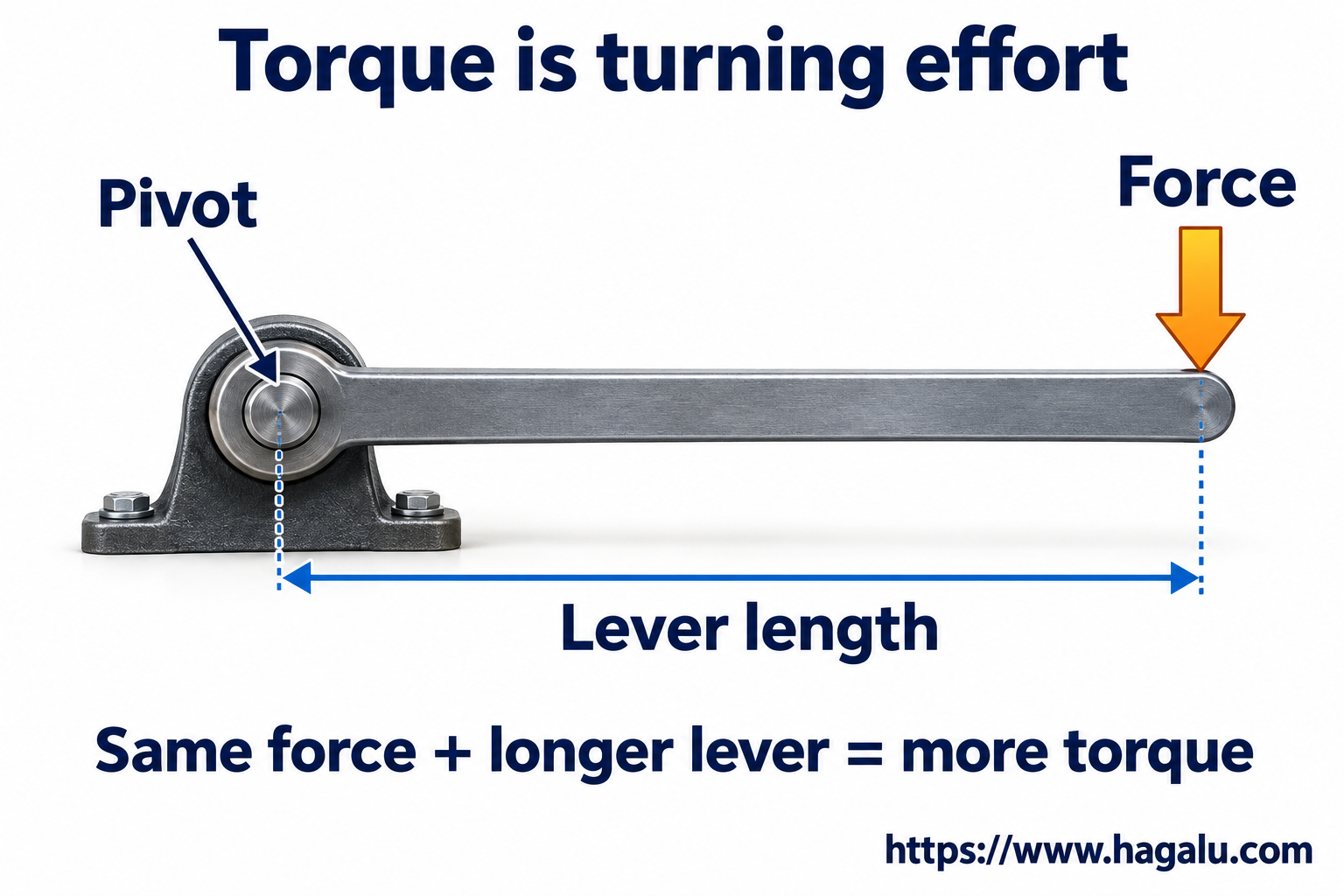
Torque is force multiplied by the perpendicular distance from the rotation axis: T = F × r. A force of 100 N acting at right angles on a 0.30 m lever gives 30 Nm. The angle matters; the same push along the lever does not make that turning effect.
An engine's quoted peak torque belongs to a stated speed or speed band. It is not the torque available at every rpm, nor the torque at the tyre. A gearbox and final drive can multiply shaft torque while reducing rotational speed.
Start hereThe same turning effort doing more turns each second does more work each second.
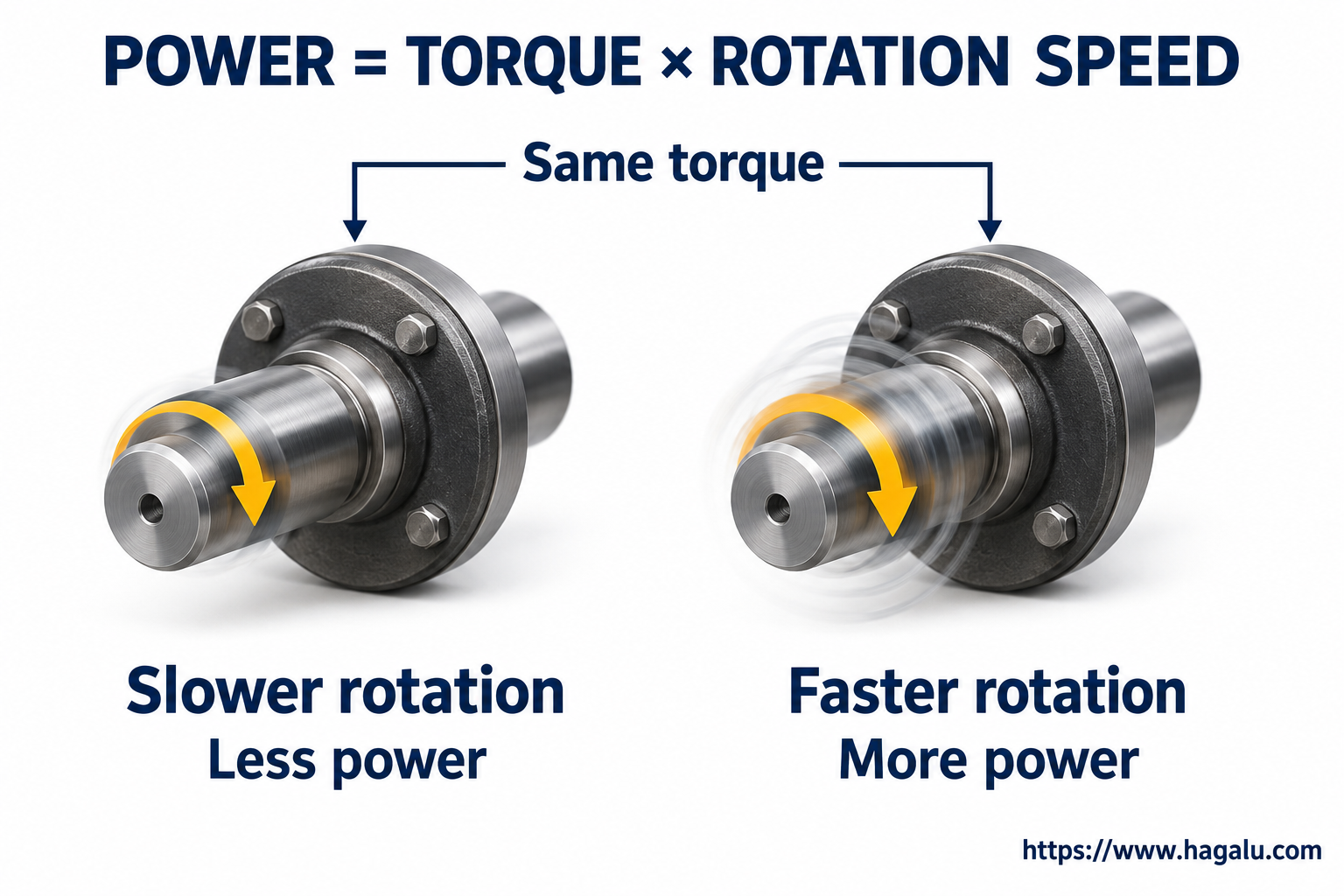
Rotational power is P = T × ω. With torque in Nm and speed in rpm, P in kW = T × rpm ÷ 9549.3. An illustrative 200 Nm at 3,000 rpm is about 62.8 kW. Torque and rpm must be measured at the same operating point; multiplying peak torque by peak-power rpm is usually wrong.
One kW is approximately 1.341 mechanical horsepower or 1.360 metric horsepower (PS). These are different unit definitions. Brake horsepower describes measured shaft power; it does not create another universal conversion factor.
| Brochure term | What it describes | Keep beside it |
|---|---|---|
| Nm | Shaft turning effort | rpm or operating band |
| kW / hp / PS | Rate of doing work | Unit convention and measurement point |
| 0–100 km/h | A complete vehicle test | Load, surface and test conditions |
Start hereEngine size is how much space the pistons sweep, not the outside size of the metal engine.
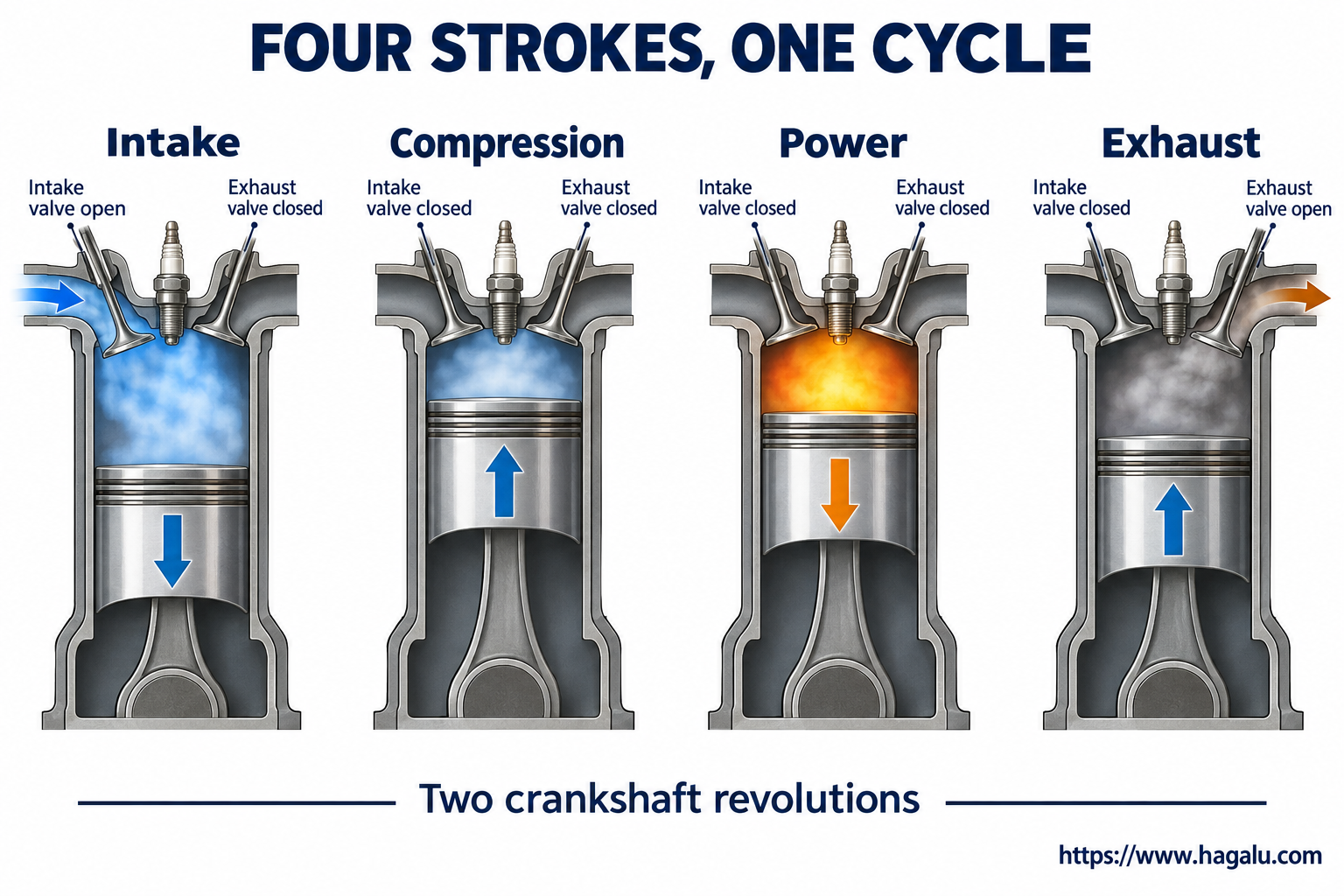
Displacement is the sum of the swept volumes: cylinder count × π/4 × bore² × stroke. Use consistent units before converting to litres or cubic centimetres. Compression ratio compares the cylinder volume at the bottom of the stroke with the remaining volume at the top; it is a ratio, not a pressure reading.
A four-stroke combustion cycle takes intake, compression, power and exhaust over two crankshaft revolutions. Petrol and diesel engines differ in how combustion is initiated. Valve timing, mixture control, cooling, friction and boosting influence output, so equal displacement does not mean equal performance.
Start hereTwo wheels share a shaft: exhaust turns one wheel, and the other compresses incoming air.
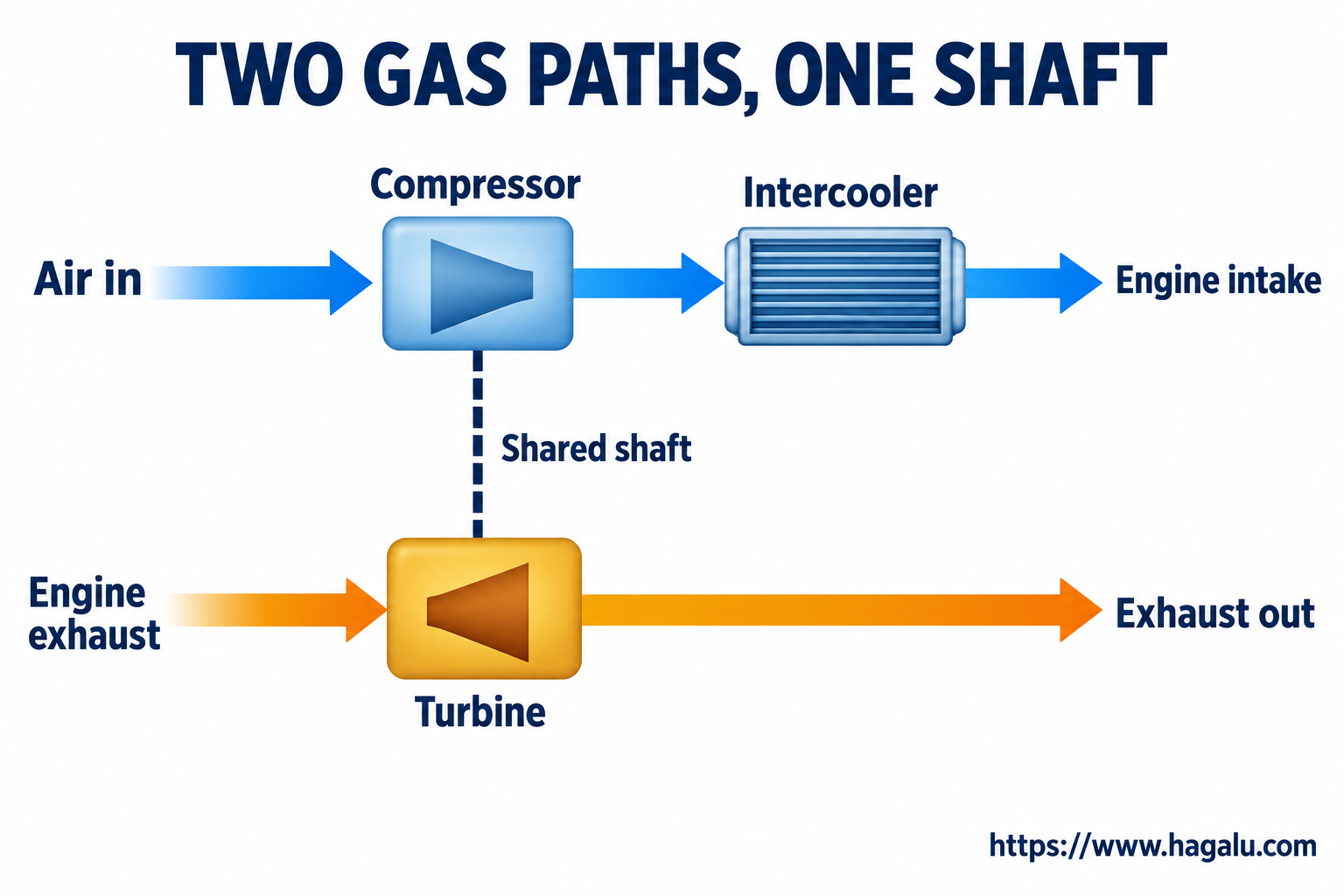
The turbine is in the exhaust path; the compressor is in the intake path. Their gases do not mix simply because they share a shaft. An intercooler can reduce the temperature of compressed intake air. Boost pressure alone does not describe airflow, efficiency or safe operating limits.
Turbo response depends on flow, inertia, control strategy and engine speed. A larger peak output may arrive later or require different fuelling and cooling. For a mechanic, an underboost symptom is a system question involving leaks, sensors, actuator control and operating conditions—not automatic proof that the turbo must be replaced.
Start hereA light car with useful gearing can move briskly without winning the biggest-number contest.
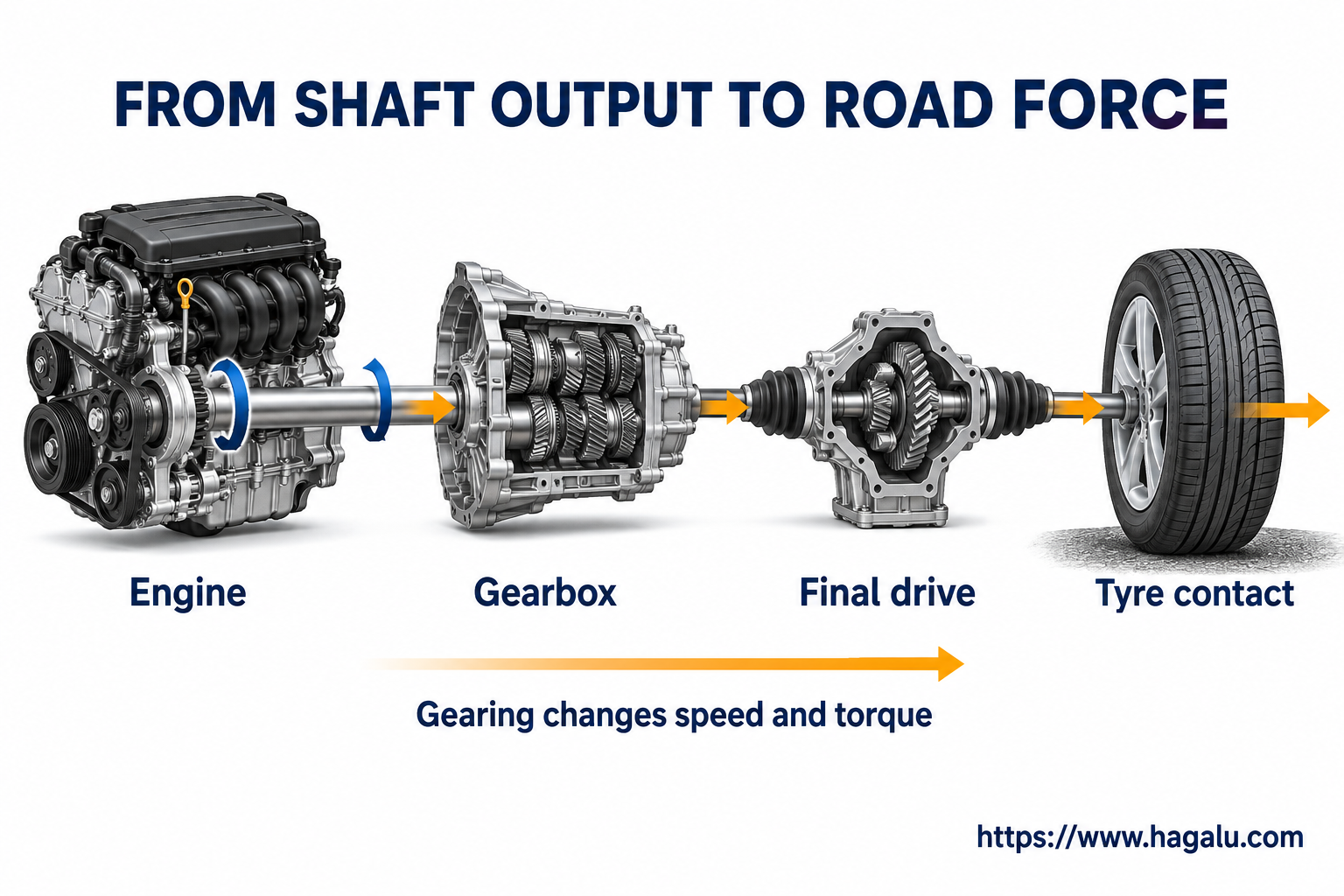
At a given gear ratio, wheel torque is approximately shaft torque × gearbox ratio × final-drive ratio × efficiency. Tyre force is wheel torque divided by effective rolling radius. At very low speed, grip can limit usable acceleration; at higher speed, available power and road resistance matter increasingly.
A useful screening measure is power-to-mass ratio, but identical ratios still do not guarantee identical acceleration. Shift time, tyre condition, aerodynamics, slope, temperature, battery state and how long a motor can sustain its output all matter. Engine-dyno and chassis-dyno results are measured at different points and should not be compared as though they were interchangeable.
This is educational context, not an OEM service procedure. Use current instructions for the exact vehicle and market before measurements, repairs or safety-critical work.
These links rotate within your selected country. Open an exact variant to check its recorded specifications; the teaching diagrams above do not represent these models.
LX 700h Urban
Read this variant's specs1.5 Amur 5MT
Read this variant's specs2.8 GD Double Cab MT
Read this variant's specs2.0L LWB Van Base 6MT
Read this variant's specsThey describe related aspects of output. Useful gearing, the operating speed and vehicle mass determine the result; neither peak number alone describes everyday response.
Multiply kW by about 1.341 for mechanical horsepower or 1.360 for metric horsepower, also called PS. Keep the unit definition consistent.
No. Displacement is only one input; load, vehicle mass, boosting, gearing, control strategy and the journey change fuel use.
Only if you also know the rotational speed at that same torque measurement. Do not combine two unrelated peak values.
They are measured at different points. A chassis measurement includes drivetrain effects and depends on its own test setup and correction method.
These references support the principles, not the specifications of every car. Regional manuals and test protocols have their own scope; never transfer one vehicle's limits or legal rules to another.
All numerical examples in this guide are labelled illustrations. Technical images simplify the mechanism; they are original Hagalu teaching artwork, not manufacturer-approved parts drawings.