Toyota Land Cruiser 79 Double Cab
2.8 GD Double Cab MT
Read this variant's specsThe purchase price is the opening chapter. Read the calendar, the exclusions and the running costs before deciding whether the whole story fits your budget.
Start hereOwning the car costs more than paying for the car.
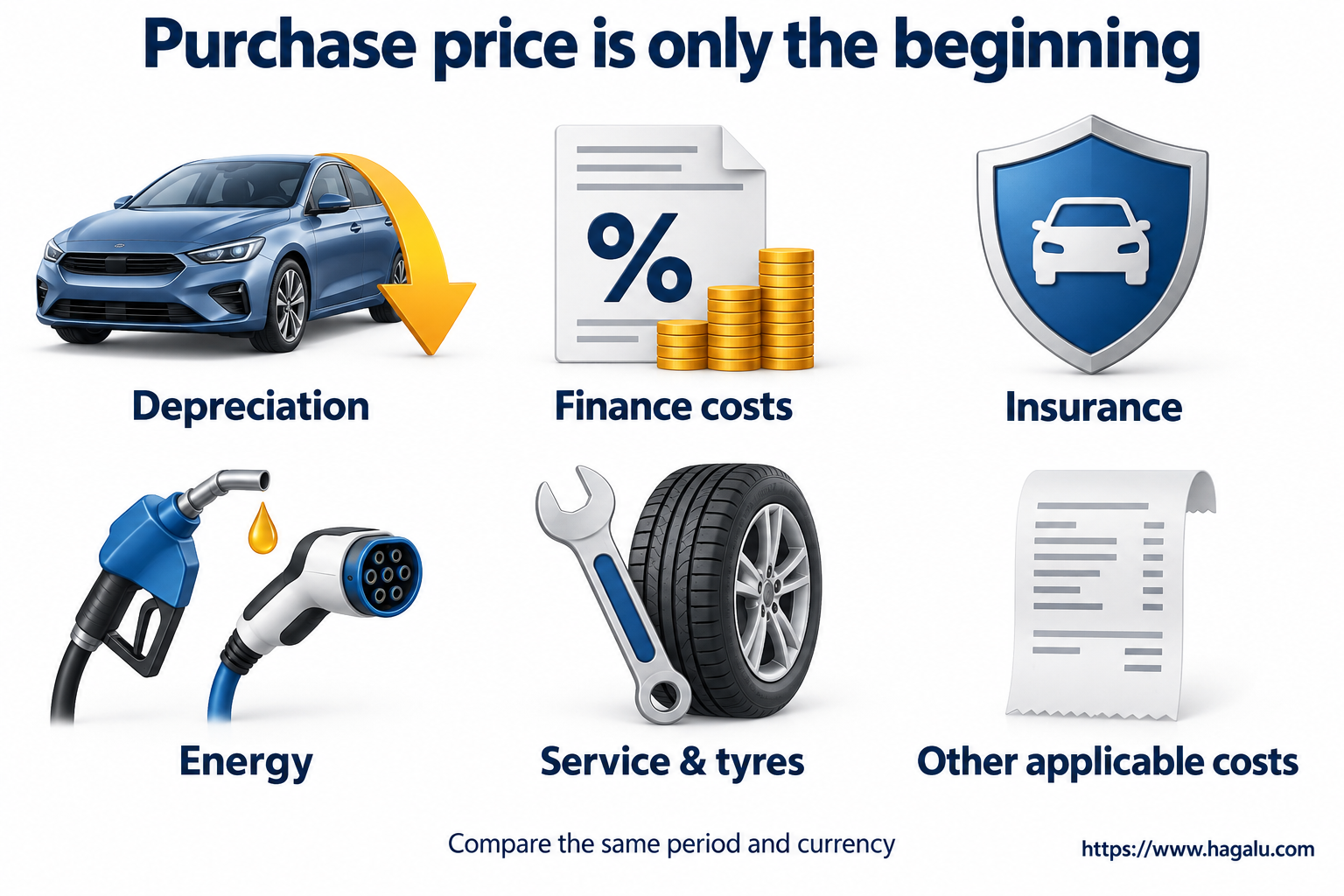
For a chosen period, include purchase price minus an explicit resale assumption, finance interest and fees, insurance, energy, scheduled service, tyres, repairs, registration and other applicable costs. Do not add full loan principal again if the purchase price is already counted. Your cash-flow budget and economic cost calculation answer different questions.
An illustrative car costing 100,000 currency units and resold for an assumed 60,000 has 40,000 of depreciation over that period—not 100,000 plus another 40,000. Resale is uncertain. Use written quotes and a conservative range rather than presenting a single invented total as a current local forecast.
Start hereA car can need a service before it reaches the kilometre limit because time passes too.
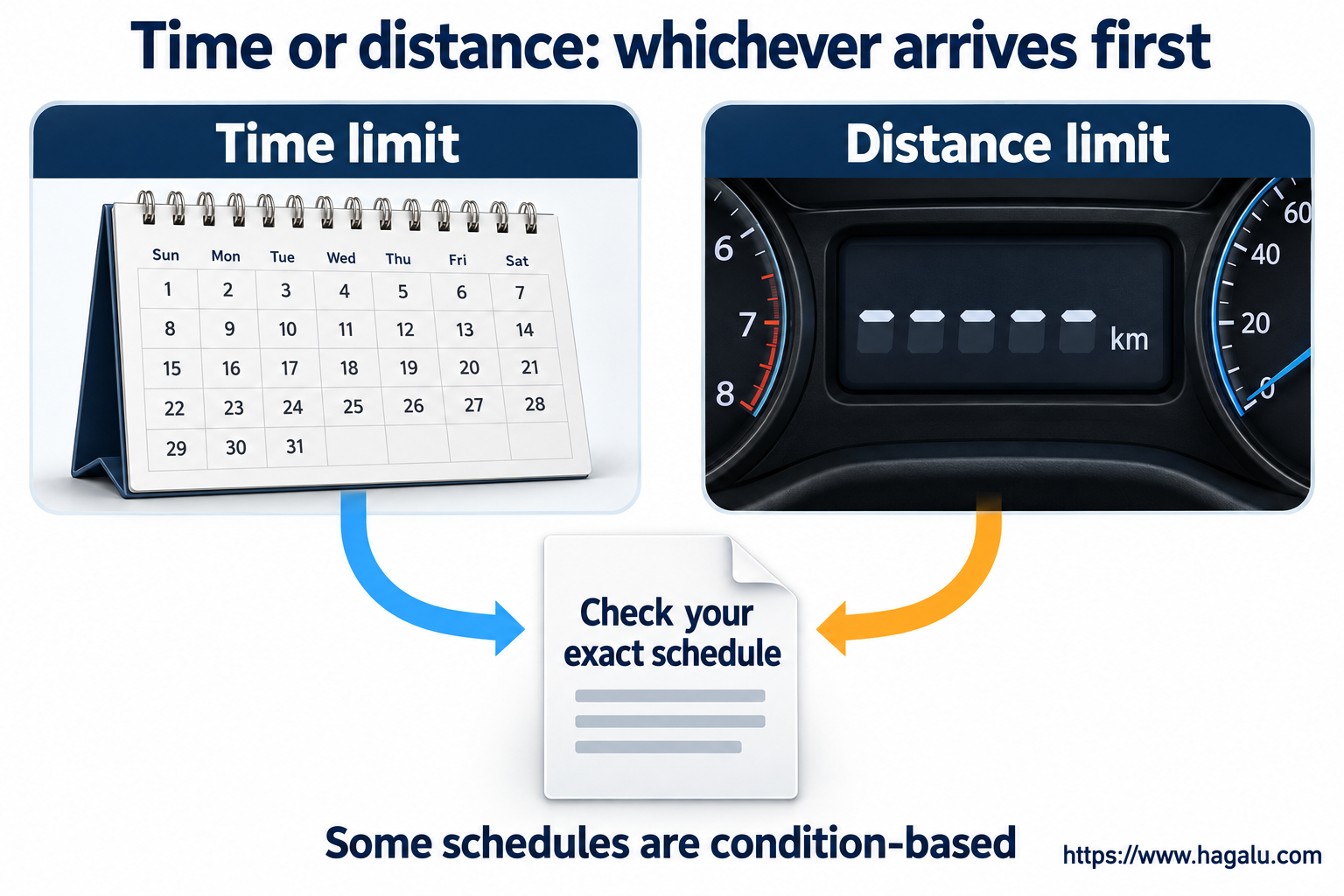
Where a schedule says a distance or a time interval, the applicable earlier trigger normally matters; read the exact wording. Some vehicles use condition-based schedules. Severe-use definitions, fluid specifications, inspections and replacement intervals vary by system and market.
Low annual distance does not mean fluids, seals, corrosion and time-based items stop ageing. Keep dated invoices and odometer readings. Do not turn one model's interval into a rule for an entire brand or for electric cars as a group.
Start hereThree documents can pay for three different kinds of work—even if their headline durations match.
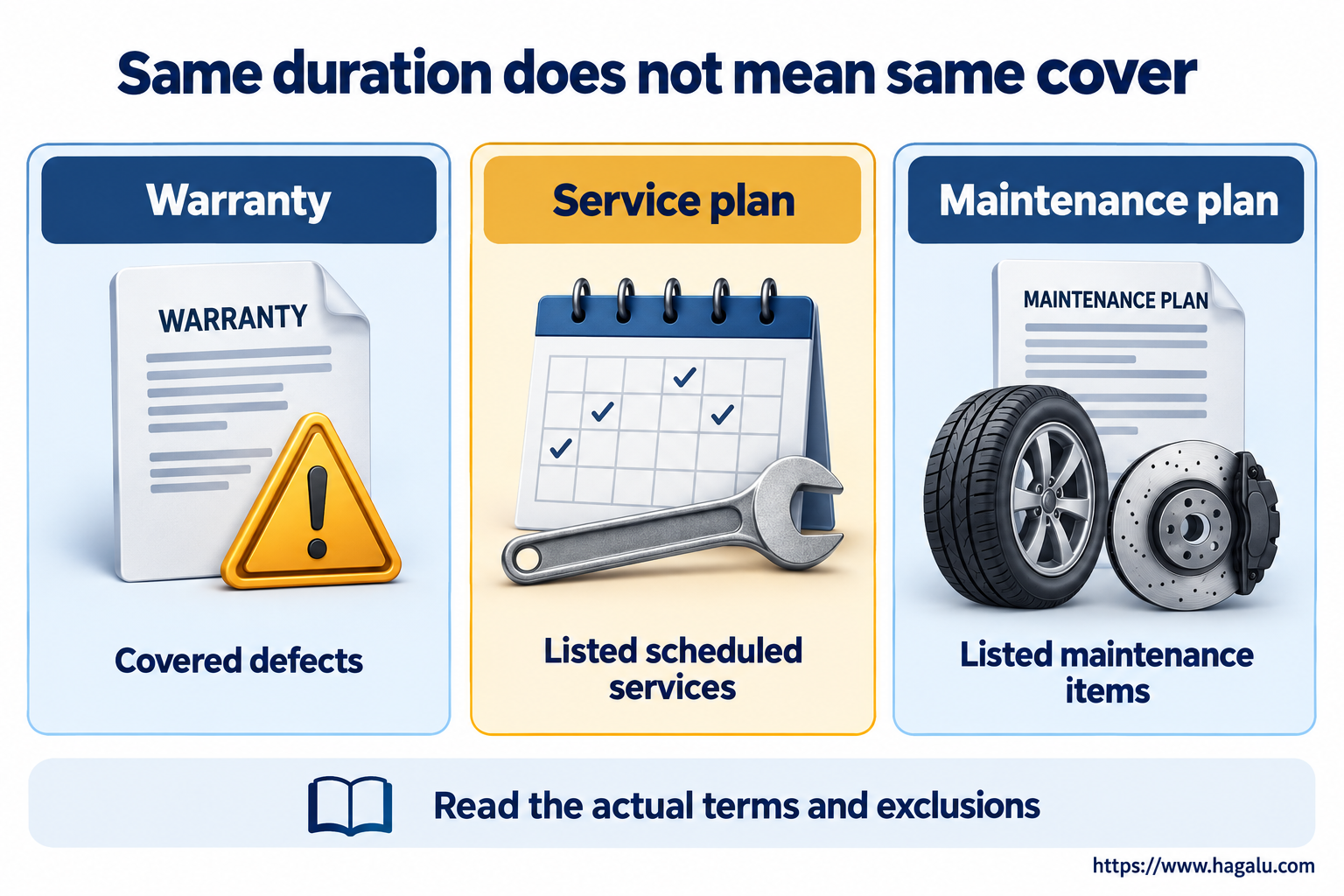
A manufacturer's warranty usually defines covered defects and remedy conditions. A service plan usually lists scheduled servicing. A maintenance plan may include additional listed wear or maintenance items, but its scope, caps and exclusions must be read. Roadside assistance is another service, not a promise that every recovery or repair is free.
Check expiry by time and distance, transferability, authorised service conditions, claim process and exclusions. Legal rights and contract terms are market-specific; this global explainer does not substitute for local advice. Ask for the actual document before paying for an extension.
| Document | Typical purpose | Read carefully |
|---|---|---|
| Warranty | Covered defects/remedies | Scope, exclusions and claim conditions |
| Service plan | Listed scheduled services | Items, interval and expiry |
| Maintenance plan | Listed maintenance/possibly wear items | Caps and excluded components |
| Roadside assistance | Specified breakdown support | Geography, recovery and limits |
Start hereAn item wearing out is not automatically a manufacturing defect.
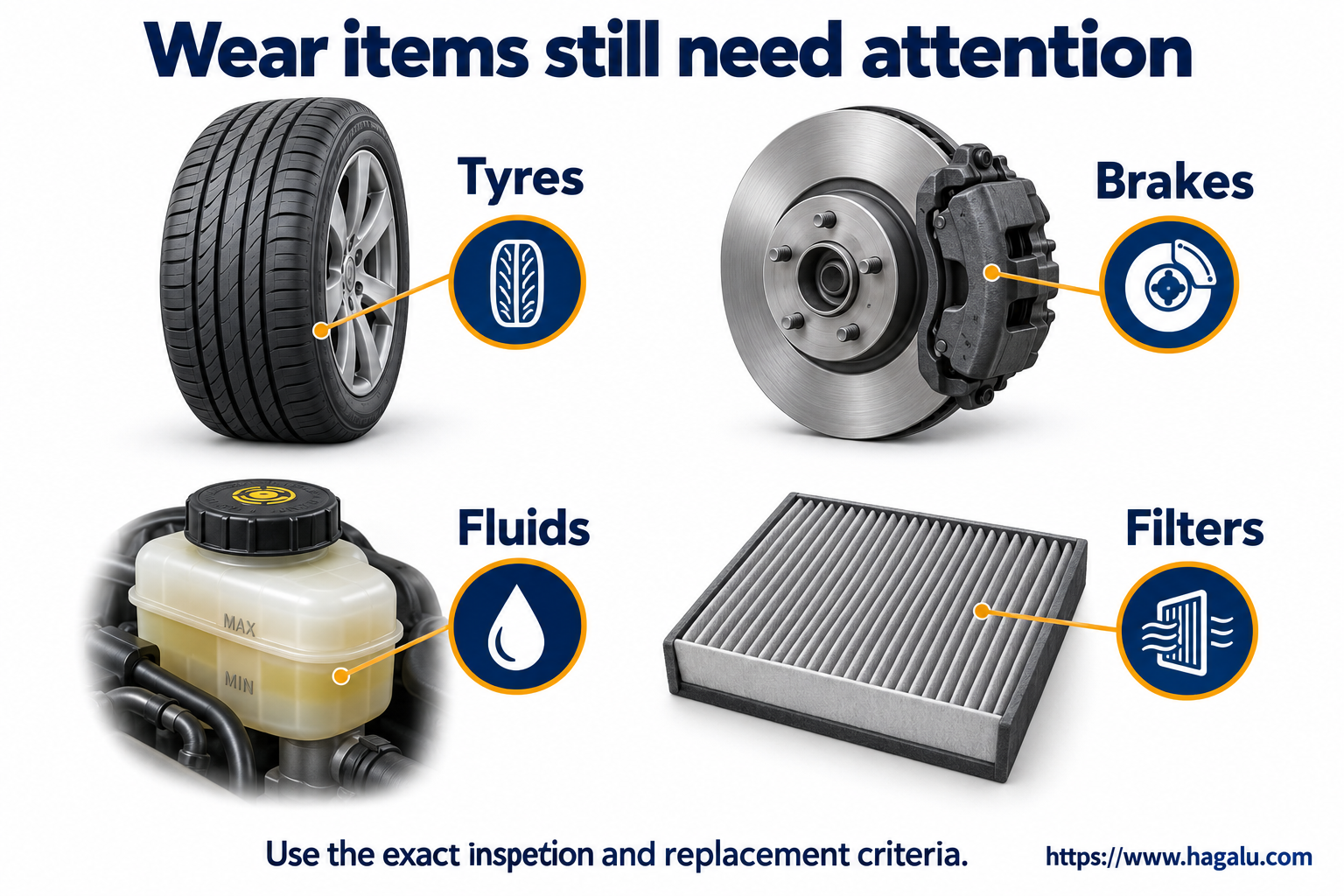
Use the prescribed inspection and replacement criteria for tyres, brakes, fluids, filters and other items. Time and usage can matter differently. A plan may include one item and exclude another, and an EV still has tyres, suspension, brakes and other systems requiring attention.
Replacement cost depends on the exact part, fitment, labour, taxes and location. Quotes are more useful than a generic claim that one fuel type is always cheaper to maintain. Do not prescribe a universal brake thickness, tyre pressure or battery replacement age.
Start hereA battery can still work while storing less energy. The contract decides which loss of capacity is covered.
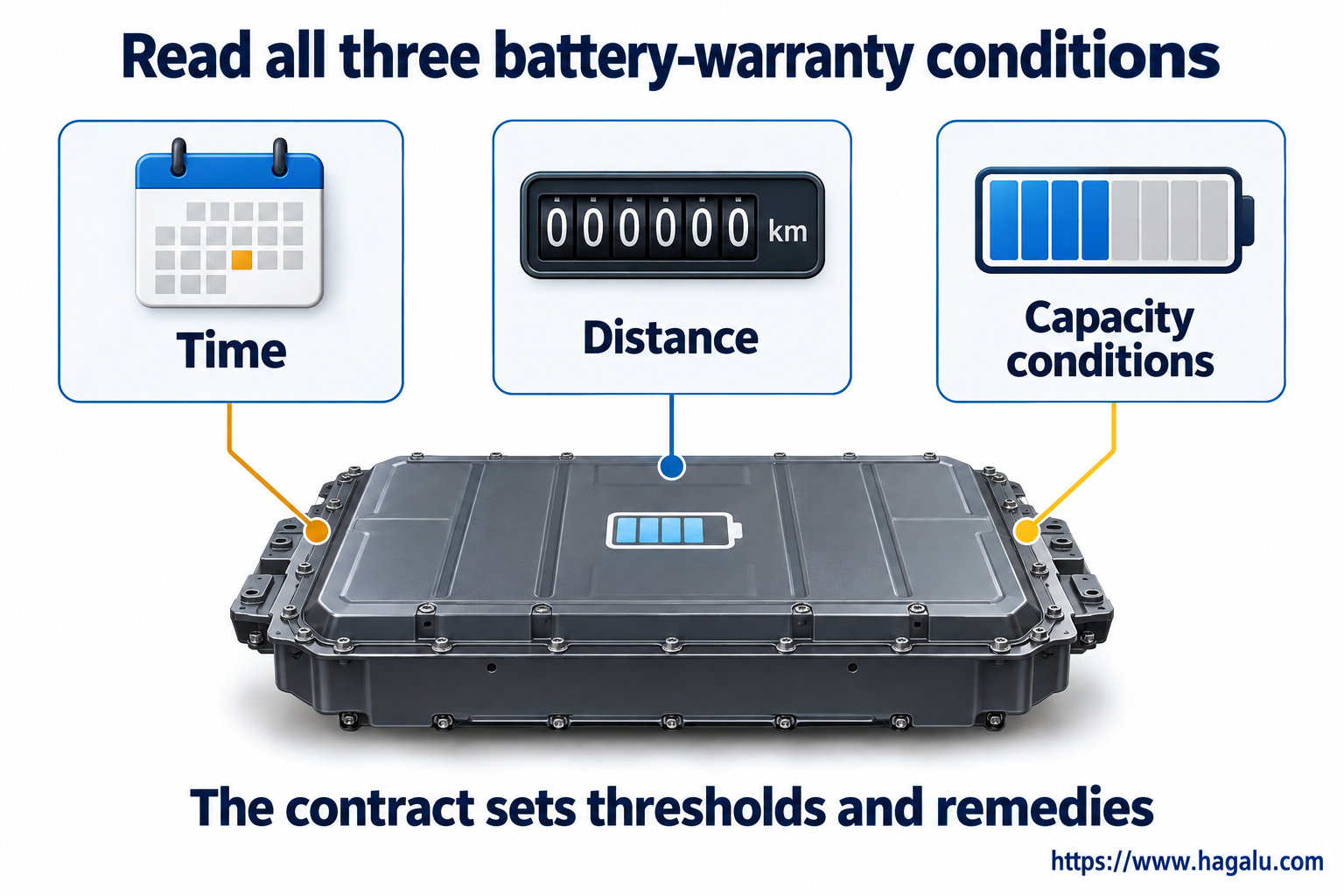
Read the coverage duration, distance, stated capacity threshold if any, testing method, exclusions, repair remedy and transfer conditions. A high-voltage battery warranty and a low-voltage starter/accessory battery warranty are different. Do not assume the headline covers every cable, charger or drive component.
A battery-health report needs its baseline and measurement method. Displayed range can change without a corresponding capacity change because consumption and temperature also change. Used-car buyers should ask for supported health evidence and remaining coverage rather than treating a range screenshot as a laboratory test.
Start hereA neat stamp is helpful. Dated details of what was done are better.
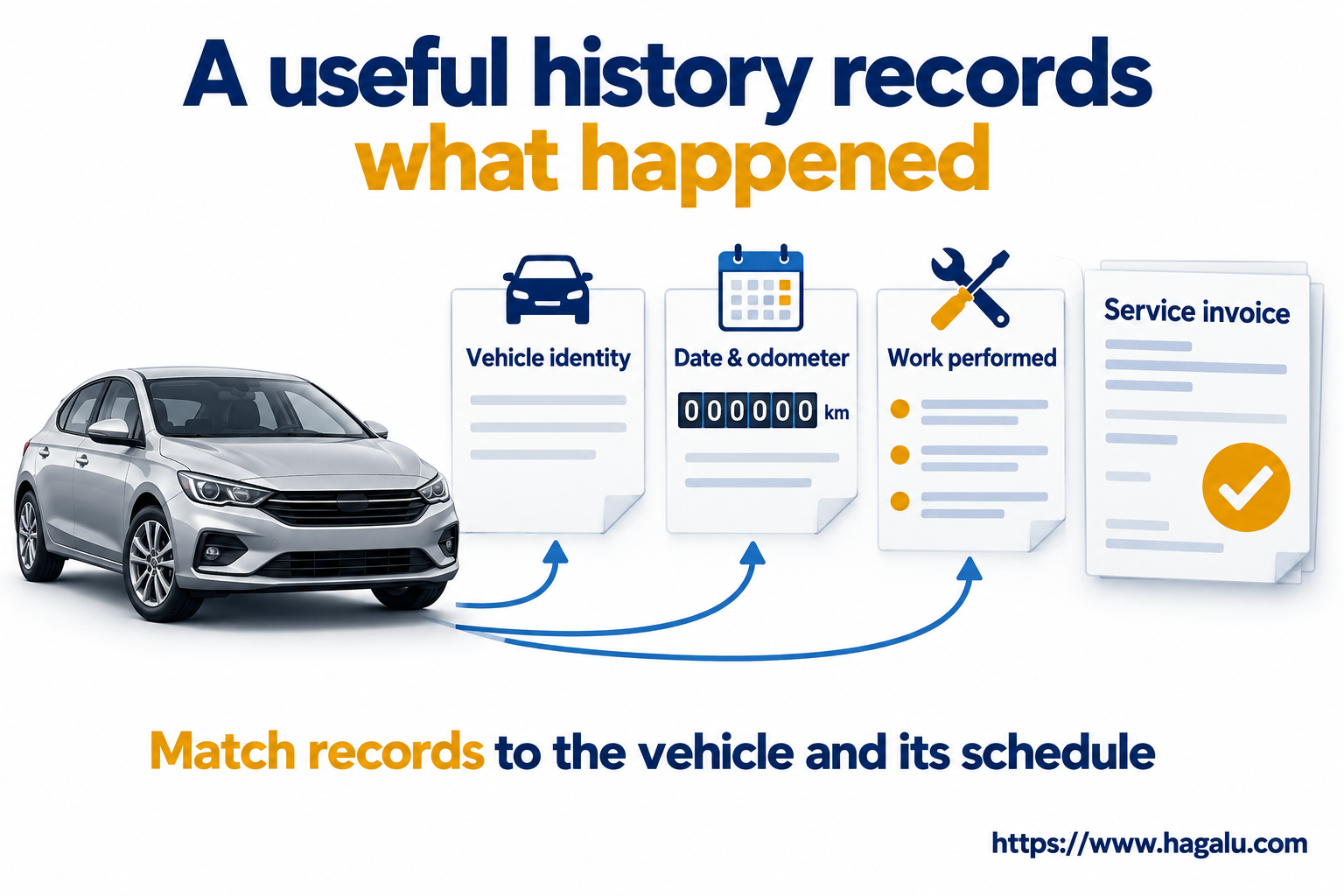
Match invoices, vehicle identification, dates, odometer records and the required service operations. Check outstanding recalls through the appropriate official channel. A recall, an optional update and a routine service are not interchangeable events.
For a future purchase, collect insurance, tyre, servicing and charging-installation quotations where relevant. Stress-test your budget for a lower resale value or unexpected repair. The cheapest purchase does not automatically have the lowest total cost, and the lowest energy bill does not automatically win the whole comparison.
This is educational context, not an OEM service procedure. Use current instructions for the exact vehicle and market before measurements, repairs or safety-critical work.
These links rotate within your selected country. Open an exact variant to check its recorded specifications; the teaching diagrams above do not represent these models.
2.8 GD Double Cab MT
Read this variant's specs1.5 GA MT
Read this variant's specsG 580
Read this variant's specsC5 SHS
Read this variant's specsNo. Scheduled service coverage and cover for specified defects have different purposes and conditions.
Not necessarily. Read the specific included items, caps, exclusions and claim requirements.
Where the exact schedule specifies a time limit, low distance does not remove it. Some systems use condition-based rules instead.
No. Tyres, brakes, suspension, filters and other systems still require appropriate inspections and service.
No. It also depends on consumption, conditions and estimation. Use an appropriate documented health test and understand its measurement basis.
These references support the principles, not the specifications of every car. Regional manuals and test protocols have their own scope; never transfer one vehicle's limits or legal rules to another.
All numerical examples in this guide are labelled illustrations. Technical images simplify the mechanism; they are original Hagalu teaching artwork, not manufacturer-approved parts drawings.