TDCi Engine Explained: Turbo Diesel Common-Rail Made Simple
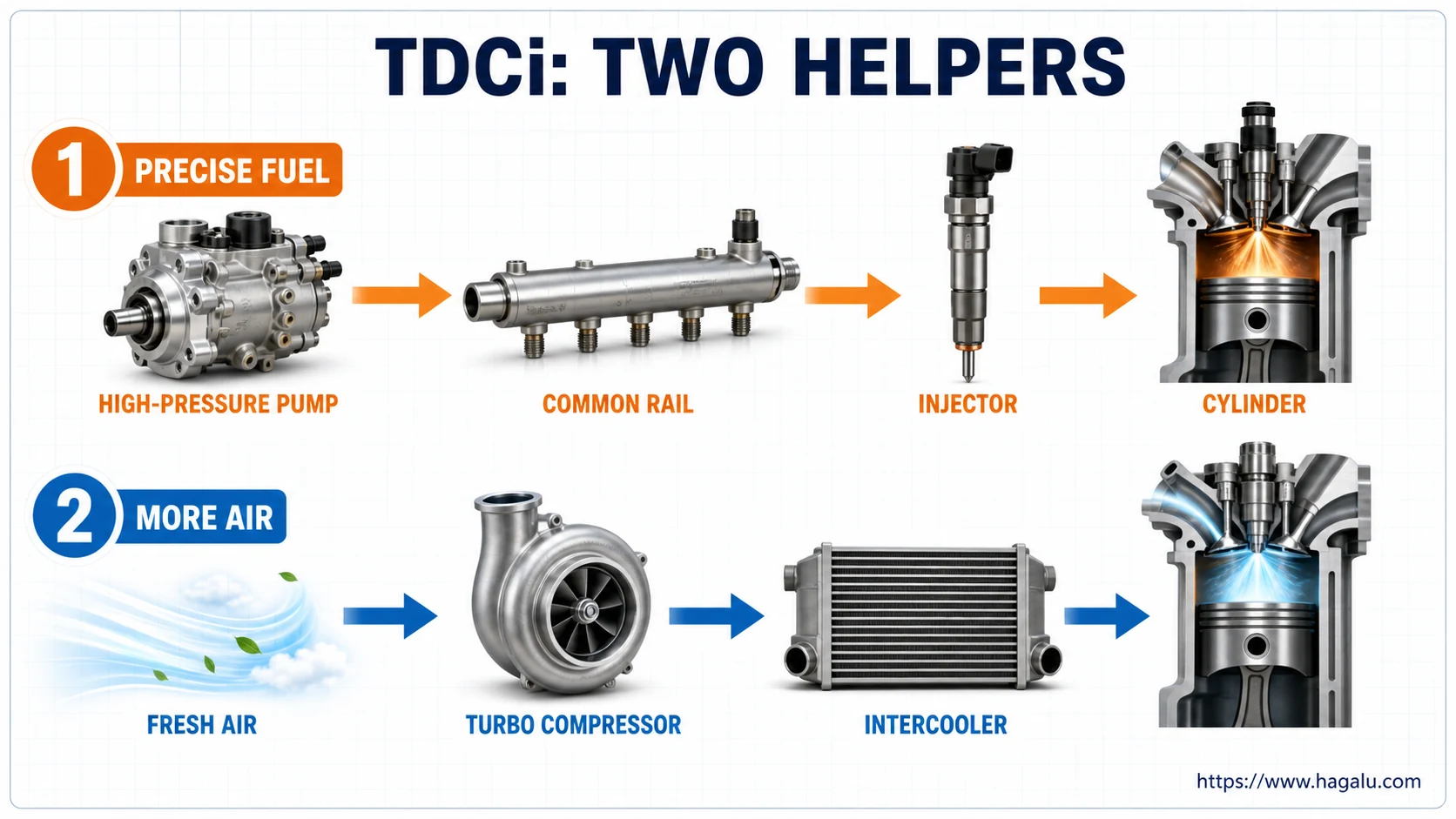
Two helpers do the clever work: one supplies more air, and one measures the diesel with great precision.
Think of a bicycle pump and a super-accurate water sprayer
A fire burns best when it gets the right amount of air and the right amount of fuel. A TDCi engine has two clever helpers to arrange that.
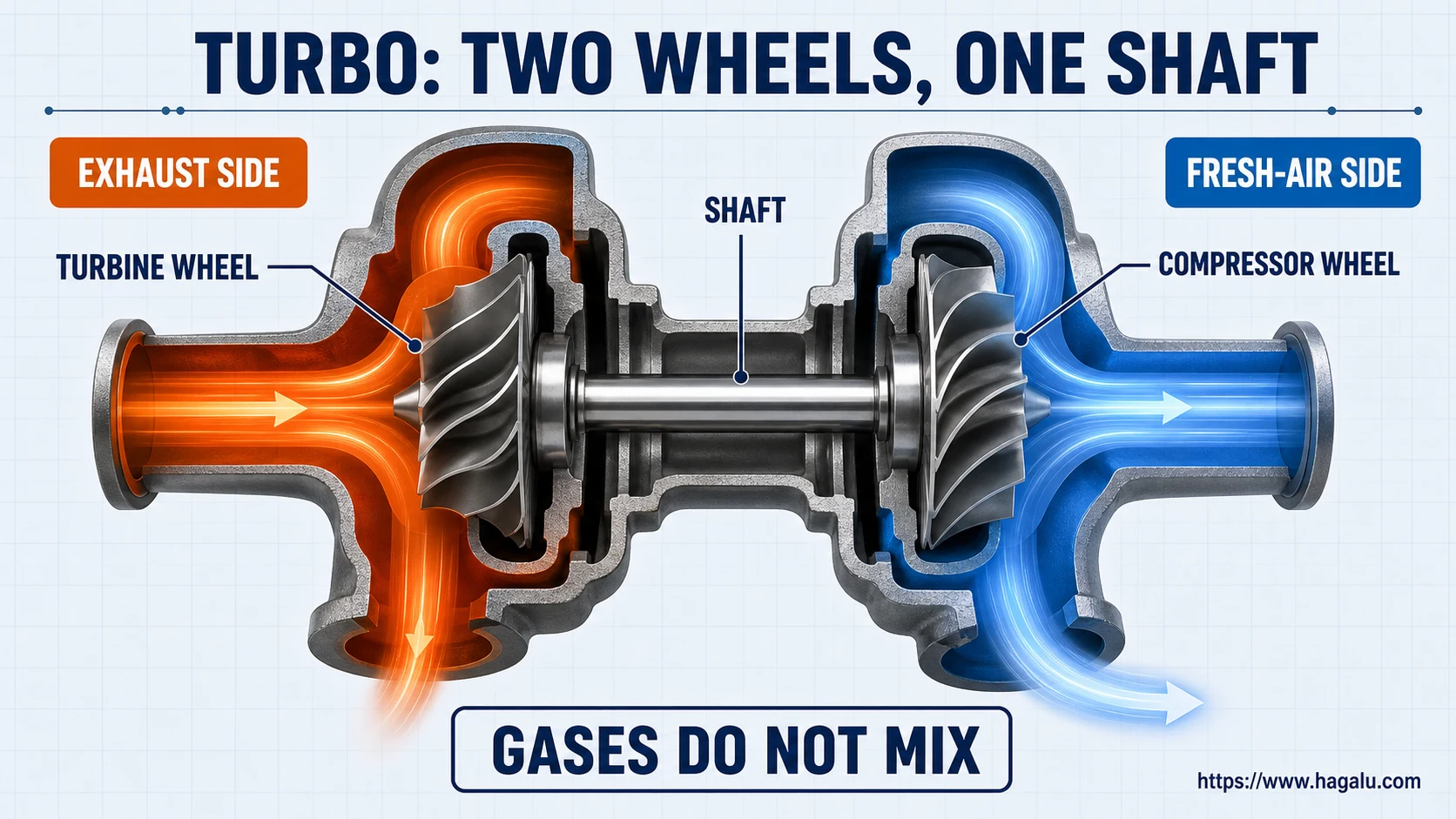
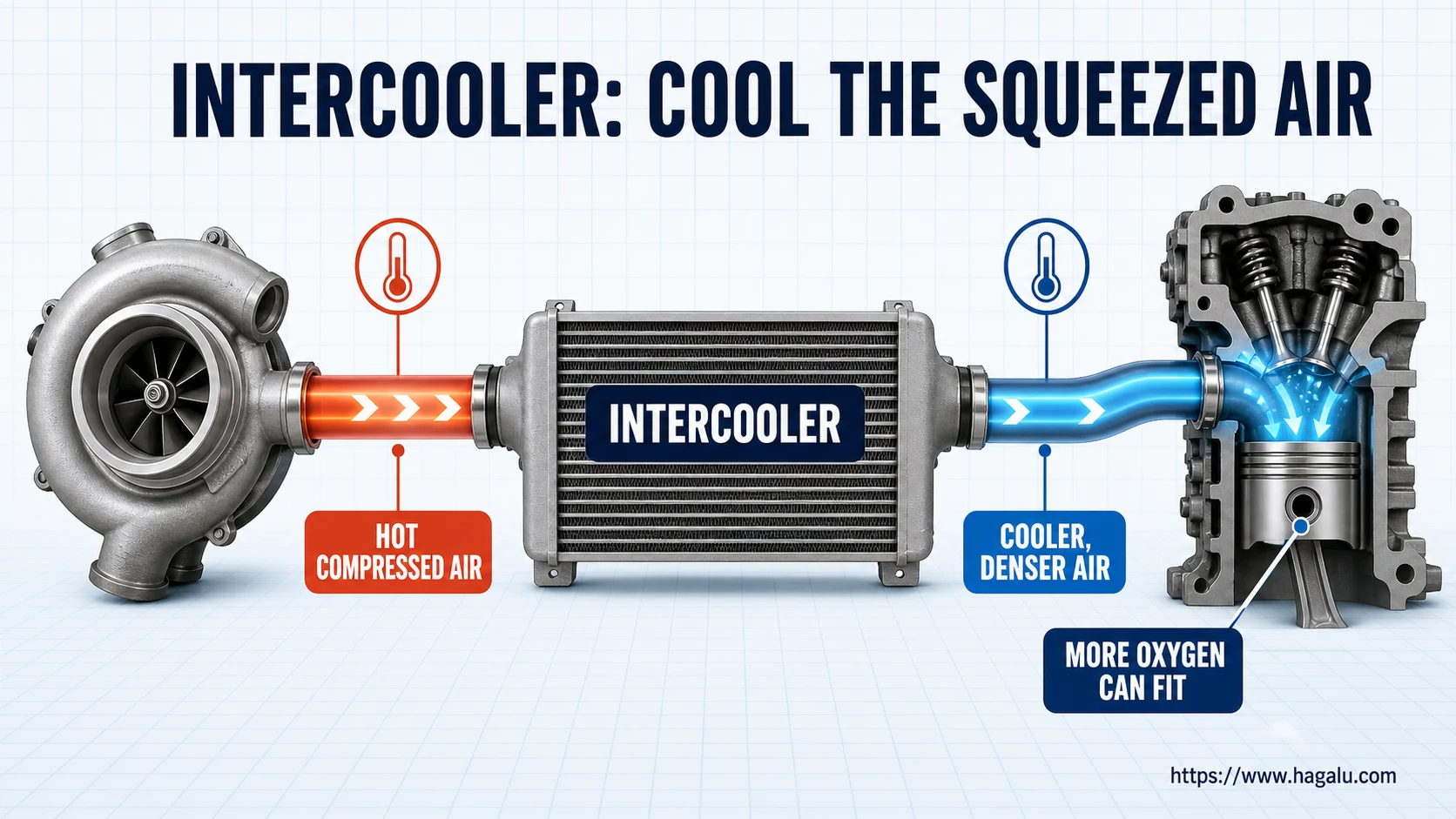
The turbo is like a fast air pump. Exhaust gas spins one side of it; the connected other side squeezes fresh air toward the engine. Squeezing warms the air, so an intercooler cools it again. Cooler air is denser—more oxygen can fit into the same space.
The common-rail system is the super-accurate sprayer. A pump pressurises diesel, one shared rail holds it ready, and electronic injectors deliver a fine mist at the right moment. Hot compressed air ignites the mist—there is no normal petrol-style spark.
Do exhaust gas and fresh air mix inside the turbo?
No. They travel through separate housings. Two wheels share a shaft, so the spinning exhaust-side wheel can turn the fresh-air compressor.
Why cool air after squeezing it?
Squeezing air makes it hot. The intercooler removes some heat so the air becomes denser and more oxygen can fit.
What starts the diesel burn?
Compression heat starts it when the injector sprays diesel. The engine does not use a normal petrol-style spark.
What does TDCi mean?
TDCi is Ford's badge for a family of turbo-diesel common-rail direct-injection engines. It is commonly explained as “turbo diesel common-rail injection.” Ford technical documents describe TDCi engines as turbo diesels with high-pressure common-rail direct injection.
The badge is useful, but it is not an engine code. Ford has applied it to engines with different capacities, cylinder counts, turbochargers, injectors, emissions systems and outputs across several markets and generations. Later Ford diesel families may also carry names such as EcoBlue.
Exhaust energy helps a compressor push more fresh air into the engine.
Fuel ignites in hot compressed air rather than from a normal spark plug.
One shared high-pressure fuel reservoir supplies the electronic injectors.
Each injector sprays diesel straight into its cylinder's combustion chamber.
How a TDCi engine works, step by step
Air path
- 1Fresh air enters
The air filter removes dust before air reaches the compressor.
- 2Exhaust spins the turbo
Hot exhaust turns a turbine. A shaft connects it to the compressor wheel on the fresh-air side.
- 3The compressor squeezes air
Boost pressure lets the engine move a greater mass of air than it could breathe naturally.
- 4The intercooler removes heat
Compression heats the air. Cooling it makes it denser before it reaches the intake.
Fuel path
- 1Diesel is filtered
Clean fuel is essential because pump and injector clearances are extremely fine.
- 2The pump raises pressure
The high-pressure pump prepares diesel for very fine atomisation.
- 3The common rail holds it ready
The shared reservoir supplies stable pressure to each injector.
- 4The ECU commands the spray
Electronic injectors can deliver carefully timed quantities according to load and conditions.
One combustion cycle in four moves
The piston draws in turbocharged, cooled air.
The rising piston squeezes the air until it becomes very hot.
The injector sprays diesel; it ignites and expanding gas pushes the piston down.
Spent gas leaves, first helping spin the turbo turbine.
Main TDCi parts and what each one does
| Part | Its simple job | Typical clues when something is wrong |
|---|---|---|
| Air filter & airflow sensors | Supply clean air and tell the ECU how much is arriving. | Reduced power, smoke, poor economy or a fault code. |
| Turbocharger | Use exhaust energy to compress fresh intake air. | Boost loss, unusual whistle, smoke or oil consumption; diagnosis is essential before blaming the turbo. |
| Intercooler & boost hoses | Cool compressed air and carry it to the engine. | Split or loose hoses can hiss, leak oily mist, reduce power and create smoke. |
| Fuel filter / water separator | Protect the high-pressure fuel system from contamination. | Hard starting, restricted supply or a water-in-fuel warning. |
| High-pressure pump | Raise diesel to injection pressure. | Low rail pressure, non-starting or debris after severe internal wear. |
| Common rail & sensor | Store fuel pressure and report it to the ECU. | Pressure-control faults, limp mode, hesitation or hard starting. |
| Electronic injectors | Atomise and meter diesel into each cylinder. | Rough idle, knock, smoke, poor starting or excessive return flow. |
| EGR, DPF, catalyst, SCR | Reduce different exhaust pollutants where fitted. | Warning lights, limited power, frequent regeneration or an AdBlue message. |
Why does a TDCi engine pull strongly at low revs?
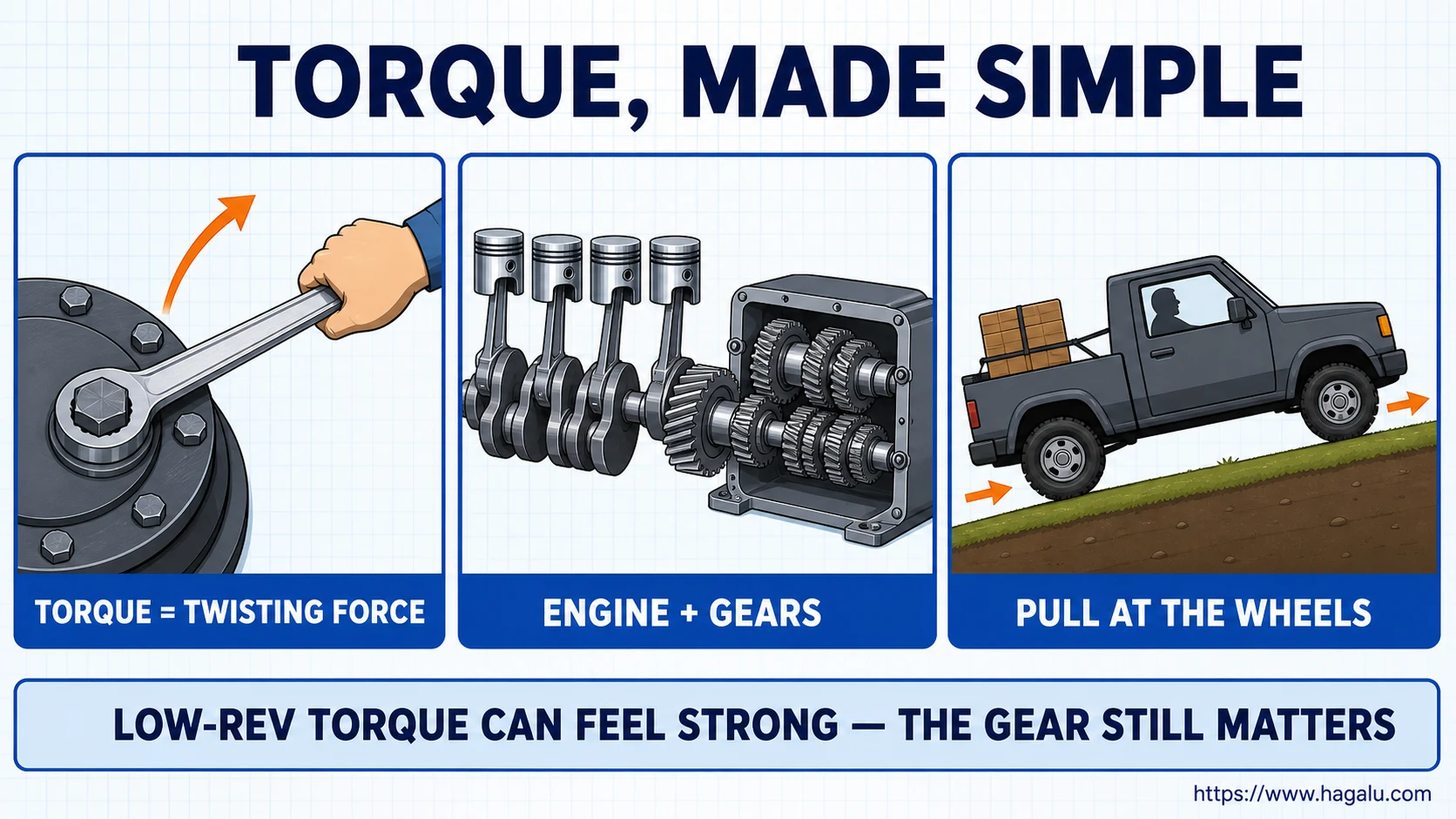
Torque is twisting force. A diesel's combustion characteristics, engine design, boost control and gearing can deliver a broad useful torque band at lower engine speeds than many naturally aspirated petrol engines. That is why a healthy TDCi can feel relaxed when climbing, overtaking or carrying a load.
More oxygen lets the engine burn the requested diesel cleanly and make more torque.
The ECU shapes when and how fuel enters, helping response, noise and emissions.
A strong engine in the wrong gear can still feel slow. The transmission turns engine torque into wheel torque.
TDCi engine pros and cons
Pros
- Strong usable torque: helpful for load carrying, hills, towing within rated limits and relaxed overtaking.
- Potential long-distance economy: particularly in a vehicle sized appropriately for the engine.
- Accurate fuel control: common rail can support several injection events and smooth driveability.
- Compact performance: turbocharging lets a smaller engine move more air when needed.
- Good cruising character: useful torque can reduce the need to chase high revs.
- Modern emissions integration: injection control can work with EGR, DPF and SCR systems where fitted.
Cons
- System complexity: boost, high-pressure fuel and aftertreatment create more possible fault paths.
- Costly fuel components: pumps and injectors require clean diesel and expert diagnosis.
- DPF use-pattern sensitivity: on equipped vehicles, frequent short cold trips may interrupt regeneration.
- Turbo and hose failures: oil neglect or boost leaks can affect performance and smoke.
- Generation-specific service risks: belts, belt-in-oil systems and intervals are not universal.
- Diesel refinement limits: it can be smooth, but cold clatter and vibration may remain more noticeable than petrol.
What fuel does TDCi use, and is it economical?
Use the diesel grade and biodiesel limit printed in the owner's manual or fuel-filler information. Never assume that a fuel approved for a newer TDCi is approved for an older one in another market.
There is no single TDCi economy figure. Ford has used the badge on small hatchback engines, family cars, vans, SUVs and bakkies. Their weight, aerodynamics, gearing and jobs are completely different.
Longer warmed-up journeys, steady cruising, moderate engine speed and work that uses the engine's torque rather than high revs.
Repeated short cold trips, heavy stop-start traffic, roof loads, high speed, under-inflated tyres, regeneration events or mechanical faults.
Use fill-to-fill L/100 km across several tanks, then compare against a vehicle of similar size, performance and duty—not an unrelated small petrol car.
A temporary consumption rise can occur during some DPF regeneration events. A persistent large change deserves checks for tyres, brakes, filters, boost leaks, injector correction and stored faults.
DPF, EGR and AdBlue on TDCi engines
The TDCi badge does not specify one exhaust system. A particular engine may have a diesel oxidation catalyst, EGR, a coated diesel particulate filter, selective catalytic reduction with AdBlue, or a market-specific combination.
Controls a portion of exhaust returning to the intake to help reduce nitrogen-oxide formation.
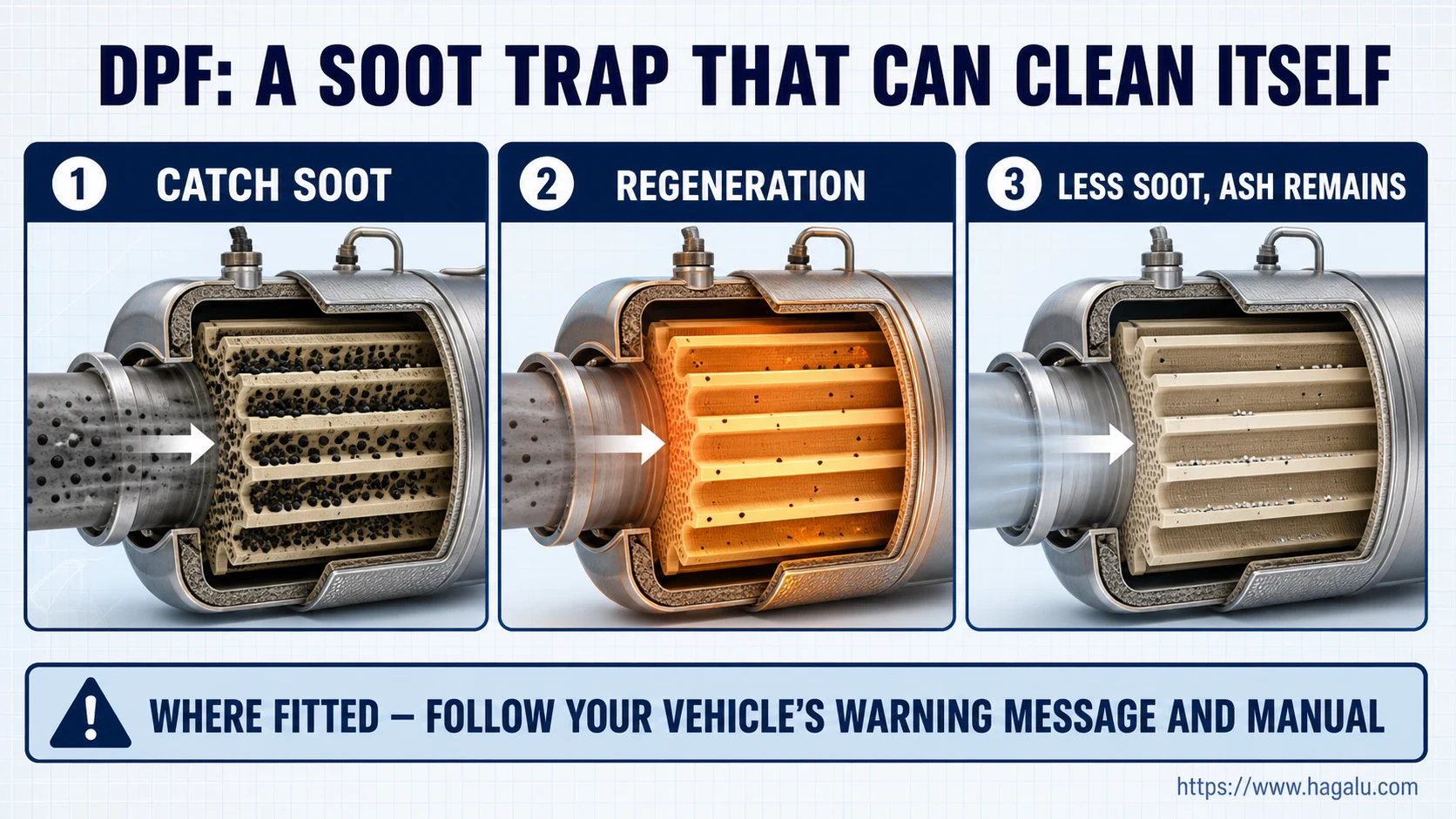
Captures soot. Regeneration raises exhaust temperature to burn the collected soot down. The correct driver action is model-specific.
Uses diesel exhaust fluid in the exhaust—not the fuel tank—to reduce nitrogen oxides on equipped versions.
Who is a TDCi diesel best for?
Often a good fit
- Frequent highway or open-road kilometres.
- Regular passenger, cargo or towing duties within vehicle ratings.
- Drivers who enjoy low-rev torque more than high-rev performance.
- Owners with access to correct service parts and diesel expertise.
Think carefully
- Nearly every journey is too short for the engine to warm fully.
- The used vehicle has no proof of correct oil, belt and fuel-filter care.
- Warning lights have been cleared without repairing the cause.
- You want the simplest possible low-mileage city-car ownership.
TDCi maintenance checklist
Use the exact Ford oil specification for that engine. The same viscosity can exist with different additive and compatibility requirements.
Change the fuel filter on time. Where a water drain or warning exists, follow the manual's procedure.
Never start the engine after a suspected petrol misfuel. Stop before the wrong fuel circulates and obtain professional recovery advice.
Inspect boost hoses and clamps. Small leaks can create big changes in torque, smoke and economy.
Give an equipped DPF the conditions its manual requests. Do not ignore repeated regeneration or filter warnings.
Use VIN-specific belt information. Some engines use different belt arrangements or oil-bathed belts; intervals and oil chemistry matter.
Diagnose before replacing a turbo. Oil supply, crankcase ventilation, hoses, sensors and exhaust restriction can imitate or cause turbo trouble.
Keep the calibration legal and conservative. Aggressive remapping can raise smoke, heat and stress beyond the original system design.
Symptoms: stop now or book a check?
Petrol in the diesel tank; red oil-pressure warning; overheating; heavy fuel or oil leak; runaway revving; severe mechanical knock.
Repeated limp mode, hard starting, persistent smoke, loss of boost, abnormal whistle, rough idle, DPF or AdBlue countdown, sudden economy change.
A hot smell, cooling fan or slightly different idle during regeneration can be normal on some vehicles. Record when it happens and investigate if it becomes frequent.
TDCi vs TDI vs CRDi vs CRDe
| Badge | Usually associated with | Shared broad idea | Do not assume |
|---|---|---|---|
| TDCi | Ford | Turbo-diesel with common-rail direct injection. | One engine design, one oil or one service schedule. |
| TDI | Volkswagen Group | Manufacturer-specific turbo direct-injection diesel technology. | That TDCi and TDI parts or procedures interchange. |
| CRDi / CRDI | Used by multiple manufacturers | Common-rail direct-injection diesel. | The same pump, rail pressure or emissions hardware. |
| CRDe | Mahindra | Common-rail electronically controlled diesel injection. | That every CRDe is mechanically the same. |
Five TDCi myths to leave behind
No. It is a family badge used across several engines and generations.
Some delay can be normal; a sudden new loss of response needs diagnosis.
No. Fitment depends on emissions design, market and year.
No. Some warnings permit a drive cycle; others require service. Read the exact message and manual.
More requested fuel and boost can increase heat, smoke and component stress.
Is a TDCi engine good?
It can be excellent for the right duty. Turbocharged air and electronically controlled common-rail fuel give a healthy TDCi useful low-speed torque, good cruising manners and the potential for strong long-distance economy.
Its weaknesses are the other side of that sophistication: high-pressure fuel components, boost control and exhaust aftertreatment demand correct fuel, exact oil, proper use and informed diagnosis. For a used Ford, service evidence and current condition matter more than the letters TDCi.
TDCi engine questions people actually ask
What does TDCi mean on a Ford?
TDCi is Ford's badge for a family of turbo-diesel common-rail direct-injection engines. It is a technology label, not one single engine design, so displacement, power, injectors, emissions equipment and service requirements vary by model and year.
Is TDCi petrol or diesel?
Diesel. A TDCi vehicle must be filled with the diesel grade specified in its owner's manual. Petrol can remove lubrication from the diesel high-pressure system and cause expensive pump and injector damage.
How does a TDCi engine work in simple words?
A turbo pushes more air into the engine while a high-pressure common rail supplies precisely measured diesel to electronic injectors. The compressed air becomes hot, the injector sprays fuel into it, and the mixture ignites without a spark plug.
Is TDCi the same as TDI?
No. TDCi is a Ford badge and TDI is associated with Volkswagen Group. Both names have been used on turbocharged direct-injection diesel engines, but the engines, components, software and maintenance requirements are not interchangeable.
Is TDCi the same as CRDi or CRDe?
They share the broad common-rail direct-injection principle. TDCi also explicitly identifies Ford's turbo-diesel family. The names do not mean that engines from different manufacturers use the same hardware or calibration.
Why do TDCi engines feel strong at low speed?
Diesel combustion and turbo boost can produce substantial torque at relatively low engine speed. That helps with overtaking, carrying loads and climbing without needing very high revs, although the exact torque band varies by engine.
Are TDCi engines fuel efficient?
They can use less fuel than a comparable older petrol engine on long, steady journeys, but there is no universal TDCi consumption figure. Vehicle size, engine version, load, gearing, traffic, speed, tyres and maintenance all affect real-world use.
What is a DPF and why does it matter on some TDCi cars?
A diesel particulate filter catches soot in the exhaust and periodically burns it off during regeneration. Repeated short cold trips can interrupt that process. Not every TDCi in every market has the same DPF system, so follow the warning-light instructions for the specific vehicle.
Do all TDCi engines use AdBlue?
No. Some later diesels use selective catalytic reduction and AdBlue to reduce nitrogen oxides, while earlier or market-specific versions may not. Check for an AdBlue filler and consult the owner's manual rather than assuming from the TDCi badge.
How should a TDCi engine be maintained?
Use the exact oil specification, diesel grade and service intervals listed for the engine. Replace the fuel filter on schedule. Respond to DPF or water-in-fuel warnings, and use the VIN-specific timing-belt schedule. A generic TDCi interval is unsafe because the badge covers many engine designs.
Primary sources and editorial notes
We used manufacturer and component-maker material for the technical facts, then rewrote the explanation in plain language. A badge can cover several engines, markets and model years, so your vehicle's owner's manual and VIN-specific service schedule remain the final authority.
- Ford Mondeo technical specificationsFord specification showing a TDCi turbo-diesel, common-rail engine management and high-pressure direct injection.
- Ford Transit EcoBlue TDCi technical specificationsManufacturer details for common-rail injection, turbocharging, EGR, DPF and SCR on one later TDCi application.
- Ford: three decades of diesel powerFord's history describing Duratorq TDCi engines as turbo-diesel common-rail engines.
- Bosch Mobility: common-rail systemComponent-maker explanation of high-pressure rail storage and flexible injection control.
- Ford Transit owner's manualExample of manufacturer-specific DPF regeneration requirements and why owners must use the exact vehicle manual.
Illustrations are original Hagalu educational artwork, not an OEM workshop drawing and not a substitute for a repair manual. Component shape and placement are simplified so the flow is easy to see.