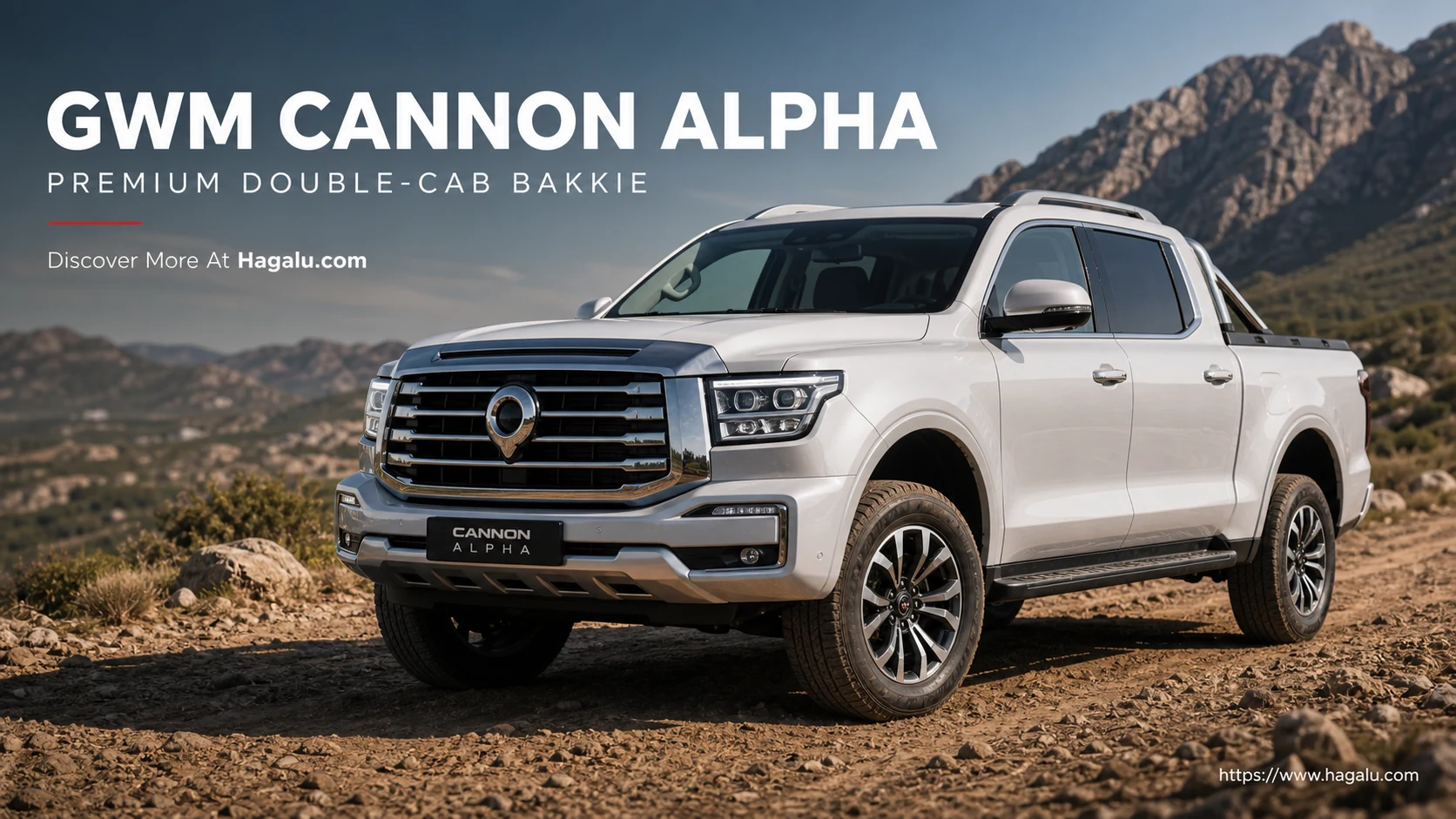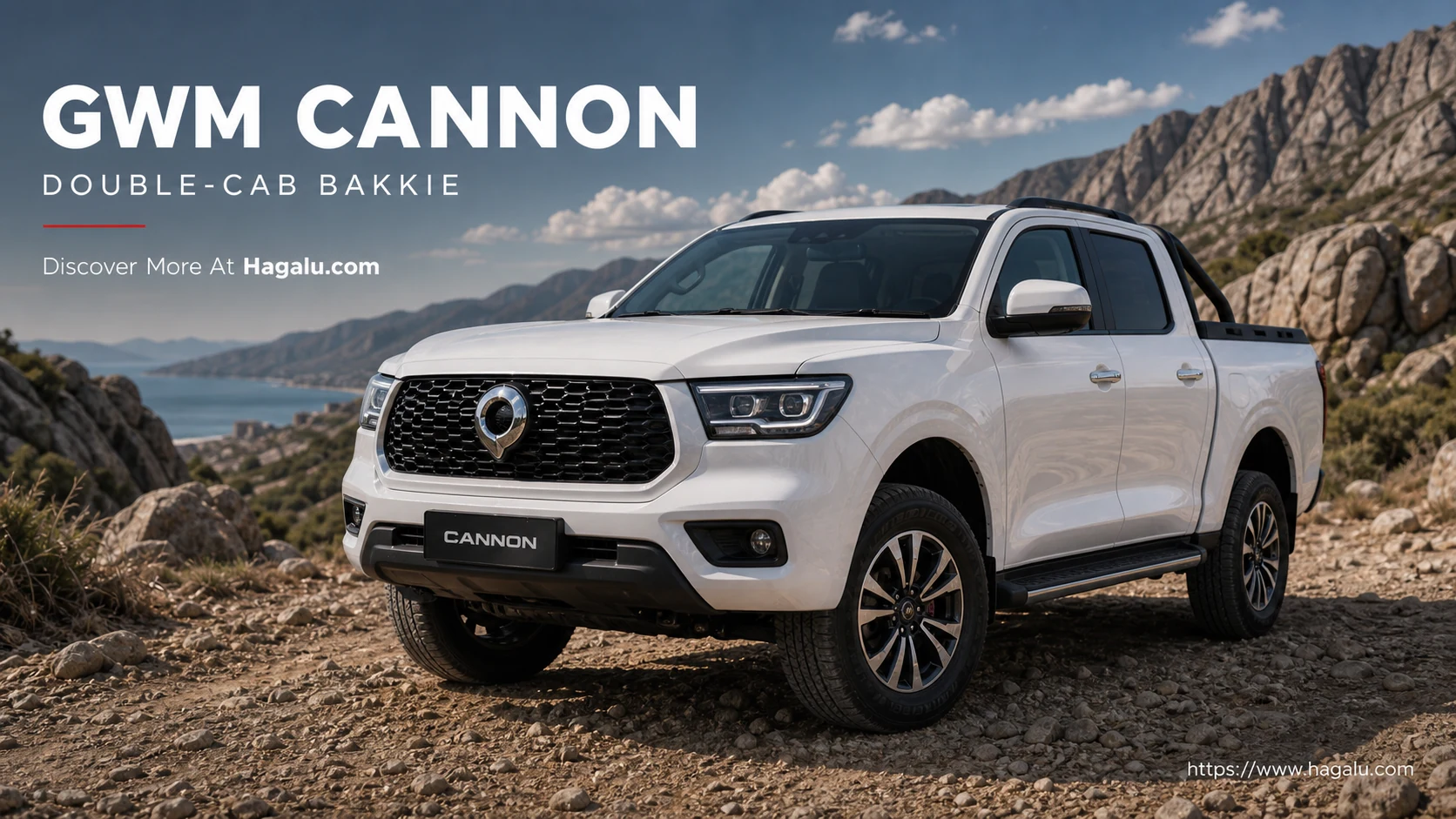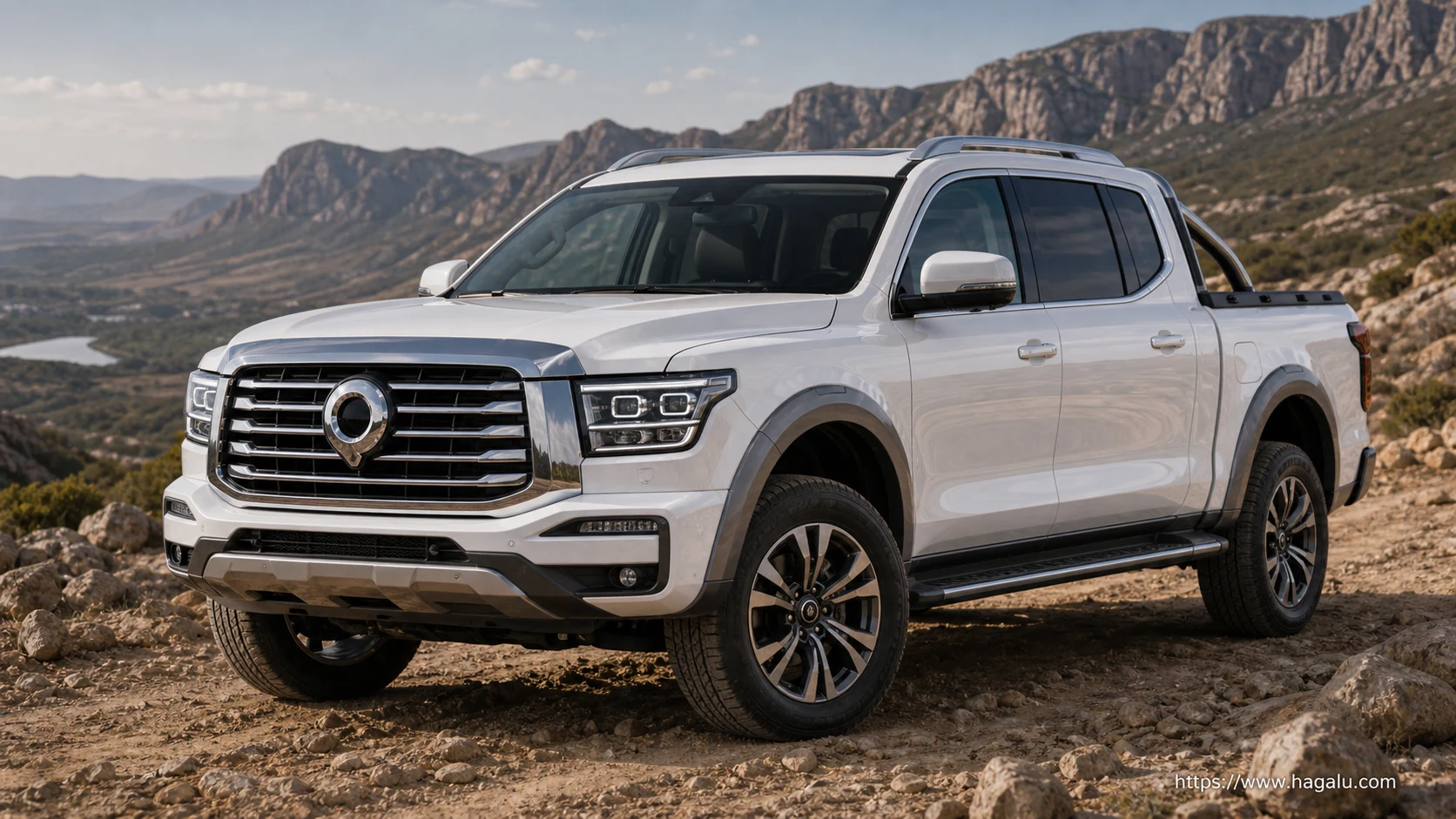
The Cannon Alpha is GWM's most expensive bakkie sold in South Africa, sitting at the top of the company's pickup hierarchy and competing directly with the Hilux Legend, Ranger Wildtrak and Volkswagen Amarok PanAmericana for the lifestyle bakkie flagship pound. Priced from R699,900 for the Double Cab LS 4x4 to R829,900 for the Double Cab LX 4x4 flagship, it sits R100,000 above the regular Cannon and brings a different powertrain, a more sophisticated chassis and equipment levels that would normally require six-figure premiums on European rivals. The headline change versus the Cannon is the engine. The Alpha runs GWM's 2.4-litre GW4D24 turbocharged diesel, producing 135 kW and 480 Nm of torque. That's a 25 kW and 80 Nm increase over the Cannon's 2.0-litre, and brings the Alpha into the same horsepower territory as the Hilux 2.8 GD-6 (150 kW / 500 Nm) and the Ranger 2.0 Bi-Turbo (154 kW / 500 Nm). Real-world performance feels markedly stronger than the Cannon — 0-100 km/h takes around 11.5 seconds versus 13.0 for the Cannon, and overtaking response from 80–120 km/h is noticeably more urgent. The transmission is a 9-speed torque-converter automatic — one ratio more than the Cannon and tuned for closer-spaced shifts that keep the larger engine in its torque sweet spot. Drive type is full-time 4WD with selectable low-range, a substantial step up from the part-time 4x4 on the Cannon LX. The full-time AWD system means the Alpha can be driven on tar in 4x4 mode without binding the drivetrain, which makes it more usable for the South African lifestyle bakkie buyer who occasionally hits gravel without wanting to manually engage 4x4 each time. Chassis-wise the Alpha shares its body-on-frame ladder construction with the Cannon and P Series, but with revised suspension. Independent double-wishbone up front, multi-link coil-sprung live axle at the rear — the coil-sprung rear is the same architecture used on the Ranger Wildtrak and the Amarok, and it delivers a noticeably smoother ride than the leaf-sprung Cannon. Payload drops to 900 kg as a result (versus 930 kg on Cannon), but for the lifestyle buyer this is irrelevant. Towing capacity remains 3,500 kg. Off-road capability is where the Alpha justifies its premium pricing. Approach angle of 32 degrees, departure 28 degrees, ramp-over 26 degrees. Ground clearance of 224 mm. Wading depth of 850 mm. Front and rear locking differentials (Hilux Legend has only rear; Ranger Wildtrak has rear plus locking centre). Five terrain modes including a dedicated rock-crawl mode that locks both differentials and adjusts throttle response. On a comparison test against the Hilux Legend and Ranger Wildtrak at a 4x4 facility outside Johannesburg, the Alpha's off-road capability is genuinely competitive with the established Japanese and American rivals. Cabin equipment is where the Alpha turns the segment value equation on its head. The LX flagship at R829,900 includes a 14.6-inch infotainment screen with wireless CarPlay and Android Auto, a full digital instrument cluster, panoramic sunroof, ventilated front seats, heated front and rear seats, massage function on the driver's seat, head-up display, ambient lighting with 64 colour options, 12-speaker premium audio, and a refrigerated cool box in the centre console. The Ranger Wildtrak at R1,070,000 doesn't have the cool box, doesn't have rear-seat heating, and has a smaller 12-inch screen. The Hilux Legend at R935,900 has none of these features. Safety equipment is comprehensive — eight airbags standard (versus six on Cannon and P Series), full driver-assistance suite including adaptive cruise control with stop-go, traffic-sign recognition, lane-keep assist, blind-spot monitoring with rear cross-traffic alert, AEB with pedestrian and cyclist detection, and 360-degree camera with transparent under-body view that shows what's beneath the vehicle on technical off-road obstacles. The Cannon Alpha has been on sale in South Africa since 2024 and is currently the volume-leading premium Chinese bakkie in the market. Owner feedback to date has been broadly positive — the powertrain is praised for its refinement, the cabin for its equipment level, and the off-road capability for its real-world ability. The most consistent criticism is fuel economy, which sits around 10.5 L/100 km in real-world mixed driving compared to 9.8 for the Cannon. The larger engine demands more diesel, and the kerb weight of 2,125 kg is up 90 kg over the Cannon. Residual values for the Alpha are still developing as the model is recent, but indications from the broader Chinese bakkie market suggest the Alpha will track the same residual pattern as the Cannon and P Series — approximately R100,000–R130,000 less recovery at 5 years versus a Hilux Legend or Ranger Wildtrak. For the buyer specifying the Alpha LX at R829,900 versus a Hilux Legend at R935,900, that R106,000 up-front saving currently more than covers the eventual residual gap for ownership cycles of 4 years or more. For the South African buyer comparing the Cannon Alpha against the Ranger Wildtrak, the Hilux Legend and the Amarok PanAmericana, the Alpha is the most equipment-rich choice at the lowest price point. Whether it represents the best long-term ownership value depends on how long you keep your bakkies and how much you value the established residual safety of the Japanese alternatives. As with every Chinese bakkie purchase in South Africa, the buyer is choosing between paying more up-front for reliability certainty (Hilux/Ranger) or paying less up-front for substantially more equipment with some residual uncertainty (Cannon Alpha).