South Africa · Inverse affordability calculator

How Much Car Can I Afford in South Africa?

Start with the money that must keep your life running. The car receives what remains—not the other way around.
Plain-language review5 checked visualsReviewed 2026-09-09
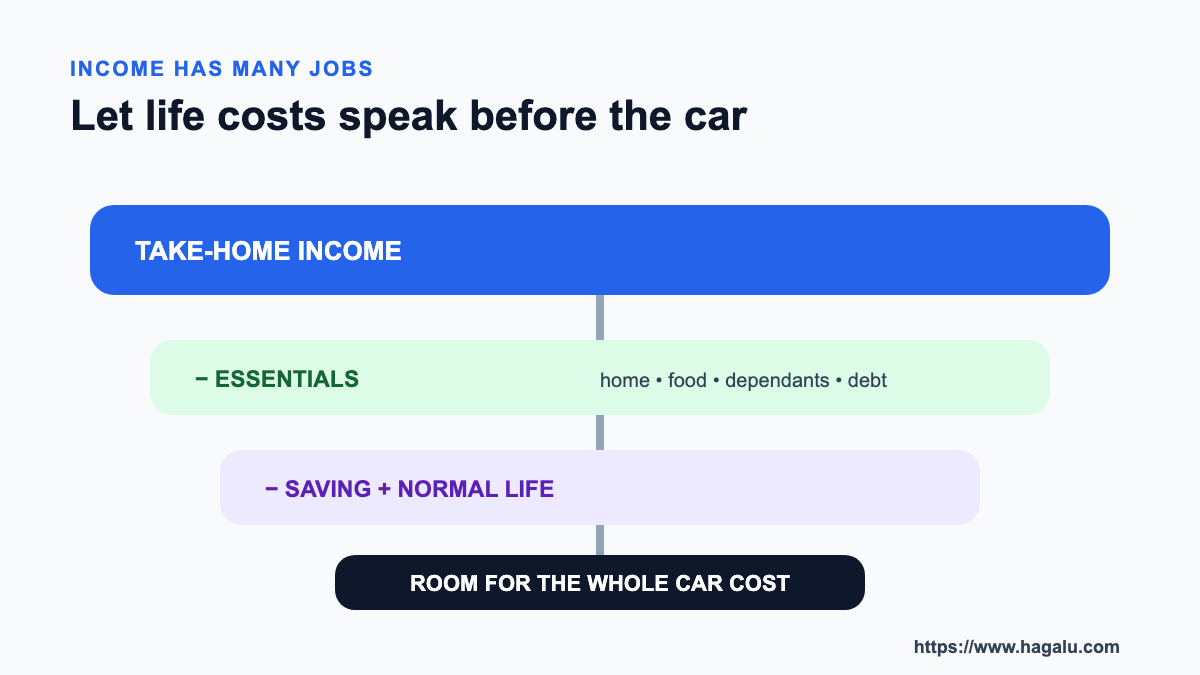
Simple flow from take-home income through essential living costs, debt, savings and finally a car allowance
The car budget comes last in the subtraction. Rent, food, debt, family needs and savings do not disappear when a new car arrives. On a phone, swipe the diagram sideways to read it at a larger size. Open full-size image · Hagalu Editorial Studio · image usage terms
One budget, two very different meanings

What does a R5,000 monthly car budget really cover?

If R5,000 is the entire amount your household can spend on a car, an advertised R4,999 instalment has already used almost all of it. Insurance, fuel and the next set of tyres still need paying. The first task is to split the budget, not find a longer loan term.

The example below reserves R3,000 for costs outside the loan. These are invented planning allowances—not insurance quotes, national averages or a claim that they will suit your vehicle. Someone driving farther, paying for secure parking or insuring a high-risk vehicle may need substantially more.

Hypothetical monthly cash-flow plan, including a reserve
Where the money goesMonthly allowanceReplace it with
InsuranceR800A personal quote for the exact car and use
Fuel or chargingR1,200Your distance, consumption and energy price
Servicing, maintenance and tyresR350Expected annual spending divided by 12
Licence provision and parkingR300Annual licence cost plus actual parking needs
Additional cash reserveR350Headroom for irregular costs; not a guarantee against a large repair
Available for the loanR2,000What remains after those allowances
TotalR5,000All six buckets together

What a R2,000 instalment can finance

At an illustrative fixed annual interest rate of 12%, over 60 monthly payments, with no balloon, R2,000 a month finances approximately R89,910. Add a R20,000 cash deposit and the corresponding vehicle-price ceiling is roughly R109,910 before finance fees, delivery charges or other financed items. This is arithmetic, not a lender offer or a claim that a suitable new car exists at that price.

The calculator below starts with these inputs. Its “other monthly costs” field combines the R300 licence/parking allowance and R350 reserve. Replace them all before using the result for a purchase. A quoted monthly credit-service fee must also fit within the R5,000 total; an initiation fee financed into the loan uses some of the available principal.

Why a balloon does not repair a tight budget

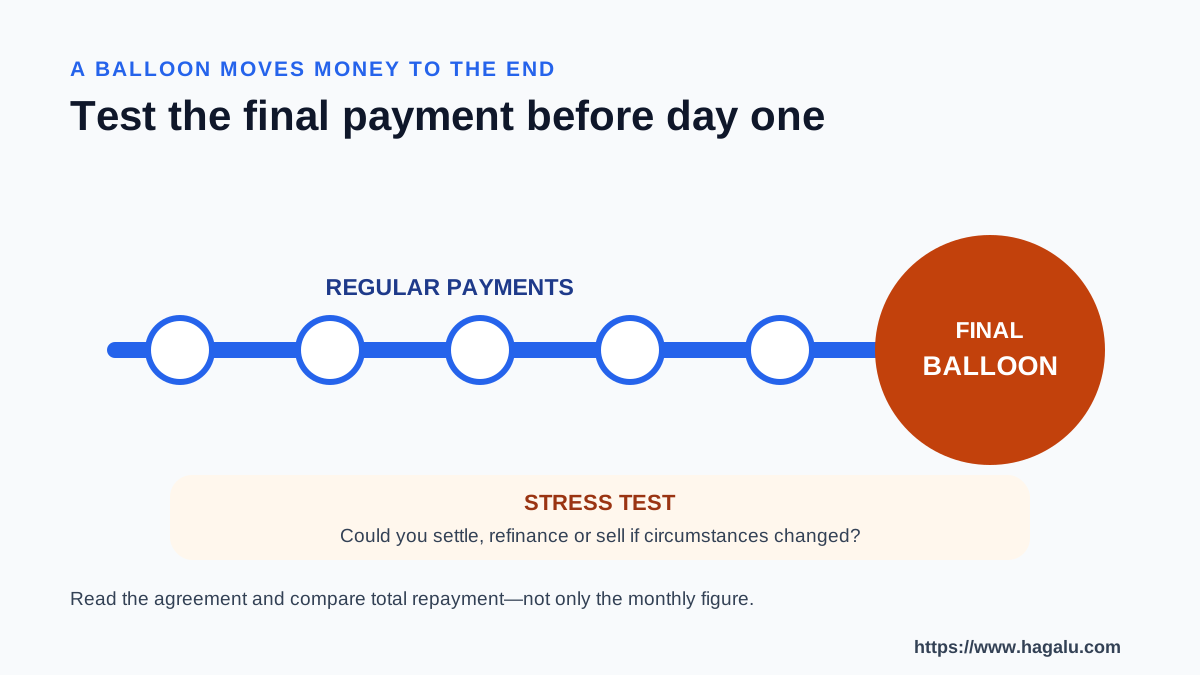
A balloon can lift the apparent purchase ceiling by leaving debt for the end. If your monthly budget is already stretched, where will the settlement money come from? A future sale price is uncertain, and another loan is not guaranteed. See the same-car balloon versus no-balloon comparison before treating the smaller debit order as a saving.

If the ceiling does not reach a suitable car, the useful result is the warning. Consider waiting, saving a deposit without draining emergency funds, a carefully inspected cheaper used car, or a different transport arrangement. Lowering the insurance allowance or ignoring tyre replacement does not make the car cheaper to own.

And if R5,000 means only the instalment?

With the same R3,000 of assumed non-loan costs, the full monthly commitment becomes R8,000. That distinction should be written at the top of any quotation comparison. Cash-flow budgeting also differs from total ownership cost: depreciation matters to the latter, but adding the full purchase price and full loan principal again would double-count the car.

For energy inputs, the EV versus petrol calculator separates fuel and wall-electricity assumptions. For cover, establish what the warranty and service plan actually pay for before reducing your upkeep allowance.

Live, checked catalogue

Current low-price examples for your ceiling check

These are the lowest active passenger-car entry prices in Hagalu's South African data. Compare them with your calculated ceiling as a reality check; a registered credit provider still performs its own affordability assessment.


Change the numbers yourself

Estimate a comfortable maximum car price

Start with the full amount you choose to spend on transport each month. Ownership costs come out first; only the remainder is available for a loan repayment.

Estimated maximum vehicle priceUse the calculator
Available for the loan each month
Estimated amount financed
Balloon still due at the end
Maximum price if the rate rises by 2 points

This is a planning estimate, not approval or a lender quotation.

Five useful pictures, not decoration

See the decision before reading the fine print
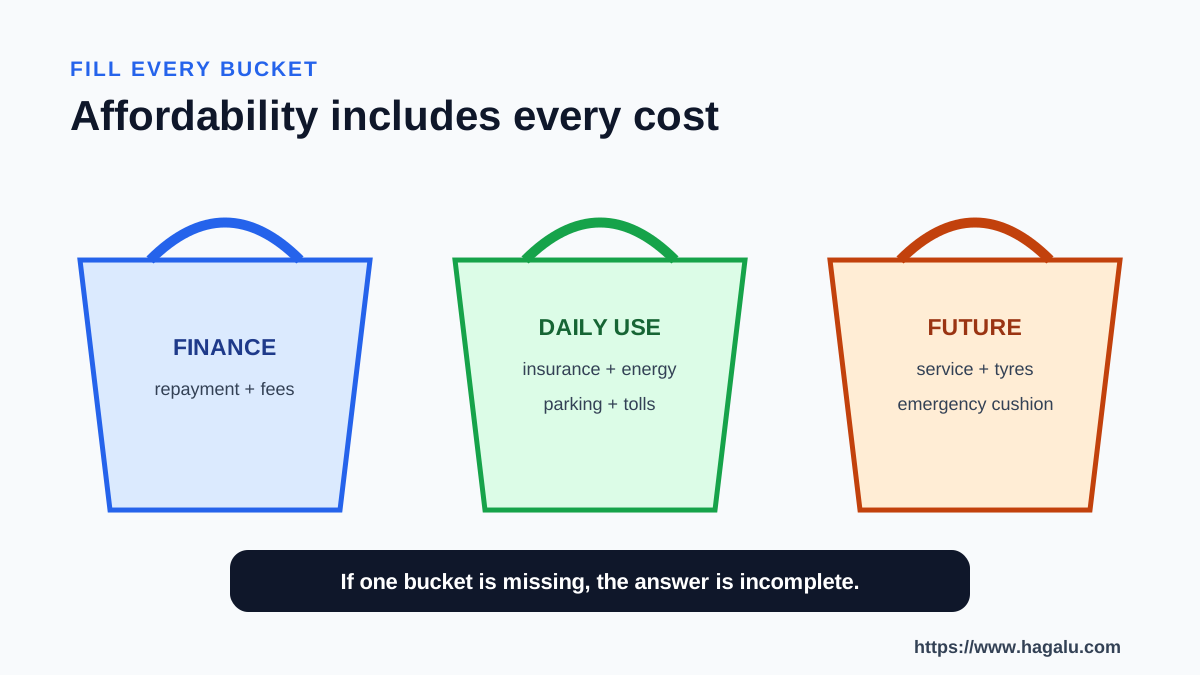
Three large budget buckets grouping finance, daily-use costs and future service, tyre and emergency costs into one affordability total
Finance, daily use and future costs are grouped into three buckets. Every cost inside them needs room before the car is affordable. On a phone, swipe the diagram sideways to read it at a larger size. Open full-size image · Hagalu Editorial Studio · image usage terms
Two jars separating a car deposit from emergency savings for insurance excess, tyres and household surprises
A useful deposit lowers debt; a separate reserve protects the agreement when life produces an unexpected bill. On a phone, swipe the diagram sideways to read it at a larger size. Open full-size image · Hagalu Editorial Studio · image usage terms
Timeline showing lower instalments followed by a large final balloon that still needs payment, sale proceeds or approved refinancing
A balloon moves debt to the end. It does not make that part of the car free. On a phone, swipe the diagram sideways to read it at a larger size. Open full-size image · Hagalu Editorial Studio · image usage terms
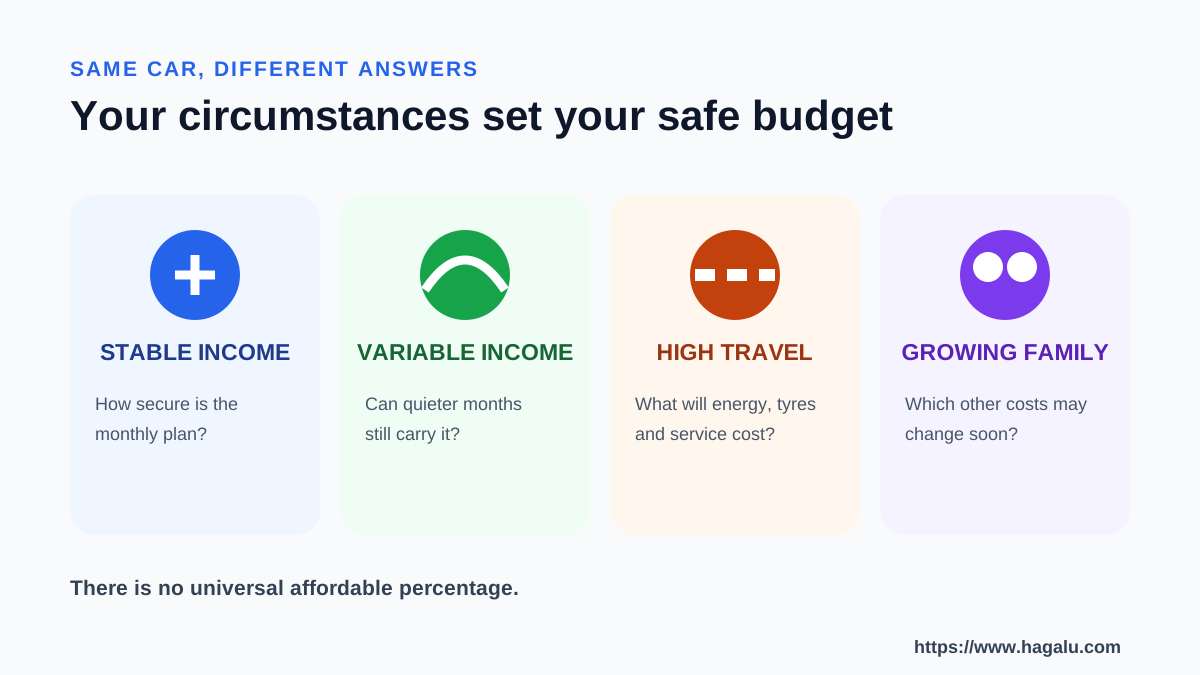
Four household cards showing how stable income, variable income, high travel and a growing family can produce different safe car budgets
The same car can fit one household and strain another. Test income stability, travel and likely family costs before choosing a ceiling. On a phone, swipe the diagram sideways to read it at a larger size. Open full-size image · Hagalu Editorial Studio · image usage terms
Income is not spare money

Begin with take-home pay and real obligations

Gross salary is not what reaches the bank. Start with average take-home income, especially when overtime or commission changes. Subtract housing, food, utilities, transport already used, education, dependants, existing debt and other commitments honestly.

Then set aside savings and a buffer before giving money to a car. A calculator that ignores irregular school costs, medical needs or family support can produce a precise-looking answer that is wrong for your household.

  • Use a cautious three-month income average when earnings vary.
  • Include existing credit obligations and realistic living expenses.
  • Keep savings as a budget line, not whatever accidentally remains.
Find the real instalment space

Subtract car costs that are not the loan

Insurance, fuel, parking, tolls and a maintenance reserve all consume the same monthly income as the repayment. Estimate them first. The amount left inside your total transport allowance is the maximum planning instalment—not the entire allowance.

The calculator then works backwards from that instalment using a deposit, interest rate, term and balloon assumption. Longer terms or larger balloons can inflate the apparent purchase ceiling while increasing risk or total interest.

  • Get a personal insurance quote before trusting the ceiling.
  • Estimate fuel from your kilometres and a cautious consumption figure.
  • Test a higher interest rate and fuel price before accepting the result.
Approval is not comfort

Use the lender result as a gate, not a target

A credit provider must assess affordability, but an approval does not know every personal goal or future expense. You may legally qualify for more debt than feels comfortable while saving for a home, supporting family or planning a change in work.

Compare formal quotations with identical price, deposit, rate type, term and balloon. Read the total amount repayable and all fees. If a salesperson focuses only on lowering the monthly amount, ask what changed elsewhere in the agreement.

  • Never misstate income or obligations to obtain approval.
  • Ask whether the rate is fixed or linked and how payments can change.
  • Walk away from guaranteed-approval promises or unexplained upfront fees.
Take this with you

Inputs to collect before calculating

Tick each item before deciding

  • Average monthly take-home income after deductions.
  • Essential living costs, dependants and current debt payments.
  • Desired monthly saving and emergency-buffer amount.
  • Personal insurance quote and realistic monthly kilometres.
  • Deposit that does not empty emergency savings.
  • Interest-rate range, term, fees and any balloon amount.
No jargon test

Words on this page, made simple

Derivative
The exact version of a model—its engine, gearbox and equipment—not merely the badge on the boot.
ESC
Electronic stability control. It can brake individual wheels to help the car follow the driver's intended path during a skid.
ISOFIX
Built-in metal anchor points used by compatible child seats. The vehicle and child-seat manuals must still agree.
Payload
The combined weight the vehicle may carry, including people, bags and accessories.
Braked towing limit
The heaviest trailer the vehicle may tow when that trailer has its own working brakes.
Tow-ball limit
The most downward weight the trailer may press onto the vehicle's towbar connection.
Gross combination mass
The highest allowed total weight of the loaded vehicle and loaded trailer together.
PHEV
A plug-in hybrid: it has a battery that can be charged from an external plug as well as an engine.
Principal
The money borrowed before interest and finance fees are added.
Balloon payment
A large part of the debt deliberately left for the end of the finance agreement.
Annualise
Turn an irregular cost into a yearly amount, so monthly and occasional bills can be compared fairly.
How the list was built

Method, eligibility and limits

  1. This is an educational planning tool, not credit approval or financial advice.
  2. The calculator starts with a user-set total car allowance and subtracts non-loan ownership costs.
  3. The remaining instalment is converted to an estimated finance principal using the entered rate, term and balloon.
  4. Deposit is added only after preserving a separate emergency reserve.
  5. The fixed low-price example set is filtered in your browser to entries at or below the calculated ceiling; it is not a personalised recommendation and every result still requires a formal quote.
Straight answers

Questions people actually ask

What does a R5,000 monthly car budget cover?

If R5,000 is your entire car budget, it must cover insurance, fuel or charging, upkeep, licensing, parking and a reserve as well as finance. This guide's hypothetical R3,000 non-loan allowance leaves R2,000 for the instalment. Replace those allowances with your own quotes and travel costs.

How much of my salary should go to a car in South Africa?

There is no universal safe percentage. Households with the same income can have different rent, debt, dependants and travel. Build a complete budget and choose a total car allowance that leaves savings and headroom.

Does this calculator guarantee car-finance approval?

No. It is a planning scenario. A registered credit provider performs its own assessment using verified income, expenses, debts, credit history and agreement details.

Should insurance be included in affordability?

Yes. Comprehensive cover may be required for a financed car and the premium can vary greatly by driver, location, use and vehicle. Obtain a personal quote.

Does a balloon payment make a car more affordable?

It lowers earlier instalments by leaving a lump sum for the end, but the debt remains and interest is generally charged according to the agreement. Stress-test how you would settle it.

Is a longer finance term better?

It usually lowers the monthly instalment but can increase total interest and keep you in debt longer. Compare the total amount repayable using identical other inputs.

What if the calculator leaves no room for an instalment?

Do not force the result. Reduce the total car cost, improve the deposit without draining reserves, lower other obligations where safely possible, or wait and save.

Evidence before excitement

Sources and checking method

Hagalu keeps the detailed evidence ledger, checking dates and source links in its internal editorial record. Buyer-facing pages show Hagalu's conclusions without promoting third-party vehicle websites.

Prices, equipment and availability can change after publication. Ranked model cards link their recorded vehicle source when one is available; the broader sources above explain market, legal or calculation context. Always verify the exact derivative in a current OEM document and written dealer quotation.

Guide library Choose another plain-language guide
Browse 41 guides
Buying Cheapest New Cars in South Africa A live price-ranked shortlist that separates the advertised car price from the complete monthly cost. Buying Cheapest Automatic Cars in South Africa The least-expensive qualifying automatic derivatives, with gearbox type and exact variant price kept together. Running Costs Most Fuel-Efficient Cars in South Africa Comparable petrol, diesel and non-plug-in hybrid consumption with clear unit checks and fuel-cost maths. Family Cars Best SUVs Under R500,000 Live-price SUV candidates assessed for family fit, safety checks, road use and whole monthly cost. Family Cars Best 7-Seater Cars in South Africa Verified seven-seat derivatives with honest third-row access, luggage and child-seat trade-offs. Finance How Much Car Can I Afford? An inverse affordability calculator that subtracts real ownership costs before estimating a safe car-price ceiling. Ownership Total Cost of Owning a Car in South Africa A complete monthly and annual ownership calculator for finance, fuel, insurance, tyres, service and licensing. Buying Best First Cars in South Africa A beginner-first starter list with recorded safety basics, visibility checks, easy controls and personal insurance quotes. Launches Upcoming Cars in South Africa by Brand A live brand-by-brand directory separating upcoming catalogue models, source-backed launch trackers and monitored research candidates. Launches Upcoming Toyota Cars: Confirmed vs Rumoured A fact-checked Toyota tracker separating global reveals from confirmed South African launches. Budget Best Cars Under R400,000 Budget picks linked to live model prices and EMI calculators. Finance How Vehicle Finance Works in South Africa Plain-language guide to deposits, interest, loan terms, balloon payments and total repayment checks. Prices Car Prices South Africa Full new-car price guide by budget, brand and body type. Market SA Car Sales 2025 Official full-year market totals, sector movement, exports and practical buyer lessons. Technical Drivetrain Guide FWD, RWD, AWD, 4x4, monocoque and ladder-frame explained for SA roads. Engine Technology Engine Technology Library Plain-language engine badges, diesel systems and ownership basics for any market. Engine Technology CRDe Engine Explained Common-rail diesel fuel flow, benefits, drawbacks, fuel care and warning signs. Engine Technology TDCi Engine Explained How turbocharging and common-rail injection work together in Ford TDCi engines. Launches Suzuki South Africa 2026 Tracker What actually launched, what is already on sale and what remains unconfirmed in South Africa. Comparison New 4th-Gen Swift vs Old 3rd-Gen Swift Used-versus-new Swift decision guide for South African buyers. Suzuki Is the Suzuki Fronx a Hybrid? Local Fronx hybrid fact-check, official prices, fuel-use maths and a confirmed Suzuki alternative. Launches Upcoming Ford Cars in South Africa Everest Tremor and Ranger Super Duty timing checked against Ford South Africa's own announcements. Launches Upcoming Volkswagen Cars in South Africa The second-generation T-Roc launch window and T7 Multivan Caravelle pre-order status, without treating them as the same step. Launches Upcoming Chery Cars in South Africa Chery Q launch facts and the Tiggo V's official local preview kept separate from unannounced timing and prices. Technical Hybrid vs Plug-in Hybrid vs Electric Global guide to choosing between HEV, PHEV and electric power using your charging access, journeys and ownership costs. Ownership Home EV Charging Global guide to wallboxes, charging time, electricity costs and the checks to make before installation. Variant choices Geely E5 EM-i Aspire vs Apex: Which Should You Buy? Compare the E5 EM-i Aspire and Apex in South Africa: live grade prices, shared PHEV hardware, worthwhile upgrades and the safety checks before ordering. Variant choices JAC T9 Lux, Super Lux and Hunter: Grades Explained Choose a South African JAC T9 by grade and drivetrain. Compare live Lux, Super Lux and Hunter prices, equipment, power claims and real work requirements. Variant choices Coolray Nova vs Vanguard vs Vertex: Where to Spend A South African Geely Coolray grade guide: live Nova, Vanguard and Vertex prices, the safety-led upgrade decision and features to check on the exact car. Powertrain decisions Geely E5 Electric vs E5 EM-i: Two Different Choices E5 Electric or E5 EM-i in South Africa? Compare charging routines, electric range, petrol flexibility, boot space and live prices without mixing the models. Practical shortlists Cars with AEB Under R400,000 in South Africa A carefully checked starting shortlist for automatic emergency braking under R400,000: exact South African grades, current catalogue prices and fitment caveats. Practical shortlists High-Ground-Clearance Cars Under R400,000 South African cars below R400,000 with useful published ground clearance. Compare exact grades, load-condition caveats and the limits of a clearance number. Practical shortlists Seven-Seater Boot Space with Every Seat in Use What fits behind the third row? Read seven-seat luggage figures with the right seat position, measurement method and a practical family packing test. Running costs EV vs Petrol Running-Cost Calculator: South Africa Compare petrol and EV energy costs using your kilometres, fuel price, wall consumption and home/public tariffs. Editable estimates with clear assumptions. Running costs Does a PHEV Make Sense Without Home Charging? A practical PHEV decision for South Africans without a home charger: workplace access, public charging costs, fuel-only use and when a full hybrid fits better. Running costs When Does a Hybrid Recover Its Higher Price? Calculate fuel-only hybrid payback from your purchase-price gap, distance and consumption. See when savings recover the premium—and when they cannot. Work vehicles Single-Cab Bakkies for a Small Business Choose a South African work bakkie around cargo, crew, downtime and quotes. JAC, Foton and established alternatives assessed without unsupported reliability rankings. Work vehicles Payload vs Towing Capacity: The Weight You Can Use Understand bakkie payload, GVM, GCM, axle limits and tow-ball load with worked examples. Avoid adding maximum payload to maximum towing without checking both. Work vehicles Single Cab vs Double Cab: Choosing for Work A work-first single-cab versus double-cab decision: crew seats, load length, payload, daily access, family use and the cost of needing a second vehicle. Ownership confidence Warranty vs Service Plan vs Maintenance Plan Understand South African car ownership cover: defects, scheduled services, wear items, exclusions, expiry, transfers and the questions to put in writing. Ownership confidence Buying a Newer Car Brand: The Parts and Service Check A South African checklist for buying a newer car brand: workshop access, parts lead times, insurance, repair support and written ownership-cover evidence.