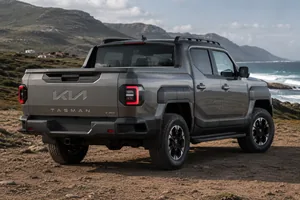
The Kia Tasman entered South African retail sale in 2026 with six named double-cab derivatives. LX and LX Colour Coded are rear-wheel drive. SX and X-Pro, each also offered with colour-coded fenders, use part-time four-wheel drive with high and low range. Every derivative combines a 2,151 cc four-cylinder common-rail turbodiesel with an eight-speed automatic, producing 154 kW at 3,800 rpm and 440 Nm from 1,750-2,750 rpm. Official combined consumption is 7.5 L/100 km for LX 2WD and 7.8 L/100 km for the four-wheel-drive grades.
It is a full-size working double cab: 5,410 mm long, 1,930 mm wide and built on a 3,270 mm wheelbase. Kia publishes 1,123 kg payload for LX and 1,008 kg for SX and X-Pro, plus a 3,500 kg braked and 750 kg unbraked towing limit. The load box holds 1,212 litres on LX and 1,173 litres on SX/X-Pro. Four disc brakes, double-wishbone front suspension and a leaf-sprung rigid rear axle underline its work-and-tow brief.
LX rides on 265/65 R17 tyres and is the price-led 2WD. SX adds part-time 4WD, selectable Snow, Mud and Sand terrain modes, more driver assistance, front parking sensors and the 12.3-inch display. X-Pro moves to taller 265/70 R17 all-terrain tyres, raises clearance to 252 mm, improves the approach, breakover and departure angles, adds Rock mode, a locking rear differential, underbody protection, heated seats, leather and an eight-speaker system. All derivatives publish an 800 mm wading depth; that number is a maximum capability claim, not permission to enter moving or unknown water.
The range carries a five-year/unlimited-kilometre warranty and six-year/90,000 km service plan. Those current terms, along with 154 kW, 440 Nm and 7.5/7.8 L/100 km, replace stale pre-launch records. The standard and colour-coded versions within each grade share the same engine and drivetrain; the extra price is for the exterior treatment, not extra capability.
Grade choice changes the geometry as well as the equipment. LX has 231 mm clearance; SX has 224 mm; X-Pro has 252 mm. LX and SX publish 28.9-degree approach, 23.7-degree breakover and 25.0-degree departure angles, while X-Pro improves those to 32.2, 25.8 and 26.2 degrees. The X-Pro's taller tyres are therefore part of a measurable capability change, not only a styling package. Ground clearance is the default manufacturer figure; Kia does not publish a separate value with every seat occupied, so Hagalu keeps that loaded measurement explicitly undisclosed.
Cabin and load-box numbers should be read together. Front headroom is 1,044 mm and rear headroom 1,004 mm. Fixed-rear-seat versions publish 915 mm rear legroom; the adjustable rear arrangement reaches 940 mm at maximum. LX offers a 1,573 x 1,600 mm box and 1,212-litre VDA capacity. SX and X-Pro use a 1,512 x 1,572 mm box with 1,173 litres. A colour-coded derivative does not alter those measurements, drivetrain or payload.
A tow rating is not a promise that every heavy trailer can be attached while the vehicle is also fully loaded. The driver must reconcile kerb mass, payload, passengers, accessories, tow-ball download, GVM and the 6,200 kg gross combined mass. Kia publishes 350 kg maximum tow-ball download. A canopy, drawer system, replacement bumper or recovery equipment consumes payload before people and cargo are counted. The same discipline applies off-road: 800 mm is a controlled maximum wading claim, while depth, flow, hidden holes, entry speed and water-ingestion risk can make a shallower crossing unsafe.
Ownership comparison should use the current retail price, exact derivative, five-year/unlimited-kilometre warranty and six-year/90,000 km service plan. A temporary monthly promotion is not the cash price and depends on deposit, term, rate and residual. Fuel claims are comparison numbers, not guarantees. For a work vehicle, downtime support, dealer access on the intended route, tyre replacement cost and insurance for accessories deserve the same attention as headline output.