Van Diesel Manual RWD 2-seat

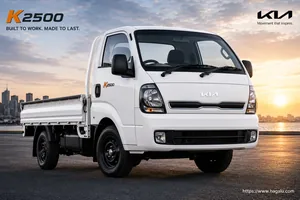
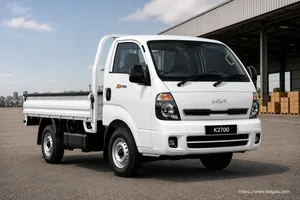
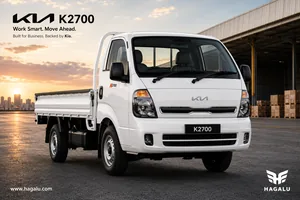
KIA K2700

Price in South Africa, real specs & fuel economy — 2026

Model year 2026 Generation Long-running light commercial vehicle; established in SA commercial fleet market Current version 2012 Body style Van
KIA's light commercial K2700 is South Africa's workhorse truck — available in Chassis Cab, Workhorse, Workhorse Aircon and Tipper configurations, it underpins municipal fleets, agricultural operations and urban delivery businesses across the country.
ZAR 404,995
On-road in
ZAR 420,854
Ex-showroom ZAR 404,995
Finance estimate from ZAR 6,158/month Based on 2.7D Chassis Cab Ex-showroom basis · approx. 20% deposit · 11.5% p.a. · 60 months · no balloon
Engine:2665cc (2.7L) Torque:152Nm (112 lb-ft) Ground Clearance:195mm (7.7″) Power:56kW (75 bhp) Boot3000L (105.9 cu ft)

Hover or tap any pill for a plain-English explanation. Bracketed values show common equivalents (bhp, lb-ft, inches, cu ft).

Fuel Economy km/l · US mpg equivalent
Combined 10.5 km/l (25 mpg)
City 9.1 km/l (21 mpg)
Highway 11.8 km/l (28 mpg)

On-road pricing varies by dealer. Fuel figures are manufacturer claims or source-backed estimates where a separate city/highway cycle is not published; your real numbers depend on traffic, terrain and driving style.

Model Range PDF
₿ Pay with crypto BTC · ETH · USDT · USDC
Estimate monthly vehicle finance for the KIA K2700 in South Africa. The default illustration uses the ex-showroom price, approximately 20% deposit, 11.5% nominal annual interest over 60 months and no balloon payment.

Estimated monthly instalment
ZAR 6,158
Total Interest
ZAR 89,476
Total Payable
ZAR 369,476
Principal Interest

* Illustrative estimate based on the ex-showroom price, approximately 20% deposit, 11.5% nominal annual interest, 60 months and no balloon payment, using the 2.7D Chassis Cab. Excludes initiation fees, monthly service fees, credit-life insurance and vehicle insurance. Your lender quotation may differ.

Source-backed vehicle data • Verified by the Hagalu team

KIA K2700

KIA's light commercial K2700 is South Africa's workhorse truck — available in Chassis Cab, Workhorse, Workhorse Aircon and Tipper configurations, it underpins municipal fleets, agricultural operations and urban delivery businesses across the country.

The KIA K2700 is not a vehicle you buy because you want to. You buy it because you need it to work, every day, in conditions that make the morning commute appear pleasant by comparison. Municipal waste collection runs through Johannesburg's townships, agricultural supply deliveries across Limpopo's farming communities, building material transport across the East Rand's industrial zones, tipper work on Free State farms and mining town construction sites — these are the operational contexts for which the K2700 was designed, and in which its defining quality is not excitement or technological sophistication but the unglamorous excellence of continuing to function without drama when other vehicles would be parked for unscheduled repairs. The K2700 has been part of South Africa's commercial vehicle landscape for decades, accumulating a track record for mechanical durability that drives fleet procurement decisions in municipal governments, agricultural cooperatives and construction businesses with the same quiet persistence that Toyota's Hilux reputation drives private vehicle choices. Fleet managers at South African municipalities — from Cape Town's City Bowl service depots to Ekurhuleni's waste management operations, from eThekwini's municipal services to Mangaung's infrastructure department — have specified the K2700 in consecutive procurement cycles precisely because it does not surprise them. In commercial fleet management, the absence of unpleasant surprises is more valuable than any individual feature on a specification sheet. The 2.7-litre J2 diesel four-cylinder is the engine around which the K2700's commercial value proposition is built. Producing approximately 59kW and 160Nm — modest numbers measured against passenger vehicle benchmarks — it is engineered for the actual requirements of commercial application: sustained reliability under continuous load operation, straightforward maintenance accessible to the wide range of technical competencies that service South African commercial fleets, and a fuel consumption profile that makes operational cost sense when multiplied across a fleet of ten vehicles each covering 150,000km over five years of daily commercial use. The J2's architecture is deliberately conventional rather than progressively efficient. It avoids the complex common-rail injection systems and sophisticated turbocharger configurations that provide efficiency and performance advantages in controlled environments but introduce repair complexity and parts cost in remote locations, informal workshop settings and municipal vehicle depots where technical staff maintain dozens of different vehicle types simultaneously. In a country where a significant proportion of commercial vehicle maintenance is performed outside manufacturer-authorised workshops — by mechanics in township informal repair areas, by farm workshop technicians in the Northern Cape and North West, by municipal vehicle depots whose technical teams prioritise operational continuity over warranty compliance — the K2700's engineering accessibility is not a technological concession but a commercial virtue of the highest order. South African K2700 configurations address distinct commercial use cases with a specificity that reflects deep understanding of the actual operations they serve. The Chassis Cab at R351,995 provides the base platform for operators who need to mount custom bodies: refrigerated panel vans for pharmaceutical distribution, mobile workshop conversions for utilities maintenance fleets, specialised cargo platforms for materials handling, and communication equipment mounting for municipal and emergency services. The Chassis Cab is the K2700's most versatile commercial expression precisely because it is the least complete one — it provides the structural and mechanical foundation for an operator-specific body rather than constraining the use case with a factory finish. The Workhorse at R359,995 provides a flat load bed with drop-side panels for general cargo applications. Drop-sides that lower on three of four sides create the full access geometry that manual loading from multiple approaches requires. This is not a detail irrelevancy — the practical difference between a three-sided drop and a tailgate-only configuration is measurable in loading time, loading safety and operator fatigue over a full shift. The K2700 Workhorse's drop-side arrangement is designed for the actual human beings who load and unload it, not for the specification sheet. The Workhorse Aircon at R375,995 adds driver cab air conditioning. In South Africa's commercial vehicle context this requires specific justification rather than assumption of premium preference. Gauteng summer temperatures regularly exceed 38 degrees Celsius with humidity levels that make unairconditioned cab conditions a genuine physiological safety concern over extended operating shifts. Limpopo's bushveld summer heat is more intense and sustained. The Northern Cape's desert conditions in February are extreme by any standard. Driver heat stress in unventilated commercial vehicle cabs affects alertness, physical well-being and long-term driver health in ways that responsible fleet operators now incorporate into duty-of-care obligations. The R16,000 premium for the Aircon variant measured against the driver welfare outcomes it enables is defensible on both human resource and operational safety grounds. The Workhorse Tipper at R404,995 adds a hydraulic tipping mechanism. Hydraulic tipping in the sub-R410,000 commercial vehicle price bracket is genuinely unusual — most tipper vehicles with meaningful payload capacity are priced substantially higher. Construction contractors managing site clearance and aggregate delivery, agricultural operations moving grain, sand and soil, municipal services handling rubble and material removal, and civil engineering projects requiring high-cycle tipping operations all find the K2700 Tipper's capability-at-price positioning commercially compelling. The hydraulic mechanism's simplicity — powered by the vehicle's power take-off, operated by a cab-mounted switch — is aligned with the K2700's general maintenance-accessibility philosophy. KIA's commercial vehicle warranty of five years with three-year roadside assistance covers all K2700 configurations. For fleet operators, this warranty functions as an operational cost certainty instrument. Knowing that major mechanical failures within five years are manufacturer-covered allows fleet managers to construct total cost of ownership models with a degree of financial certainty that unwarranted vehicle ownership cannot provide. The three-year roadside assistance covers the operational gap between roadside failure and dealer workshop repair that is particularly significant for commercial vehicles operating beyond urban centres — the K2700 working forty kilometres from Rustenburg or sixty kilometres from Louis Trichardt needs roadside support infrastructure as much as mechanical reliability. Fleet finance accessibility for the K2700 is strong. South African commercial vehicle financiers — WesBank, Absa Vehicle Finance, Wesbank Fleet, Stannic — have long experience with the K2700's collateral profile. Fleet procurement rates reflect the vehicle's established residual value track record in the South African commercial vehicle secondary market. Government and municipal procurement through the existing supply chain approval processes is straightforward because the K2700 has been on approved supplier lists for extended periods across multiple procurement cycles. The competitive field includes Hyundai H100 and H150 derivatives, older-format Nissan NP300 commercial applications, Tata Super Ace variants and an increasing presence of Chinese-origin light trucks including BAIC, Foton, Dongfeng and JAC. Against Hyundai products, the K2700's advantage is KIA's South Africa-specific parts depth and the fleet procurement track record that makes the vehicle the familiar choice for every government procurement agent and municipal fleet manager in the country. Against Chinese-origin alternatives, the advantages are after-sales support infrastructure depth, warranty backing credibility and the risk-averse procurement culture of South African government and parastatal fleet buyers who represent a significant portion of the K2700's total market volume. The K2700 is a vehicle that does not need to be sold with enthusiasm. It needs to be specified with precision. Fleet managers who run commercial operations in South Africa already know the K2700. Their evaluation is not "should we consider the K2700?" — it is "how many units do we need this procurement cycle and which configurations suit our current operational requirements?" That is the highest form of commercial vehicle market positioning: the vehicle that occupies the default position in its buyers' operational vocabulary, where consideration requires justification for the alternative rather than for the K2700 itself. The K2700's total cost of ownership in South Africa's public sector fleet context — where government and municipal procurement accounts for a material percentage of the vehicle's annual sales — is evaluated against Government Fleet Management guidelines that specify maximum procurement pricing, minimum warranty requirements and approved vehicle categories. The K2700 has been on the National Treasury's approved vehicle list for government procurement for extended periods, and its pricing across the Chassis Cab through Tipper configurations sits within the procurement thresholds applicable to light commercial vehicles used in municipal service and government maintenance departments. This approved status simplifies procurement bureaucracy for government fleet managers and reduces the tender documentation burden versus specifying a vehicle not on the approved list. The K2700's engine service interval economics over a commercial fleet's 300,000km lifecycle require examination. At KIA commercial dealer scheduled service intervals — based on the J2 diesel's maintenance schedule — a K2700 requires approximately twelve services over 180,000km at standard 15,000km intervals. At KIA commercial dealer pricing for J2 diesel maintenance, the total scheduled service cost over this distance is lower than comparable European-origin light commercial vehicles whose authorised labour rates and parts pricing reflect higher overhead structures. For municipal and government fleet cost-benefit analyses that include lifecycle maintenance cost projections, the K2700's lower authorised maintenance cost structure is a measurable procurement advantage that appears in the total cost of ownership calculation rather than just in the purchase price comparison. South Africa's increasing focus on fleet vehicle telematics integration — GPS tracking, driver behaviour monitoring, fuel consumption reporting — as part of municipal and commercial fleet management best practice is compatible with K2700 integration. Third-party telematics devices including Ctrack, Hino Telematics (Cross-brand), MiX Telematics and DigiCore can be installed in K2700 vehicles through standard OBD port and wired power connections, enabling real-time location tracking, driver behaviour scoring and fuel consumption monitoring that fleet managers use to reduce operating costs and improve operational visibility. The K2700's electrical architecture accommodates standard telematics device installation without specialist modifications. The K2700's position in South Africa's solid waste management sector deserves specific documentation. South African metropolitan municipalities — City of Johannesburg, eThekwini Metropolitan, City of Cape Town, Tshwane, Ekurhuleni and Buffalo City — operate refuse collection fleets that include K2700 Workhorse variants adapted for refuse collection support roles. While the Workhorse body is not a dedicated refuse compactor, it serves waste management departments in collection support, skip transport, recyclable material aggregation and small-volume waste transfer roles that the larger refuse compactor trucks do not serve cost-effectively. At municipal procurement pricing — where volume purchasing agreements create pricing below standard retail — the K2700's total fleet cost per unit makes it the accessible option for waste management departments that need to expand collection support capacity without the capital expenditure of full-size refuse vehicles. The K2700's specific suitability for South Africa's spaza shop and informal retail supply chain is a commercial application that the vehicle's manufacturer promotional material understates relative to its actual market penetration. Spaza shop suppliers in South Africa's township economies operate distribution networks that carry ambient food products, beverages, cleaning supplies and general merchandise from formal wholesalers to informal retail outlets. The K2700 Workhorse's flat deck, drop sides, compact dimensions for township street navigation and low fuel cost per kilometre create an appropriate vehicle profile for these distribution operations. In Soweto, KwaMashu, Khayelitsha, Mamelodi and the township commercial environments of South Africa's secondary cities, the K2700 is a common sight precisely because its operational economics align with the thin-margin distribution economics of informal retail supply. The K2700's production longevity — the model has been in continuous South African production and specification for approximately twenty-five years across its lifecycle — has created a spare parts ecosystem that extends well beyond KIA's authorised parts network. Independent parts suppliers, motor factors and online retailers stock J2 diesel engine components, clutch assemblies, brake components and body parts for the K2700 at prices that provide commercial operators with repair cost flexibility. This ecosystem depth is not replicated for newer or lower-volume commercial vehicles, and it represents a long-term ownership cost advantage that is invisible in new-vehicle purchase comparisons but material across a commercial fleet's ownership lifecycle. The K2700's position in South Africa's non-governmental organisation (NGO) and community development vehicle fleet context is worth acknowledging. NGOs operating in South Africa's rural and township communities — health outreach, agricultural development, education support and community services organisations — operate vehicle fleets under budget constraints that prioritise reliability and maintenance accessibility over specification or comfort. The K2700 appears in NGO fleet inventories for community outreach programmes, agricultural field support operations and rural clinic supply chains precisely because its maintenance cost predictability, repair accessibility in areas without authorised KIA dealers and the commercial vehicle tax treatment of NGO fleet assets align with the operational and financial requirements of non-profit operations in South Africa's development sector. The K2700 Chassis Cab's bodybuilding compatibility with South African specialist body manufacturers is supported by KIA South Africa's chassis specification documentation that Chassis Cab buyers receive at purchase. The chassis specification includes mounting point dimensions, payload distribution calculations, cab-to-axle measurements and electrical integration guidelines that body manufacturers use to design and build custom bodies that are correctly matched to the K2700's chassis capabilities. South African body manufacturers including SA Truck Bodies, GRP Trailer Manufacturers, Serco and various specialist fabricators are familiar with the K2700 Chassis Cab's specification and have built custom bodies for municipal, agricultural, cold chain and specialised cargo applications. The documentation support that facilitates this bodybuilding relationship is a practical aspect of the K2700 Chassis Cab ownership experience that commercial operators who intend to body it should confirm is current and complete at the time of their purchase.

KIA K2700 — Quick Facts

KIA K2700 Variants & Prices

Pick up to 3 variants, hit Compare Variants and you'll get a proper side-by-side spec breakdown.

Maximum 3 variants reached
Uncheck one of the selected variants below before choosing another.
Cmp Variant Trim Fuel Transmission Price
2.7D Chassis Cab Base Diesel Manual ZAR 351,995
2.7D Workhorse Mid Diesel Manual ZAR 368,995
2.7D Workhorse Aircon Top Diesel Manual ZAR 384,995
2.7D Workhorse Tipper Flagship Diesel Manual ZAR 404,995
Cmp Variant Trim Fuel Transmission Price
2.7D Chassis Cab Base Diesel Manual ZAR 351,995
2.7D Workhorse Mid Diesel Manual ZAR 368,995
2.7D Workhorse Aircon Top Diesel Manual ZAR 384,995
2.7D Workhorse Tipper Flagship Diesel Manual ZAR 404,995
2 variants selected

KIA K2700 Specifications

Length
4870 mm
Width
1840 mm
Height
2060 mm
Wheelbase
2685 mm
Ground Clearance (Default)
195 mm
Ground Clearance (With Full Seating Load)
145 mm
Fuel Tank Capacity
70 l
Boot/Cargo Space
3000 l
Kerb Weight
1880 kg
Gross Vehicle Weight (GVW)
2850 kg
Payload Capacity
1300 kg
Towing Capacity
1180 kg
Seating Capacity
2 seats
Number of Rows
1 rows
Doors
2 doors
Minimum Turning Radius
11.4 m
Front Headroom
1010 mm
Rear Headroom
Not Applicable
Front Legroom
1040 mm
Rear Legroom
Not Applicable
Driving fit

Where the KIA K2700 Fits Best

A practical view of the buyer and roads this model is best suited to.

Who buys this

Municipal fleet; agricultural operation; construction contractor; urban delivery business; government procurement; fleet operator needing reliable, repairable light commercial truck. For the Kia K2700, the best buyer is someone who can match the vehicle to a known routine instead of shopping only by advertised price or exterior style.

City
Good — compact dimensions navigate urban delivery routes and municipal service areas effectively. For the K2700, city use also means potholes, tight shopping-centre ramps, speed humps, heat-soaked traffic and short trips where fuel use can rise. The most comfortable derivative is the one that combines the right gearbox response, seating position and parking support with tyre sizes that do not punish everyday surfaces.
Highway
Adequate — 59kW limits freeway speed; suited to urban and peri-urban commercial radius. A buyer who drives between provinces or carries family on holiday should also consider noise, seat support, spare-wheel arrangements, overtaking response and how confidently the vehicle holds speed when loaded. Those details often separate two trims that look similar on paper.
Off-Road
Good for farm roads and construction site access — robust ladder frame handles commercial terrain. Where rougher roads are part of ownership, the buyer should check tyres, underbody clearance, approach to traction control and recovery practicality before relying on the body style. If the route is mainly tar, comfort and running costs should take priority over unused off-road image.

KIA K2700 — Should You Buy It?

South Africa's most trusted light commercial truck — decades of fleet reliability, simple field-repairable engineering, and configurations from chassis cab to tipper make the K2700 the default commercial fleet specification for municipalities, contractors and agricultural operators.

The K2700 earns its fleet procurement dominance through the accumulated trust of decades of South African commercial operation. It is not the most powerful, most fuel-efficient or most technologically advanced light truck — it is the most reliably functional one at its price point, backed by parts availability, workshop familiarity and a commercial warranty that gives fleet managers the cost certainty they require. The fairest verdict on the Kia K2700 is therefore use-case driven. It can be a strong South African choice when the buyer chooses the correct derivative for the intended mix of city driving, freeway work, passengers, cargo and rough-road exposure. It becomes less convincing when bought only for styling or badge appeal without checking the practical numbers and ownership costs that will matter after delivery.

What's Good
  • Decades of South African fleet service history provides unmatched reliability track record
  • Simple J2 diesel engine architecture enables field repair and informal workshop maintenance
  • Tipper variant at R404,995 provides hydraulic tipping capability at uniquely accessible commercial pricing
  • Chassis Cab configuration enables custom body mounting for specialised commercial applications
  • 5-year commercial warranty with 3-year roadside provides fleet cost certainty
  • Strong parts availability through KIA commercial network across all SA provinces
  • Compact dimensions navigate urban delivery routes and construction site access efficiently
  • Established fleet finance collateral profile streamlines procurement through SA commercial lenders
  • Aircon variant addresses driver heat stress in Highveld and Limpopo operational environments
Watch Out For
  • 59kW output is modest — not suited for sustained freeway operation at commercial loads
  • Cabin comfort is basic commercial-grade — no infotainment, limited refinement
  • Older engine technology is less fuel-efficient than modern common-rail diesel alternatives
  • No automatic transmission option — manual-only for all variants
  • Dated exterior styling reflects long production run without significant visual update
  • Limited payload capacity compared to larger commercial trucks for high-volume operations
  • No passenger comfort features beyond basic cab — unsuitable for mixed passenger/commercial use
  • Technology gap vs newer commercial competitors growing as fleet expectations evolve
  • Single colour (white) limits fleet branding differentiation without additional livery investment

KIA K2700 FAQs

Current recommended retail prices for the KIA K2700 run from R351,995 to R404,995, depending on the derivative. Compare the exact trim before calculating finance because options, insurance and dealer charges can change the final monthly cost.

The current South African range comprises 2.7D Chassis Cab, 2.7D Workhorse, 2.7D Workhorse Aircon, 2.7D Workhorse Tipper. Prices and equipment are shown by derivative so buyers can compare the actual local range rather than specifications from another market.

The listed ground clearance for the KIA K2700 is 195 mm. Use that number as a practical comparison point against similar cars, especially if you regularly deal with steep driveways, gravel roads or uneven parking areas.

The listed engine capacity for the KIA K2700 is 2665 cc, with output shown as 56 kW (75 bhp). Where a model has more than one derivative, compare the specific variant because fuel type, gearbox and drivetrain can change the way it drives.

The combined fuel-economy figure shown for the KIA K2700 is around 10.5 km/l.

Municipal fleet; agricultural operation; construction contractor; urban delivery business; government procurement; fleet operator needing reliable, repairable light commercial truck. For the Kia K2700, the best buyer is someone who can match the vehicle to a known routine instead of shopping only by advertised price or exterior style.

Good — compact dimensions navigate urban delivery routes and municipal service areas effectively. For the K2700, city use also means potholes, tight shopping-centre ramps, speed humps, heat-soaked traffic and short trips where fuel use can rise. The most comfortable derivative is the one that combines the right gearbox response, seating position and parking support with tyre sizes that do not punish everyday surfaces.

Adequate — 59kW limits freeway speed; suited to urban and peri-urban commercial radius. A buyer who drives between provinces or carries family on holiday should also consider noise, seat support, spare-wheel arrangements, overtaking response and how confidently the vehicle holds speed when loaded. Those details often separate two trims that look similar on paper.

Compare KIA K2700 with Similar Vans

Tap any card to see a full head-to-head — specs, scores and a clear verdict on which one's worth your money.

KIA K2700
VS
Hyundai Venue Cargo
K2700 vs Venue Cargo
Petrol Van 1 Variant
Hyundai Venue Cargo from ZAR 309,900
See full specs & who wins →
KIA K2700
VS
Mahindra XUV 3XO Xprez Panel Van
K2700 vs XUV 3XO Xprez Panel Van
Petrol Van 1 Variant
Mahindra XUV 3XO Xprez Panel Van from ZAR 296,999
See full specs & who wins →
KIA K2700
VS
Mahindra S4 Refrigeration
K2700 vs S4 Refrigeration
Diesel Van 3 Variants
Mahindra S4 Refrigeration from ZAR 457,149
See full specs & who wins →
KIA K2700
VS
Volkswagen Caddy Cargo
K2700 vs Caddy Cargo
Petrol Van 3 Variants
Volkswagen Caddy Cargo from ZAR 466,700
See full specs & who wins →

Also Worth Exploring in South Africa

Different body types — refreshed every visit so you discover something new.

Suzuki Across petrol mild hybrid
Suzuki Across
Suv 3 Variants
From R349,900
Toyota Land Cruiser 76 Diesel
Toyota Land Cruiser 76
Suv 2 Variants
From R980,000
Ford Ranger Raptor Petrol
Ford Ranger Raptor
Pickup 1 Variant
From R1,299,000
Renault Duster petrol / mild hybrid
Renault Duster
Suv 3 Variants
From R489,999

Other Current KIA Models in South Africa

Models currently listed for sale in the South African range.

KIA Carens Diesel
KIA
Carens
MPV 4 Variants
Starting from ZAR 399,995
KIA Carnival Diesel
KIA
Carnival
MPV 2 Variants
Starting from ZAR 1,049,995
KIA K2500 Diesel
KIA
K2500
Van 3 Variants
Starting from ZAR 424,995
KIA Pegas Petrol
KIA
Pegas
Sedan 4 Variants
Starting from ZAR 239,995

Data verified against: KIA Official South Africa Website

More from KIA