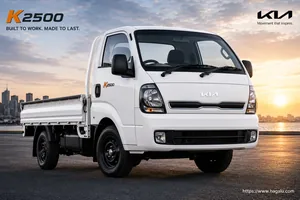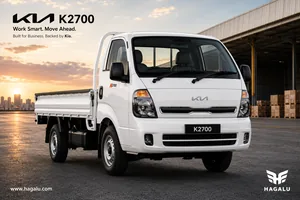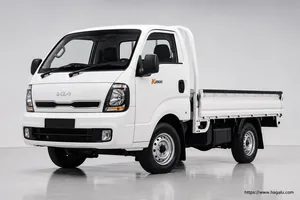
The KIA K2500 occupies the tier above the K2700 in South Africa's light commercial truck segment, providing operators whose payload and power requirements have outgrown the K2700 with a natural upgrade path within KIA's commercial vehicle family. The step up is not merely incremental — the K2500's 2.5-litre turbodiesel, greater gross vehicle mass and Dropside body configuration open commercial application categories that the K2700's operating envelope does not accommodate. The 2.5-litre turbodiesel D4BH four-cylinder produces 80kW and 225Nm. Against the K2700's 59kW/160Nm, this represents a 35 percent power increase and a 40 percent torque increase — numbers that translate into meaningfully different operational capability when the K2500 is loaded to its rated payload on an inter-city delivery route or in a tipper application moving multiple loads per shift. The turbodiesel's improved output moves the K2500 away from the urban-only performance boundary that constrains the K2700, making it practical for the secondary road routes and moderate freeway sections that connect South African cities' commercial districts to their industrial peripheries and surrounding regions. The five-speed manual gearbox is the only transmission available across all K2500 configurations — a commercial vehicle standard that prioritises durability and repairability over driving refinement. For the fleet operators who specify the K2500, transmission choice is evaluated against maintenance cost and operational reliability rather than driving experience criteria. The five-speed manual meets those criteria with the same engineering philosophy that has made the K2700's manual-only offering commercially acceptable for decades. Three configurations address the K2500's commercial use case spectrum precisely. The Workhorse Dropside at R424,995 provides a flat bed with drop-side panels in a format identical in function to the K2700 Workhorse but with greater payload capacity. The Dropside's full circumferential access — side panels and tailgate all dropping independently — creates an unobstructed load bed accessible from any approach direction. This access geometry reduces loading time and loading-induced driver and crew fatigue in high-cycle delivery operations where the vehicle is loaded and unloaded multiple times per shift. The operational context for the K2500 Dropside in South Africa's commercial economy is broad. Plumbing and electrical wholesalers making daily distribution runs from Johannesburg's South and East Rand industrial areas to contractors across the metropolitan periphery. Agricultural cooperatives delivering fertiliser, seed and equipment from regional depots in the Boland, Overberg, North West and KwaZulu-Natal Midlands. Fruit and vegetable traders making daily produce runs from packhouses in Grabouw and Elgin to Cape Town market depots. Building materials suppliers in Polokwane, Emalahleni, Mbombela and Rustenburg servicing the construction activity in South Africa's secondary cities. In each of these operations, the K2500 Dropside's combination of greater payload, side-access convenience and commercial registration advantages makes it the appropriate tool. The Workhorse Dropside Aircon at R444,995 adds driver climate control. The additional R20,000 premium for Aircon over the standard Dropside follows the same operational rationale as the K2700 Aircon variant but applies to a vehicle that is likely operating in higher-payload, longer-route applications where driver exposure to cabin heat is of longer duration per shift. Commercial vehicle operators in Limpopo, the Northern Cape, Mpumalanga and the North West manage fleet assets in climates where mid-shift cabin temperatures without air conditioning are a legitimate driver welfare and operational safety concern. Progressive fleet management practice in South Africa increasingly incorporates driver welfare considerations into vehicle specification decisions, and the Aircon variant's R20,000 premium is one of the most direct investments in driver working conditions available in the commercial vehicle specification process. The Tipper at R460,995 tops the K2500 range with a hydraulic tipping load bed calibrated for the K2500's greater payload capacity. Where the K2700 Tipper moves modest loads of soil, aggregate and rubble appropriate to light construction and maintenance applications, the K2500 Tipper's additional payload capacity makes it appropriate for medium construction projects, municipal bulk material removal operations and agricultural applications where per-load volume needs to be maximised to achieve commercial efficiency. Construction companies managing site preparation and foundation excavation on projects of meaningful scale, municipalities handling road maintenance and stormwater system rehabilitation, and agricultural operations clearing and redistribution large volumes of organic material find the K2500 Tipper's step-up capacity relevant in ways the K2700 Tipper cannot accommodate. KIA's five-year commercial vehicle warranty with three-year roadside assistance creates the fleet cost certainty that enables accurate per-kilometre cost projections across the K2500's operational life. For fleet cost models that are required to project total ownership costs over 60-month or 72-month fleet finance periods, manufacturer warranty coverage eliminates the most uncertain and potentially most expensive cost category from the projection. The three-year roadside assistance covers the operational continuity risk that is most acute for commercial vehicles operating in routes distant from major urban service centres — the K2500 working between Tzaneen and Hoedspruit, the vehicle covering rural construction sites west of Kimberley, the agricultural supply vehicle running routes in the Kalahari basin all benefit from roadside coverage that addresses breakdown scenarios in situations where commercial vehicle repair capability is not immediately accessible. Parts availability for the K2500 through KIA's South African commercial dealer network is supported by the vehicle's long production run and the resulting depth of stock maintained by dealers who service established commercial fleets. The D4BH turbodiesel's architecture, while not representing the most modern commercial diesel engineering available, is sufficiently well-documented in South Africa's commercial vehicle repair ecosystem that roadside and independent workshop repairs are achievable without specialist diagnostic equipment. Fuel injection components, turbocharger units, clutch assemblies and electrical components for the D4BH are available through both KIA's authorised parts network and through the aftermarket supply chain that serves South Africa's commercial vehicle sector. The competitive positioning of the K2500 within South Africa's light commercial truck segment positions it against the Hyundai H150, Tata range, Hino light commercial entries and Chinese-origin alternatives from Foton, BAIC and JAC. Against the Hyundai H150, differentiation centres on brand and dealer network familiarity and the accumulated fleet trust that comes from the K2700's commercial track record — fleet operators who have operated K2700s successfully tend to specify K2500s as the natural upward step. Against Hino at higher price points, the K2500 wins on purchase price accessibility while Hino maintains its specific reputation for diesel longevity in sustained-load applications. Against Chinese-origin alternatives, the K2500's advantages are established commercial track record, warranty backing credibility and the procurement culture of South Africa's risk-averse government, municipal and parastatal fleet buyers who collectively represent a material portion of the commercial truck market's purchasing volume. Commercial vehicle evaluation in South Africa reduces to a practical checklist: Does the vehicle carry the required payload? Does it operate reliably in the conditions we use it in? Can it be repaired when it breaks down in a location far from a dealer workshop? Does the warranty provide commercially defensible cost certainty? Is the total operating cost per tonne-kilometre acceptable against the operational revenue it generates? The K2500 answers each of these questions positively for its intended application envelope. It does so not through technological advancement, premium positioning or aspirational marketing, but through the accumulated evidence of long operational service in South African commercial conditions. That evidence is the currency that commercial vehicle buyers respect most and that no amount of marketing can substitute for. The K2500's role in South Africa's post-load-shedding commercial landscape — where many businesses have invested in generator infrastructure, solar panel systems and backup power equipment — includes a specific application that its payload and flatbed configuration enables: the transport of generator sets, solar mounting hardware and electrical infrastructure components that the construction and installation boom in this sector has generated. Businesses installing commercial-scale solar systems in Cape Town's industrial areas, Johannesburg's commercial precincts and Durban's business parks move components including panel racks, inverter cabinets and cable conduit systems that require the Dropside's open access from multiple sides and the K2500's payload capacity. This use case was less prevalent five years ago; it is now a consistent commercial application for the Dropside variant in South African urban commercial markets. KIA's commercial vehicle after-hours support programme — including the roadside assistance coverage and the emergency parts ordering capability that KIA dealers can activate for commercial fleet operators facing operational emergencies — is increasingly relevant as South African businesses operate extended hours in response to load-shedding's disruption to standard working patterns. A commercial vehicle breaking down at 22:00 on a night shift in a municipality operating extended service hours due to infrastructure backlogs requires after-hours assistance capability that the K2500's three-year roadside assistance provides. The availability of KIA's roadside assistance contact number and the programme's geographic coverage across South African national routes and secondary roads is a fleet management consideration that commercial operators should factor into their operational contingency planning. The K2500's position in South Africa's emerging circular economy logistics sector — the transportation of recyclable materials, e-waste, construction waste and agricultural by-products that the country's recycling and waste management industry manages — represents a growing application for the Dropside and Tipper variants. Recycling operations in South Africa's metropolitan areas, which have grown substantially as commodity prices for recyclable metals and polymers have made collection economics viable, use the K2500's Dropside for collection routes and the Tipper for transfer operations between collection vehicles and processing facilities. The vehicle's combination of adequate payload, accessible maintenance and commercial pricing creates a credible operational tool for the recycling sector's diverse fleet requirements. South Africa's construction sector — which has experienced significant activity driven by infrastructure delivery programmes, private residential development and commercial property investment in secondary cities — creates specific K2500 procurement demand. Construction projects requiring consistent materials delivery — aggregates for foundations, cement for structural pours, sand for plastering, bricks for walling — use K2500 Tippers for site-to-site material movement and supply consolidation. The construction contractor who does not own a concrete mixer truck or a large tipper but needs occasional tipper capability finds the K2500 Tipper at R460,995 the most commercially rational entry to owned tipper capability, avoiding the daily hire cost of rented tipper vehicles that can exceed R2,500 per day on active construction sites. The K2500's structural robustness under South African commercial operating conditions — the repeated loading cycles, the unpaved construction site surfaces, the kerb strikes and tight manoeuvring that characterise urban commercial vehicle operation — has been documented through fleet operators' experience over multiple ownership cycles. Fleet managers at South African companies that have operated K2500s through 300,000km cycles without major structural failures characterise the vehicle's chassis and cab structure as meeting their operational durability expectations. This operational documentation does not appear in specification sheets or press releases but exists in fleet maintenance records and in the procurement decisions of operators who specify the K2500 repeatedly across procurement cycles. The K2500's emission compliance and fuel injection system serviceability at South Africa's independent diesel workshops is an operational consideration for fleet operators who need fuel injection services outside KIA's authorised network. The D4BH turbodiesel's injection system, while a fuel injection pump rather than modern common-rail, is serviceable at any diesel pump specialist with the appropriate calibration equipment. South Africa has a strong independent diesel injection workshop network — particularly in regions like the East Rand, Durban South and the Cape's Bellville industrial corridor — whose technicians are familiar with D4BH injection systems from their service exposure across multiple commercial vehicle models that use related architectures. This independent workshop serviceability reduces the K2500 operator's dependency on authorised dealer proximity for injection system maintenance. The K2500's role in South Africa's agricultural export supply chain — moving produce from farm packing operations to refrigerated trucking collection points — creates specific operational requirements that the Dropside's open-air load configuration must accommodate. Fresh produce destined for export markets (citrus from the Citrusdal and Grabouw valleys, stone fruit from the Hex River Valley, table grapes from the Olifants River Valley, avocados from Tzaneen) is typically packed in standard carton formats that Dropside load beds with standardised pallet dimensions accommodate efficiently. The K2500 Dropside's capacity to carry a standard pallet configuration of agricultural export cartons from packhouse loading dock to cold storage collection point represents a daily commercial activity for dozens of vehicles in South Africa's fruit export regions during harvest seasons that can span three to six months per year. The K2500's adaptation for the South African wine industry's logistics requirements is a specific application in the Western Cape's Winelands region. Wine barrel transport, cellar equipment delivery, bottle and packaging supply distribution between Stellenbosch, Paarl and Franschhoek estates and between the Robertson Valley's bulk wine producers and their blending partners all represent K2500 Dropside use cases that the vehicle's load bed dimensions and drop-side access geometry serve efficiently. The wine industry's premium on careful, clean transport — wine barrels cannot be exposed to contamination, breakable glassware requires gentle handling — requires operators to maintain the K2500's Dropside in clean condition, which is a maintenance discipline that the vehicle's metal drop-side construction and flat load floor facilitate.