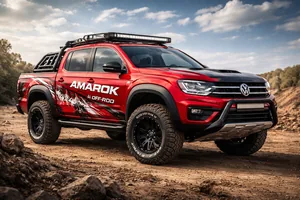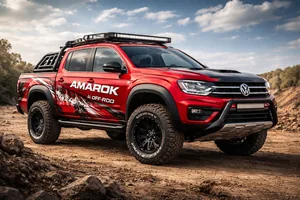
The Volkswagen Amarok occupies a specific place in the South African range: it is designed for a work, towing or leisure buyer who needs to choose cab style, payload, drivetrain and equipment before styling. The current range contains 16 confirmed derivatives, priced from R596 800 to R1 259 700. Those figures are recommended vehicle prices checked on 2026-07-17; finance interest, registration, insurance, paint, dealer accessories and optional plans can change the amount a buyer ultimately pays. The derivative list is SC 2.0 TDI 6MT, SC 2.0 TDI 4Motion 6MT, DC 2.0 TDI 6MT, DC 2.0 TDI 4Motion 6MT, DC 2.0 TDI 10AT, DC 2.0 TDI 4Motion 10AT, DC Life 2.0 TDI 10AT, DC Life 2.0 TDI 4Motion 10AT, DC Style 2.0 TDI 4Motion 10AT, DC Dark Label 2.0 TDI 4Motion 10AT, DC Style 3.0 V6 TDI 4Motion 10AT, DC Dark Label 3.0 V6 TDI 4Motion 10AT, DC PanAmericana 2.3 TSI 4Motion 10AT, DC PanAmericana 3.0 V6 TDI 4Motion 10AT, DC PanAmericana 3.0 V6 TDI 4Motion Comfort Pack 10AT, DC Aventura 3.0 V6 TDI 4Motion 10AT. Reading that list as a price ladder is more useful than treating every version as the same vehicle, because powertrain, drivetrain, seating, tyres and cabin equipment can alter both the weekly experience and the ownership budget.
The current range spans 2.0 TDI manual and automatic derivatives, 4MOTION choices, 3.0 V6 TDI grades and a 2.3 TSI PanAmericana. Dark Label is offered with 125 kW 2.0 TDI and 184 kW V6 TDI power. This engineering spread should define the shortlist before colour or monthly instalment. Buyers should identify the normal passenger count, annual distance, charging access where relevant, towing or luggage requirement and the worst road used in an ordinary month. A powertrain that looks impressive in isolation can be the wrong choice if it raises fuel, electricity, insurance or tyre cost without solving a recurring need. Equally, an entry grade can become poor value when it omits assistance, seating or traction equipment that the owner will need every week.
The current generation context is important. Current second-generation Volkswagen Amarok. 2026 range adds Dark Label derivatives based on the Style grade. A quotation should carry the full derivative name and match the current vehicle rather than relying on a model badge alone. This matters most when a range is moving through a facelift or generation change, because an outgoing vehicle may remain in stock while publicity already shows its replacement. Build date, model year, fitted wheel, infotainment version and standard safety equipment should therefore be checked on the physical vehicle before finance is signed.
Cabin quality in a premium vehicle should be judged through use, not only finish. The driver's seating position, adjustment range, screen placement, physical controls, phone integration and camera view affect every trip. Rear-seat buyers should sit behind their normal front-seat position, test child-seat access where relevant and load the luggage they actually carry. A larger wheel can sharpen appearance while raising replacement cost and reducing impact compliance. Audio, roof, upholstery and parking equipment should be compared derivative by derivative because they are often responsible for large price jumps.
Safety equipment also needs derivative-level reading. The presence of a broad assistance suite does not mean every function behaves identically in local traffic, and a model-family brochure can describe equipment that is optional or grade-specific. Check the exact vehicle for adaptive cruise behaviour, lane support, blind-spot coverage, rear cross-traffic assistance, camera resolution, parking sensors and child-seat anchorage positions. Drivers who regularly travel before sunrise, after dark or through heavy summer rain should include lighting and wiper operation in the test. Assistance systems remain support tools: tyre condition, visibility, braking distance and driver attention still determine the safety margin.
Specification numbers become useful only when connected to a routine. Power and torque describe potential, while kerb mass, gearing, driven wheels and tyre choice influence how easily that potential is delivered. A boot-volume figure should be checked against its measuring method and the shape of the opening. Ground clearance does not by itself prove underbody protection or off-road ability. Claimed consumption is a controlled comparison value, not a promise for a specific commute. Buyers should retain a written copy of the derivative specification and quotation because online equipment and prices can change during a model-year transition.
Ownership arithmetic should use a complete monthly figure. Apply the same deposit, interest rate, term and balloon to every shortlisted derivative, then add insurance, expected energy use, tyres and the service or maintenance cover shown on the sales contract. A lower instalment supported by a large final balloon is not a lower purchase cost. Buyers trading after three or four years should also consider generation timing, market demand for the exact powertrain and whether expensive optional equipment will retain value. The strongest purchase is the derivative that remains affordable under a less optimistic resale or fuel scenario.