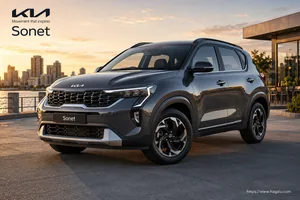
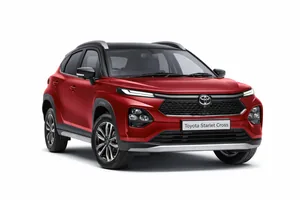
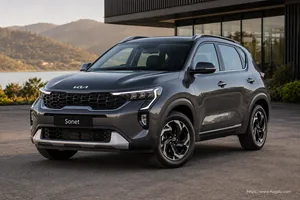
The sub-compact SUV segment is the most contested battlefield in South African automotive retail. The confluence of aspirational SUV aesthetics, compact city-friendly dimensions and pricing that nudges the sub-R400k bracket has created a cluster of competing products — the Renault Kiger, Nissan Magnite, Suzuki Fronx, Toyota Starlet Cross — each fighting for the same buyer who wants an elevated driving position, reasonable ground clearance for South Africa's pot-hole geography and enough technology to feel modern without the R500k-plus price tag of a Volkswagen T-Cross or the complexity of a full compact SUV. KIA's answer is the Sonet. It launched in South Africa in 2021 and updated for the 2023 model year, and it makes a persuasive case at every grade in the range. The design follows KIA's global tiger-nose parametric grille language and Opposites United design philosophy. There is nothing apologetic about the Sonet's visual presence — the bold front fascia, strong character line along the flanks and available contrasting roof treatment on the GT-Line-adjacent grades create a vehicle that reads as significantly more expensive than its entry price. Park a Sonet SX next to a Renault Kiger or Nissan Magnite and the KIA's dimensional solidity and design coherence reads as a size class above. In South Africa's image-conscious urban market, where a vehicle is evaluated on the street as much as on a specification sheet, this visual authority is not irrelevant to a buyer's decision. Two engine options underpin the South African range. The 1.5-litre naturally aspirated G4LC four-cylinder produces 85kW at 6,300rpm and 143Nm at 4,500rpm. Mated to either a six-speed manual or a CVT, the 1.5 NA is the volume engine of the range — specified on LS, LX and base EX grades. Real-world fuel consumption in mixed South African use runs between 6.5 and 7.2 litres per 100km, which at current 95 Octane prices delivers a monthly fuel spend that is genuinely manageable on a middle-income budget. The CVT's continuous ratio adaptation suits South African urban driving conditions particularly well, avoiding the gear-hunting that plagues conventional automatics in the stop-start rhythm of Johannesburg's Sandton, Cape Town's Foreshore or Durban's Berea Road. The 1.0-litre turbocharged G3LC three-cylinder is the more interesting engineering story. Producing 88kW at 4,500rpm and 172Nm from 1,500rpm, this compact turbocharged unit delivers its torque from the low-rev region that makes it punchy in real city traffic — overtaking a minibus taxi on the R55 in Pretoria, punching gaps in Cape Town's N2 Southern Suburbs merge traffic, or squirting through a Soweto intersection in the brief window between light cycles. The 172Nm from 1,500rpm means the Sonet 1.0T pulls without the need to rev-hunt that characterises naturally aspirated small engines in overtaking situations. Paired to a seven-speed dual-clutch transmission on EX+ and SX grades, the 1.0T transforms the Sonet's character from a sensible urban SUV into something that is genuinely engaging to drive on South Africa's national roads. The DCT's occasional low-speed clunkiness — familiar to anyone who has experienced Ford's PowerShift or VW's DSG in urban conditions — is present in the Sonet too, particularly in slow-speed parking manoeuvres where the clutch packs engage and disengage at minimal vehicle speeds. Approach it with light, smooth throttle inputs rather than modulating the brake, and it becomes entirely manageable. At road speeds the DCT is seamless, and the performance it enables transforms the Sonet's personality significantly enough that buyers who try both drivetrains back-to-back rarely choose the CVT when their budget allows the step. Ground clearance of 205mm on the Sonet is the practical measurement that most South African buyers need to understand before they dismiss the sub-compact SUV as unsuitable for their roads. Five minutes of driving in Johannesburg's northern suburbs, East Rand industrial areas or KZN's coastal townships reveals why 205mm matters more than 135mm. Standard speed humps, water-main-disrupted tarmac patches, the drainage culverts that cross suburban roads in Pretoria's older neighbourhoods — all of these require ground clearance that city cars cannot provide. The Sonet's 205mm clears the average speed hump without scraping the front spoiler, handles the gravel driveways of peri-urban developments without the traction anxiety of a low-clearance hatchback and manages the mild off-paving that South African daily life regularly demands without drama. The interior is where the Sonet most aggressively assaults the value perception of its segment. The 10.25-inch touchscreen infotainment system on EX grade and above is legitimately impressive: large, responsive and well-integrated with Android Auto and Apple CarPlay. The SX grade adds wireless connectivity for both platforms — the Sonet SX is one of the few sub-R500k vehicles in South Africa to offer wireless CarPlay, a feature that eliminates the cable management frustration that undermines the daily experience of wired connectivity in practical terms. The fully digital instrument cluster on SX grade. The ambient lighting system. The Bose audio. The ventilated front seats. Each of these is an equipment item that requires double-checking the Sonet SX's price sticker. A Bose sound system in a sub-R490k car is not typical in South Africa — it is the kind of equipment that KIA's global purchasing volume and platform-sharing strategy has made possible, deployed here as a genuine consumer value proposition rather than a badge-engineering trick. The rear seat is genuinely functional in the Sonet rather than the polite fiction it represents in some sub-compact rivals. Unlike the Picanto — whose rear bench accommodates children and small adults for short trips — the Sonet seats three adults in reasonable comfort for urban distances. Legroom behind a 180cm driver is snug but not punishing on a twenty-minute Sandton-to-Rosebank or Claremont-to-Sea Point commute. The rear bench folds 60/40 to extend cargo flexibility; the Sonet is not a dedicated lifestyle vehicle but a genuinely multi-purpose everyday tool for young families and professional couples who need practical versatility without a Seltos-sized footprint. Boot space at 392 litres with rear seats upright comfortably handles weekly grocery shopping, weekend bags for a Cape Town overnight, camping kit for a Drakensberg day trip or the accumulated child-transport paraphernalia of school-age parenthood. The rear seats fold to expand the cargo bay further. The loading lip is modest, which makes heavy items manageable. Safety deserves more than a standard specification listing. The Sonet's six-airbag standard across all grades — including the base LS — is the single most important safety differentiator in the sub-compact SUV class. Several direct competitors still offer two or four airbags on base grades; the Sonet's six are available to every buyer regardless of budget. From EX grade the suite expands to include lane keeping assist, forward collision avoidance, driver attention warning and blind-spot collision warning on SX. The safe exit assist on SX — which prevents door opening if approaching traffic is detected — is a feature with specific value at South Africa's busy urban intersections and narrow suburban streets where cyclist and motorcycle interactions are constant. At R329,995 for the LS through to R489,995 for the SX automatic, the Sonet range spans from genuine value entry to performance-and-technology upper market within the sub-compact SUV category. The LX at R379,995 represents the sweet spot for budget-constrained buyers who want the 1.5 engine without the entry-grade's sparse specification. The EX+ at R449,995 is where the 1.0T DCT and the full technology suite begin — the grade where the Sonet's full competitive advantage over rivals becomes most evident in a side-by-side specification comparison. Against the Toyota Starlet Cross, the Sonet has more airbags, more interior technology at equivalent pricing, and a longer warranty. Against the Renault Kiger, the Sonet has more powertrain choice, more safety equipment and a more genuinely spacious rear seat. Against the Suzuki Fronx, the Sonet's rear seat and boot space advantages are material. Against the Nissan Magnite, KIA's after-sales infrastructure depth and reliability perception in South Africa's fleet and private markets provide meaningful buying confidence advantages that no specification comparison fully captures. The Sonet is KIA South Africa's most successful product in recent years for reasons that a careful reading of its specification and pricing makes transparent. It addresses the South African urban buyer's principal requirements — visual presence, practical daily usability, manageable running costs and the financial security of a seven-year warranty — at a price that has been calibrated to maximum competitive effect. It wins the sub-compact SUV segment on objective measures at nearly every grade and price point in the range. That is the kind of market success that follows from engineering the right product for the right buyer, not from marketing a mediocre one harder. The Sonet's role in KIA South Africa's sales performance over the past three years has been transformative beyond the model itself. Consistent Sonet sales volume has funded the dealer network investments, parts infrastructure expansion and marketing presence that benefits every other KIA model in the South African range. The Sonet has been the product that moved KIA from consideration to decision for tens of thousands of South African buyers who had not previously purchased a KIA — and having made that first KIA purchase with the Sonet, a significant proportion are now in the pipeline for Seltos, Sportage or Sorento as their financial circumstances and family needs evolve. The Sonet is not just a successful product; it is the brand's strategic anchor in the South African market. The turbocharged 1.0T variant's performance credentials deserve more technical grounding than a 0-100km/h figure provides. The 172Nm at 1,500rpm means the Sonet 1.0T is generating near-maximum torque before most petrol engines of similar displacement have reached their torque peak. The practical consequence is that city driving in the 1.0T feels unlike what the displacement suggests: traffic light starts that pull cleanly without needing to rev the engine hard, uphill suburban sections on Johannesburg's northern suburbs' streets that the engine navigates without any throttle anxiety, and freeway on-ramp merges that do not require the committed, risky commitment of a genuinely underpowered small car. It is the kind of performance that earns driver confidence through daily use rather than through impressive numbers on paper. South Africa's motor insurance industry has noted the Sonet's safety equipment package in its pricing models. Vehicles with more airbags and active safety systems (forward collision avoidance, lane keeping assist) attract lower comprehensive insurance premiums from certain insurers than equivalent-priced vehicles with less comprehensive safety specification. For Sonet SX buyers, the full ADAS suite is not only safety equipment but insurance cost-affecting infrastructure — a financial benefit that does not appear on any brochure but does appear on the insurance renewal note. The magnitude of this saving varies by insurer and specific risk profile, but it is measurable and real across multiple major South African motor insurance providers. The Sonet's exterior dimensions — 4,120mm length, 1,775mm width, 1,570mm height — are worth stating as operational specifications for buyers navigating South Africa's built environment. In terms of parking bay compliance, the Sonet fits within standard residential garage dimensions, standard shopping centre parking bay widths and the parallel parking spaces that South African municipalities specify at minimum 2.4m width. The 1,775mm width is the critical dimension for garage users who have built-in shelving or equipment on garage walls — the Sonet fits where a Seltos or Sportage would not. For urban buyers whose ownership experience is partially defined by their daily garage fit or parking space width, the Sonet's compact footprint is a practical daily convenience. The Sonet's role in South Africa's SASSA (South African Social Security Agency) and government departmental procurement has expanded as KIA's approved vehicle list status has improved. Government and municipal procurement of passenger vehicles for official use in the sub-R450k category increasingly includes the Sonet as an alternative to the traditional Volkswagen and Toyota fleet defaults. The Sonet's seven-year warranty — which exceeds National Treasury's minimum warranty requirements for government vehicle procurement — and its service plan inclusion reduce the government fleet department's administrative burden for warranty management and scheduled maintenance cost control. For procurement officers managing large mixed fleets, a vehicle with a seven-year warranty that requires fewer warranty-claim interactions over its fleet life is a lower-administration-cost option than shorter-warranty alternatives. The Sonet 1.0T DCT's performance on South Africa's high-altitude roads deserves specific note. Johannesburg sits at approximately 1,700m above sea level. Pretoria at approximately 1,300m. Bloemfontein at 1,395m. Turbocharged engines are specifically advantaged at altitude compared to naturally aspirated alternatives — their forced induction overcomes the reduced air density that diminishes NA engine output at elevation. The Sonet 1.0T DCT at Johannesburg's altitude delivers performance closer to its sea-level specification than any naturally aspirated competitor, because the turbocharger compensates for the thinner air that cuts NA power by 15-20 percent at Highveld elevations. For South African buyers in Gauteng, the Free State, Mpumalanga and parts of the North West — who constitute a major portion of the Sonet's buyer base — the turbocharged engine is specifically better suited to their altitude than specifications suggest from sea-level performance figures.
 1 / 5
1 / 5