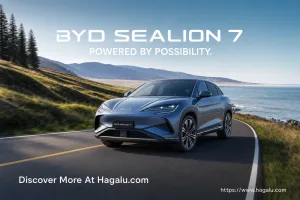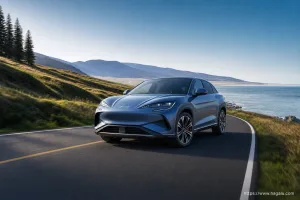
The BYD SEALION 7 is a five-seat battery-electric SUV that joined the South African range in 2025. Premium costs R1,109,900 and uses a rear-mounted motor producing 230 kW and 380 Nm. Performance costs R1,319,900 and adds a second motor for all-wheel drive, 390 kW and 690 Nm. Both use an 82.56 kWh Blade Battery, 11 kW AC charging and up to 150 kW DC charging in the published South African specification. Premium is rated at 482 km WLTP and 6.7 seconds from 0-100 km/h; Performance is rated at 456 km WLTP and 4.5 seconds. That comparison explains the range clearly: the less expensive car travels farther on the official cycle, while the flagship trades some efficiency for immense traction and acceleration. At 4,830 mm long, 1,925 mm wide and 1,620 mm high on a 2,930 mm wheelbase, the SEALION 7 is a substantial vehicle. It offers a listed 500-litre rear luggage compartment plus 58 litres under the bonnet. The long wheelbase should help passenger space, but the width needs checking against garages and city parking. Loaded ground clearance is listed at at least 140 mm, which makes the coupe-like SUV a road vehicle rather than a high-clearance off-roader. Premium has 19-inch wheels and Performance 20-inch wheels, with potential differences in replacement cost, ride and pothole vulnerability. Charging determines whether the car fits a household. An 11 kW home wall unit can use the vehicle's full published AC capability if the property and electrical supply support it. A 150 kW public charger is a peak input, not a guaranteed session average; battery temperature, charger sharing, starting state of charge and the charging curve affect time. Owners should plan everyday charging around where the car already parks, then treat public fast charging as a travel tool. The 482 km and 456 km figures are controlled WLTP results, not promised motorway ranges. Speed, headwind, temperature, elevation, passengers, tyre pressure and climate control can materially change consumption. Cabin technology is generous. BYD lists a 15.6-inch rotating central screen, 10.25-inch driver display, panoramic roof, Dynaudio audio, vehicle-to-load capability and a broad driver-assistance suite. A showroom demonstration should include phone integration, route planning, climate controls, charging settings and assistance menus. Technology that is difficult for an owner to operate can become a distraction, regardless of screen size. Vehicle-to-load can power compatible equipment, subject to the manual's current and safety limits, which may be valuable during travel or outages. Safety credentials look strong from the published structure and equipment, but powerful acceleration increases the driver's responsibility. Performance's 4.5-second claim is far beyond what is needed in ordinary traffic. Wet roads, worn tyres and short gaps remain hazards even with all-wheel drive and electronic control. Premium's 230 kW is already more than sufficient for everyday overtaking. Buyers should read battery exclusions and capacity language, arrange an insurance quote for the selected derivative and investigate local tyre supply. The SEALION 7 is impressive when the owner has reliable charging and values performance, space and technology. Premium is the balanced recommendation because it is cheaper, longer ranged and still very quick. Performance is an indulgent but coherent flagship for a buyer who specifically wants all-wheel drive and 390 kW. BYD South Africa's published warranty table lists five-year or 100,000 km complete-vehicle cover, eight-year or 200,000 km power-battery cover and five-year or 100,000 km drive-unit cover for the SEALION 7. BYD South Africa separately publishes roadside-assistance coverage for five years or 100,000 km, whichever comes first. BYD's model-specific South African booklet includes three services or 80,000 km and a five-year or 100,000 km maintenance plan covering its listed wear items; buyers should follow its schedule and exclusions.