Drivetrain & Chassis Explained
FWD vs RWD vs AWD vs 4x4 — and Monocoque vs Ladder Frame.
A plain-English guide for South African car buyers.
What is a Drivetrain?
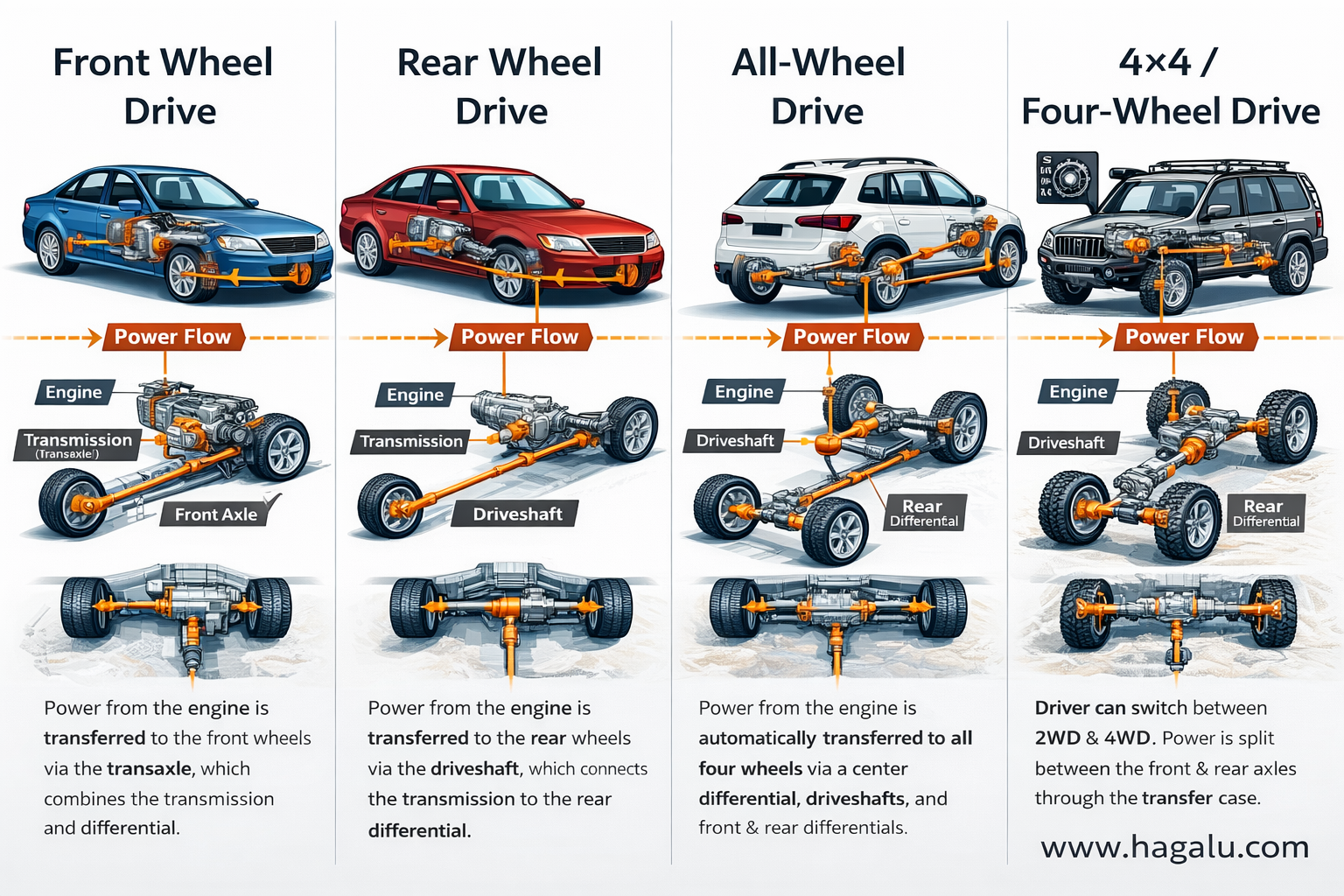
The drivetrain is the system that transfers power from the engine to the wheels that move the car. Different configurations send power to different combinations of wheels — and that choice affects fuel economy, traction, handling, off-road capability, and price.
There are four main types used in South African cars today:
FWD Front-Wheel Drive
In a Front-Wheel Drive car, the engine powers only the two front wheels. The transmission and differential are combined into a single unit called a transaxle, which keeps everything compact and lightweight under the bonnet.
- Most fuel-efficient drivetrain
- Lower purchase and maintenance cost
- Good traction in wet or light off-road conditions
- More interior space (no rear driveshaft tunnel)
- Lighter weight
- Understeer in hard cornering
- Less suited to performance or sporty driving
- Front tyres wear faster (steering + driving load)
- Limited towing capacity
Best for: City driving, families, first cars, fuel saving.
RWD Rear-Wheel Drive
In a Rear-Wheel Drive car, the engine powers only the two rear wheels. A driveshaft runs from the gearbox to the rear differential, which splits power to the rear wheels. This classic layout is used in bakkies, performance cars, and rear-engine vehicles.
- Better weight distribution (50/50 front/rear)
- More engaging, sporty driving feel
- Higher towing capacity
- Front tyres last longer (steering only)
- Better for heavy loads (load distributes to driven wheels)
- Can oversteer — tail steps out in slippery conditions
- Less traction on wet or loose surfaces
- Driveshaft tunnel reduces interior space
- Generally heavier and slightly less fuel-efficient than FWD
Best for: Bakkies, towing, performance driving, heavy loads.
AWD All-Wheel Drive
All-Wheel Drive sends power to all four wheels simultaneously and automatically. A centre differential and electronic sensors monitor wheel slip and distribute torque where it is needed most — without any driver input. AWD is always on; you never need to engage or disengage it.
- Superior traction on slippery roads (rain, gravel, light mud)
- Fully automatic — no driver action needed
- Smooth on-road handling
- Good for SUVs used on gravel roads
- More expensive than FWD or RWD
- Higher fuel consumption
- More complex — higher maintenance cost
- Not designed for extreme off-road like 4WD
Best for: Gravel roads, light off-road, wet weather, family SUVs.
4x4 4x4 / Four-Wheel Drive
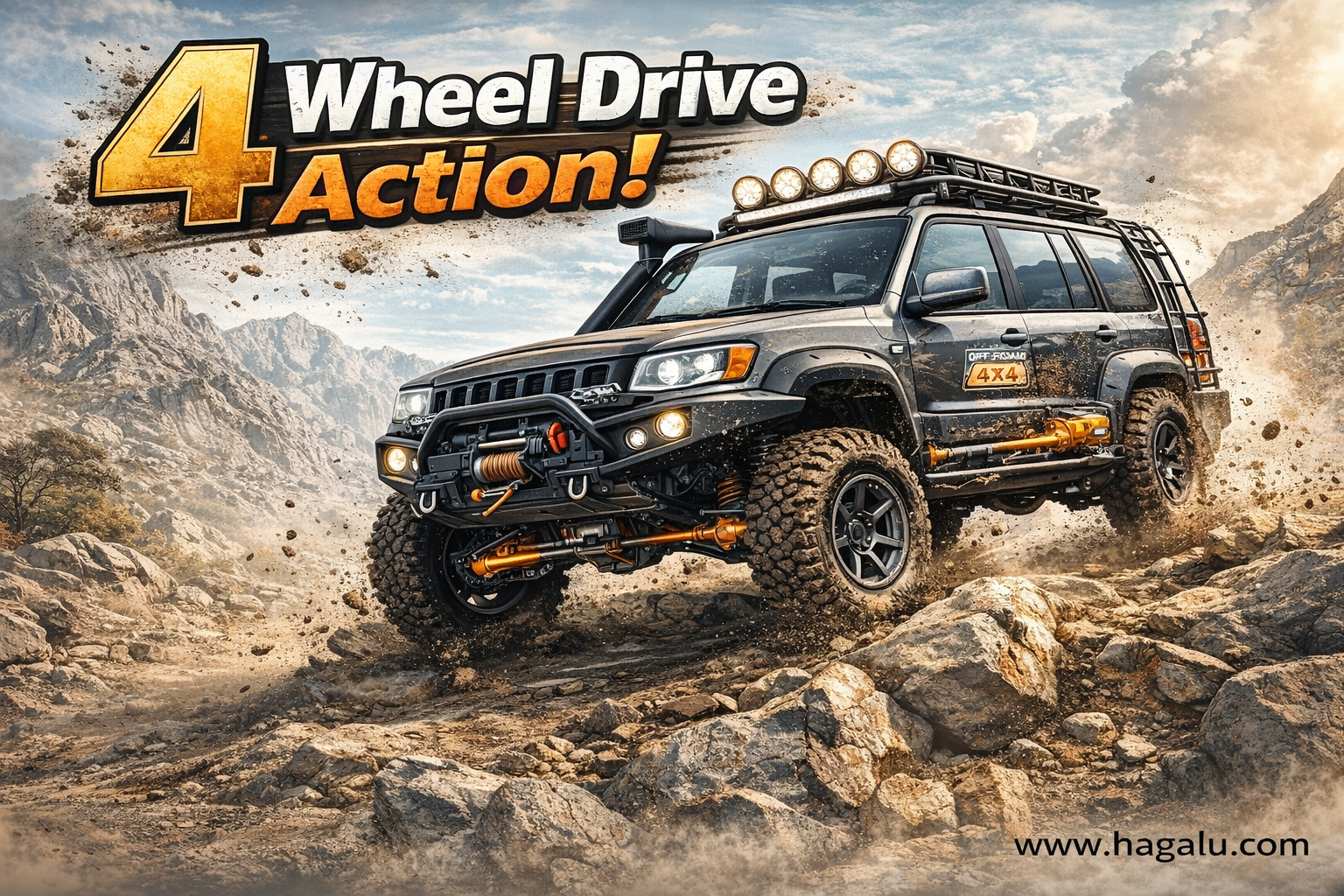
4x4 / Four-Wheel Drive is a driver-selectable system that locks the front and rear axles together so all four wheels receive equal torque. Unlike AWD, 4WD is designed specifically for serious off-road use — rock crawling, deep mud, sand, and steep inclines. Most 4WD systems offer a Low Range (4L) gearbox that multiplies torque for extreme terrain.
- Maximum traction in extreme off-road conditions
- Low Range for rock crawling, steep descents, deep sand
- Paired with ladder frame for high towing and payload
- Rugged and proven in harsh conditions
- Must be manually engaged / disengaged
- Should not be used on dry tarmac (drivetrain binding)
- Higher fuel consumption when engaged
- Heavier and more expensive to service
Best for: Serious off-road, game farms, remote areas, heavy towing.
Drivetrain Comparison Table
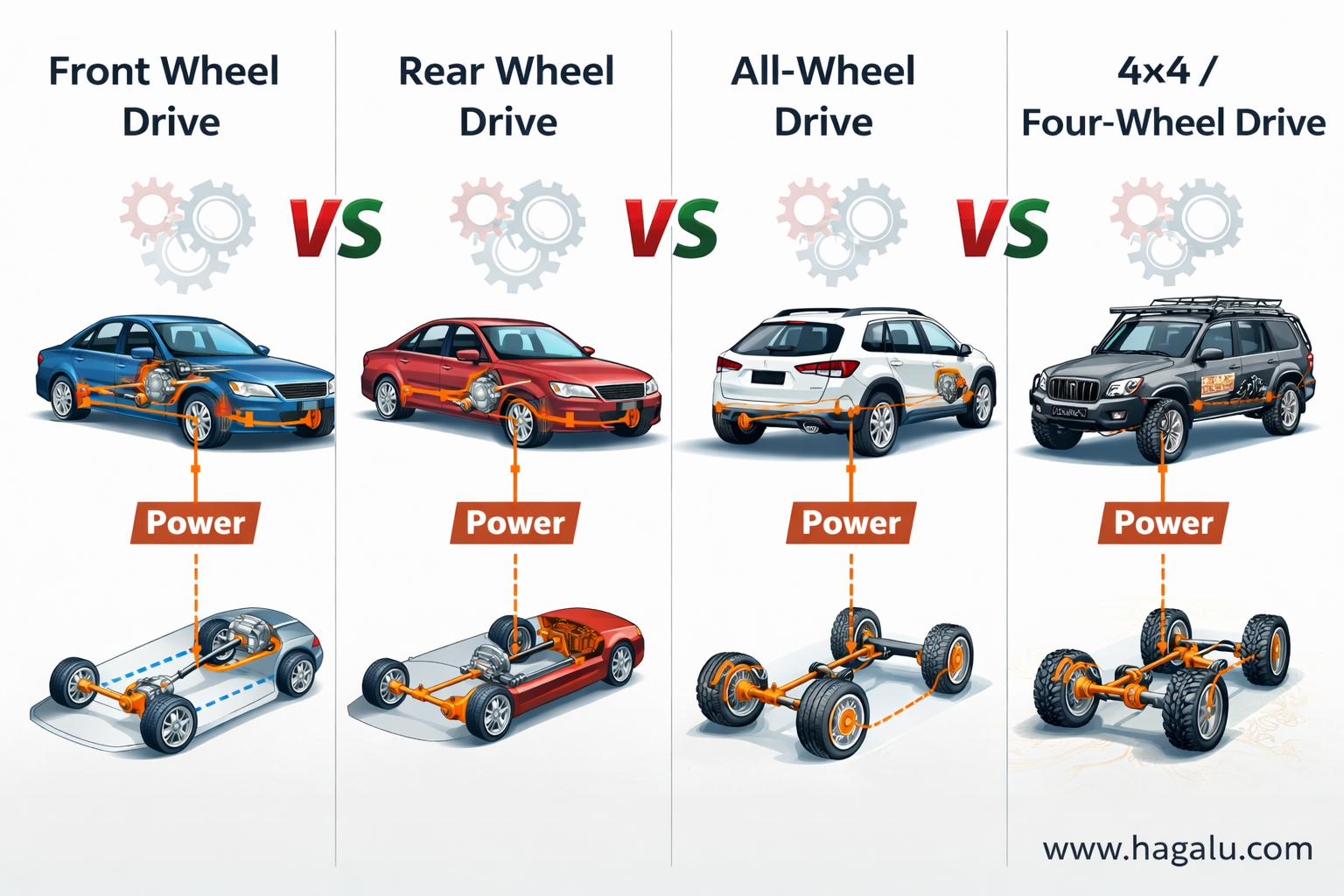
| Feature | FWD | RWD | AWD | 4x4 |
|---|---|---|---|---|
| Wheels driven | Front 2 | Rear 2 | All 4 (auto) | All 4 (manual) |
| Fuel efficiency | ⭐⭐⭐⭐⭐ | ⭐⭐⭐⭐ | ⭐⭐⭐ | ⭐⭐ |
| Wet road traction | ⭐⭐⭐ | ⭐⭐ | ⭐⭐⭐⭐⭐ | ⭐⭐⭐⭐⭐ |
| Off-road capability | ⭐ | ⭐⭐ | ⭐⭐⭐ | ⭐⭐⭐⭐⭐ |
| Towing capacity | ⭐⭐ | ⭐⭐⭐⭐ | ⭐⭐⭐ | ⭐⭐⭐⭐⭐ |
| Running cost | Lowest | Low | Medium | High |
| Driver engagement | None | None | None (auto) | Manual switch |
| Typical use | City/family | Bakkie/sport | SUV/gravel | Off-road/farm |
What is a Vehicle Chassis?
The chassis is the structural skeleton of a vehicle — everything else is built on top of or around it. The chassis determines how strong, heavy, and capable a vehicle is. There are two dominant construction types used in modern vehicles:
Monocoque Monocoque / Unibody Construction
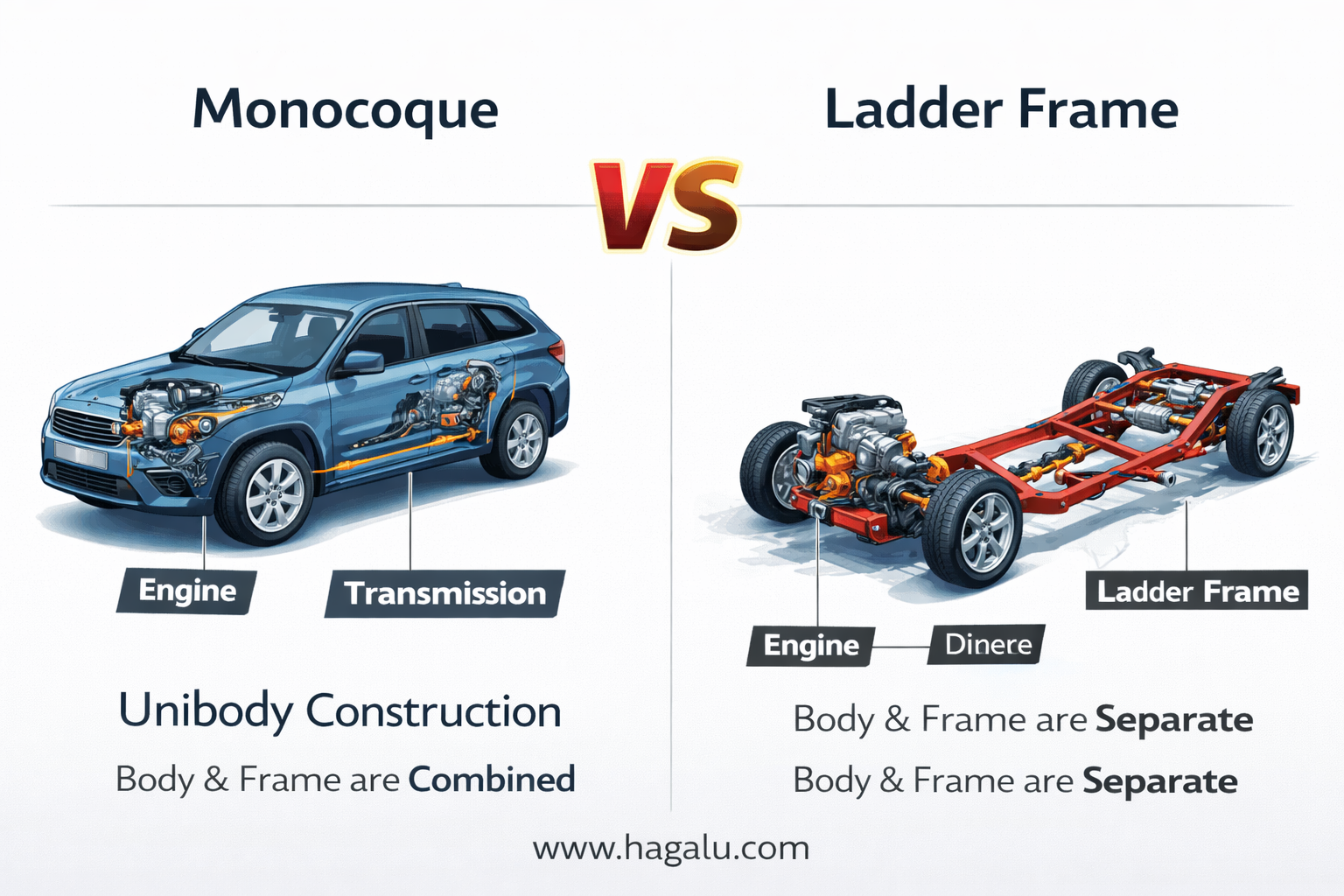
Monocoque (from French: single shell) means the body and the chassis are built as one integrated unit. The outer panels, floor, pillars, and roof all share the structural load — like an eggshell that gets its strength from its shape.
Modern manufacturing techniques have made monocoque construction extremely safe. Crumple zones are engineered directly into the body to absorb crash energy before it reaches the cabin.
- Lighter — better fuel efficiency
- Quieter, more comfortable ride
- Better crash safety (crumple zones)
- Lower centre of gravity — better handling
- Cheaper to produce at scale
- Less suitable for extreme off-road flexing
- More expensive to repair after heavy impact
- Lower towing and payload limits
- Rust can compromise structural integrity
Best for: Family SUVs, city cars, comfort-focused buyers, gravel road driving.
Ladder Frame Ladder Frame / Body-on-Frame Construction
A ladder frame chassis has two parallel steel rails (the "rails") connected by cross-members — forming a shape like a ladder. The body of the vehicle is then bolted on top as a separate structure. The body and frame are completely independent of each other.
This construction is inherently strong under twist and flex — exactly what you need when one wheel drops into a ditch and the vehicle needs to keep all wheels on the ground.
- Exceptional strength for off-road flex and impacts
- Higher towing and payload capacity
- Easier to repair/modify individual sections
- Body can be replaced without replacing chassis
- Proven reliability in demanding conditions
- Heavier — higher fuel consumption
- Rougher, more truck-like ride quality
- Higher centre of gravity — more body roll
- More road noise transmitted to cabin
Best for: Bakkies, serious off-road, farm use, heavy towing and payloads.
Monocoque vs Ladder Frame — At a Glance
| Feature | Monocoque (Unibody) | Ladder Frame |
|---|---|---|
| Body & frame | Combined as one unit | Separate — body bolts on |
| Weight | Lighter | Heavier |
| Fuel efficiency | Better | Lower |
| Ride comfort | Smoother, quieter | Firmer, more vibration |
| Crash safety | Excellent (crumple zones) | Good (rigid frame) |
| Off-road flex | Limited | Excellent |
| Towing capacity | Lower | Much higher |
| Typical vehicle | SUV, sedan, hatchback | Bakkie, 4x4, truck |
| Repair cost | Higher after impact | Lower (sections replaced) |
Which Should You Choose?
Frequently Asked Questions
What is the difference between AWD and 4WD?
AWD runs all four wheels constantly without you doing anything — good for wet tar, gravel, and light bush tracks. 4WD is something you engage yourself; it locks the front and rear axles together for proper off-road situations like mud, sand, and steep rocky terrain. Short version: AWD is passive grip, 4WD is manual muscle when you genuinely need it.
What does FWD mean in a car?
Front-Wheel Drive — the engine only drives the two front wheels. The gearbox and differential share one compact unit, which keeps weight down and fuel consumption lower. Most hatchbacks and small SUVs in SA use FWD because it's cheaper to produce and perfectly adequate for city and highway driving.
What does RWD mean in a car?
Rear-Wheel Drive — the engine pushes the car via a driveshaft to the rear axle. Bakkies use it because weight over the rear wheels helps traction when the load bay is full. Sports cars use it because it gives a more balanced handling feel. On slippery surfaces with nothing in the back, RWD can get squirrelly.
Is FWD or RWD better for daily driving in South Africa?
FWD for daily use, no question. Lower fuel consumption, lighter maintenance bills, and it handles SA roads — wet Cape Town winter roads included — without drama. RWD earns its keep in bakkies that carry loads and tow trailers. For a school-run hatchback or commuter sedan, FWD is the practical call.
Is AWD the same as 4x4?
They're not the same. AWD manages itself automatically and works well on gravel and slippery tar. 4x4 is a system you switch on manually, locks both axles, and includes a Low Range (4L) ratio for crawling over rocks and through deep mud at very low speed — something AWD can't do. AWD is for everyday traction; 4x4 is for when things get genuinely difficult.
What is monocoque construction?
Monocoque (or unibody) means the body panels and chassis are all one welded structure — no separate frame underneath. The result is lighter weight, better fuel economy, and a more comfortable ride. Nearly every modern passenger car, SUV, and crossover uses this.
What is a ladder frame chassis?
A separate steel frame — two long rails with crossmembers — onto which the body is bolted. It absorbs punishment better than monocoque, which is why the Hilux, Ranger, and D-Max all use it. The trade-off is extra weight and a slightly higher, bumpier ride on smooth roads.
Can a monocoque SUV go off-road?
Yes, within reason. A Fortuner or Everest (both monocoque) handles gravel roads, dry riverbeds, and typical SA farm tracks without trouble. Where they struggle is heavy mud, rock crawling, or sustained 4L crawling — that's where a proper ladder-frame bakkie with 4x4 has the advantage.
Which drivetrain uses the least fuel?
FWD, because fewer moving parts means less energy lost to friction. AWD adds a small penalty — usually 0.3–0.7 L/100km in real-world driving. 4WD in High Range (4H) is similar to AWD, but engaging Low Range (4L) for off-road destroys fuel economy — it's not meant for road use.
Which is better for South Africa — monocoque or ladder frame?
Depends entirely on what you do with it. Monocoque SUV for Joburg suburbs, Cape Town, or anywhere paved: better ride, lower running costs, easier to park. Ladder frame bakkie for anything beyond that — farms, game reserves, towing a caravan or trailer. Many SA buyers end up with one of each for exactly that reason.
What is Low Range (4L) in a 4x4?
A second set of gear ratios that multiplies torque at very slow speeds — think steep rocky descents, axle-deep mud, or deep sand where you need pulling power but almost no wheel speed. Always shift back to 2H before you return to normal roads. Using 4L on tar will damage the drivetrain.
Does 4x4 help on wet roads?
It helps you accelerate and hold traction in the wet — but it does nothing for stopping distance. Braking performance comes down to your tyres and ABS, not whether all four wheels are driven. More people get into trouble in 4x4s on wet roads because the extra confidence leads to corners taken too fast.
About This Guide
This guide was researched and written with the assistance of AI tools and reviewed by the Hagalu editorial team. Technical specifications and vehicle examples are based on models available in South Africa as of 2026. Always verify final pricing and specifications with your dealer. Read our Editorial Policy →