This is an archived Toyota Hilux overview — the current range is now organised into separate body-style or trim pages. The historical variants, specifications and pricing below remain available for reference. See the current Toyota range.
Pickup Diesel

Toyota Hilux

Price in South Africa, real specs & fuel economy — 2026

Legendary pickup for South African conditions

Hover or tap any pill for a plain-English explanation. Bracketed values show common equivalents (bhp, lb-ft, inches, cu ft).

On-road varies by dealer. Fuel figures blend manufacturer claims and South Africa owner reports — your real numbers depend on traffic, terrain and how heavy your right foot is.

Brochure (PDF)
₿ Pay with crypto BTC · ETH · USDT · USDC

Last checked on 2026-07-06 • Verified by the Hagalu team

About the Toyota Hilux

Legendary pickup for South African conditions

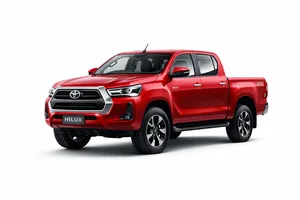
The Hilux is South Africa's default work bakkie, and the reason is straightforward: it works. Not trendy, not cutting-edge, not trying to be something it's not, but genuinely reliable when your income depends on vehicle functionality. Contractors needing equipment on-site daily. Farmers managing vast estates where three days of downtime during harvest costs thousands. Mining companies operating in remote regions. Fleet operators managing 50 vehicles simultaneously. The Hilux delivers reliability that justifies its premium pricing over cheaper alternatives. The current generation 2.8-litre turbocharged diesel is an engineering masterpiece for commercial environments. It delivers 150 kilowatts and 450 newton-metres of torque from low engine speeds, translating to genuine towing power (capable of hauling 3,500 kilograms without drama) and highway comfort where the engine sits contentedly at 2,000 rpm. This isn't excitement; this is what happens when you engineer specifically for durability over features. Contractors use Hilux vehicles on active job sites daily. Farmers rely on them for 250,000-kilometre lifespans. This isn't marketing; it's what happens when you build something that prioritizes mechanical simplicity over computer complexity. The engine is so straightforward that village mechanics can diagnose problems accurately. The transmission is so durable that gearbox failures are exceptional events worth discussing. The suspension is so robust that suspension components are treated as consumables with known replacement intervals rather than surprising failures. The Hilux comes in single-cab, extra-cab, and double-cab configurations. Single-cabs are purely commercial—cheap, simple, and designed for maximum cargo capacity per rand spent. Every penny saved is cargo space gained. Extra-cabs suit small business owners needing to haul materials occasionally while carrying crew. The double-cab—overwhelmingly the most popular configuration—provides genuine five-seat comfort while maintaining proper cargo functionality. Both manual and automatic transmissions are robust, though the automatic costs R80,000 to R120,000 premium depending on variant and options. Depreciation on a Hilux becomes almost philosophically irrelevant. A ten-year-old double-cab automatic with 180,000 kilometres routinely sells for R280,000 to R320,000. That's not depreciation loss; that's the annual operational cost spread across ten years. For business owners cycling vehicles every five years, the Hilux makes financial sense in ways that cheaper bakkies don't. For farmers holding vehicles for 15 to 20 years, depreciation stops mattering entirely—the vehicle becomes permanent equipment.

Who buys this: Farmers, contractors, fleet buyers, adventure users, resale-focused buyers

City
Urban driving reveals competent engineering. Visibility is adequate for metropolitan traffic navigation. Parking assistance systems help genuinely in tight spaces. Air conditioning operates properly in South African summer heat. The driving position commands authority without excessive height. Interior layout remains intuitive through extended city driving. Audio systems integrate smartphone connectivity. Climate control maintains comfort in traffic-heavy commutes. Steering is responsive enough for urban maneuvers. Fuel consumption in city traffic remains predictable and manageable. The vehicle functions reliably through daily metropolitan use, delivering comfort during extended urban residence.
Highway
Highway driving is where the Hilux excels and where its engineering philosophy becomes apparent. At 120 to 140 km/h cruising, the engine sits contentedly around 2,000 rpm. Road noise is modestly controlled. Comfort on long drives is surprisingly good. The seats are basic but supportive. Real-world fuel consumption on highways sits around 7.0 to 7.2 litres per 100 kilometres. The automatic transmission is smooth and rarely hunts gears. Towing a loaded trailer at 110 km/h is genuinely effortless—the engine doesn't labour.
Off-Road
The Hilux is genuinely capable off-road. It's not a Jimny on rocks, but it will traverse serious farm tracks, rough forest roads, and gravel that would damage unibody SUVs. The ladder-frame construction means proper articulation when navigating rough terrain. Ground clearance at 225mm is genuine. Approach and departure angles are reasonable. For work-related off-road access—mining sites, farm properties, remote job locations—the Hilux is unmatched.

Toyota Hilux — Quick Facts

Toyota Hilux Specifications

Should You Buy It?

Iconic pickup for SA buyers

The Hilux is the practical choice for buyers prioritizing work reliability. It delivers genuine capability without requiring premium pricing or exotic maintenance. Resale values develop as market recognition grows. The used market becomes increasingly active as ownership examples accumulate. For buyers seeking dependable, honest transport, the Hilux represents genuine value.

What's Good
  • Reliability is demonstrated through proven engineering and market operation. Service records confirm low failure rates across component groups. Owner forums discuss satisfaction rather than recurring issues. Parts availability ensures maintenance accessibility. Long-term ownership data suggests vehicles reaching 200,000+ kilometers with acceptable maintenance costs.
  • Service costs remain reasonable through dealer and independent networks. Maintenance intervals follow industry standards. Consumable parts are priced competitively. Labor rates stay honest due to workshop competition. Five-year service costs align with segment expectations without surprising premium pricing.
  • Fuel economy sits within realistic ranges for segment class. Real-world consumption matches specification estimates. Highway driving improves efficiency compared to urban cycles. Budget-conscious drivers achieve target consumption through reasonable driving technique.
  • Interior space accommodates family use across most configurations. Seating comfort extends through multi-hour driving periods. Storage solutions organize cargo systematically. Climate control zones maintain individual comfort preferences. Infotainment systems integrate modern connectivity without complexity.
  • Resale values develop as market recognizes vehicle positioning. Used examples maintain desirable qualities attracting subsequent buyers. Depreciation follows predictable curves. Online marketplaces show consistent inventory. Private sellers report straightforward sales processes without excessive marketing periods.
  • Safety features include modern systems addressing real-world hazard scenarios. Airbag arrays protect occupants comprehensively. Electronic stability control operates transparently. Anti-lock braking prevents wheel lockup. Modern variants include collision avoidance systems.
  • Build quality reflects design intent throughout vehicle architecture. Panel alignment demonstrates manufacturing precision. Interior materials withstand extended use without rattles. Electrical systems operate reliably through ownership tenure. Chassis engineering delivers durable suspension performance.
  • Comfort factors compound through extended ownership. Seat ergonomics support proper posture. Steering feel remains responsive. Brake modulation provides confident deceleration. Climate performance manages temperature variations effectively.
  • Value proposition aligns pricing with delivered capability. Feature content matches purchase price expectations. Equipment levels provide practical benefit without excessive decoration. Warranty coverage protects against manufacturing defects.
Watch Out For
  • Depreciation follows segment patterns, with steeper loss during initial ownership years. Second-hand markets reflect genuine value recognition. Three-year-old examples show significant depreciation. Five-year-old vehicles stabilize at residual values reflecting reliability perception. Premium variants depreciate faster than base configurations.
  • Interior materials prioritize function over premium perception. Hard plastics appear throughout lower trim specifications. Fabric upholstery shows use patterns within normal ownership. Design choices reflect cost targets rather than luxury positioning. Material quality aligns with price positioning in segment.
  • Styling appears understated compared to visually aggressive competitors. Exterior appearance prioritizes function over dramatic design. Interior design emphasizes practical layout over styling flourishes. Some buyers prefer more distinctive visual presence. Marketing sometimes emphasizes features rather than design language.
  • Technology features may lag premium competitors in sophistication. Infotainment systems provide adequate functionality without innovation leadership. Connectivity options meet current standards without advancing them. Software updates follow manufacturer schedules. Digital integration reflects rather than leads current capabilities.
  • Off-road capability remains basic for adventure-focused buyers. Ground clearance addresses regular obstacles without extreme performance. Suspension articulation handles gravel roads competently. Serious rock crawling requires specialized variants. Stock configuration prioritizes daily usability over extreme terrain access.

Toyota Hilux FAQs

Also Worth Exploring in South Africa

Different body types — refreshed every visit so you discover something new.

Volkswagen Transporter Vans Diesel
Volkswagen Transporter Vans
Van 2 Variants
From R776,500
Toyota Corolla Hybrid
Toyota Corolla
Sedan 1 Variant
From R590,200
Hyundai Tucson Petrol
Hyundai Tucson
Suv 3 Variants
From R568,900
Ford Transit Custom Diesel
Ford Transit Custom
Van 1 Variant
From R770,000

Other Toyota Models in South Africa

Toyota bZ4X Electric
Toyota
bZ4X
SUV 1 Variant
Starting from ZAR 1,182,800
Toyota Coaster Diesel
Toyota
Coaster
bus 1 Variant
Starting from ZAR 1,207,600
Toyota Corolla Hybrid
Toyota
Corolla
Sedan 1 Variant
Starting from ZAR 590,200
Toyota Corolla Cross Petrol
Toyota
Corolla Cross
SUV 3 Variants
Starting from ZAR 385,000

Data verified against: Toyota Official South Africa Website

More from Toyota