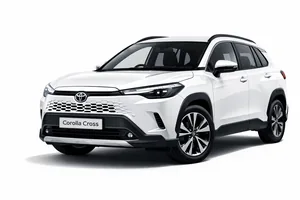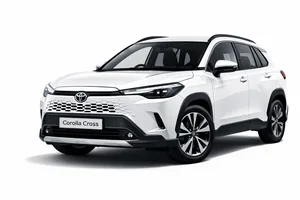
Toyota's 2026 Corolla Cross is positioned for five-seat family SUV buyers who want locally built practicality with a clear petrol-versus-hybrid choice. The current South African range contains 7 derivatives and runs from R424 900 to R575 400. Those prices are Toyota South Africa's listed vehicle prices on 2026-07-16; finance interest, insurance, licensing, delivery and accessories sit outside that comparison. Every derivative uses a 1.8-litre engine and CVT. Petrol grades produce 103 kW and 172 Nm, while HEV grades combine a 72 kW petrol engine with Toyota's hybrid system for 90 kW total output and 4.3 l/100 km claimed consumption. The derivative list is 1.8 Xi CVT, 1.8 XS CVT, 1.8 HEV XS CVT, 1.8 XR CVT, 1.8 GR-S CVT, 1.8 HEV XR CVT, and 1.8 HEV GR-S CVT. That spread matters because the cheapest and most expensive versions do different jobs. Buyers should begin with body format, passenger count, drivetrain and normal route, then compare equipment and price inside the group that can actually do the work.
The 2026 update is not a speculative future entry. Toyota's current local configurator and specification sheets identify the derivatives, prices, powertrains and major equipment. Facelifted first-generation Corolla Cross built in South Africa. 2026 range adds petrol and HEV GR-S derivatives alongside Xi, XS and XR grades. That launch context is useful when comparing dealer stock because an earlier model-year vehicle can carry a familiar badge while having different styling, safety equipment, screens, wheels or drivetrain details. A written quotation should identify the exact derivative and model year, and the specification should be checked before a deposit is paid.
The mechanical choice is central to ownership. Every derivative uses a 1.8-litre engine and CVT. Petrol grades produce 103 kW and 172 Nm, while HEV grades combine a 72 kW petrol engine with Toyota's hybrid system for 90 kW total output and 4.3 l/100 km claimed consumption. A lower purchase price can be sensible when annual mileage is modest and the entry grade already has the required hardware. A more expensive derivative becomes rational only when its drivetrain, safety systems, cabin equipment or ownership role is used regularly. Fuel or electricity cost should be calculated from a realistic monthly distance rather than one laboratory figure. Tyres, insurance and finance cost can also change sharply between grades even where the body shell looks similar.
Packaging is equally important. The Corolla Cross is a suv with 5 seats and 5 doors in this local body configuration. A proper test drive should include the driver's normal parking space, a representative stretch of broken road and, where relevant, passengers, cargo or a trailer. Seat comfort, visibility, steering effort, brake feel and low-speed gearbox behaviour are easier to judge in familiar conditions than on a short route around a showroom. Available finishes include Glacier White, Platinum White Pearl, Celestite Grey, Metal Stream, Attitude Black, Arizona Red, Brass Gold, Oxide Bronze, Caribbean Blue, bi-tone GR-S finishes, although production batches and dealer stock can limit a particular colour and trim combination.
Ownership planning should be completed before choosing the final grade. Compare the official service plan and warranty, ask for the service schedule in writing, price replacement tyres in the fitted size and obtain an insurance quotation using the exact derivative. Buyers financing the vehicle should compare deposit, term, rate, initiation fee, monthly service fee and balloon payment on the same basis. A lower monthly instalment created by a large balloon is not the same as a lower total cost. Trade-in settlement and optional products should be shown separately so the vehicle price remains visible.
For South African use, the strongest Corolla Cross is therefore not automatically the top trim. It is the derivative whose passenger space, drivetrain, running cost and equipment match the owner's ordinary week. The Corolla Cross is at its most convincing in daily urban use, where the HEV can exploit low-speed electric assistance and the compact SUV footprint remains manageable. Xi and XS focus on value; XR and GR-S add equipment and appearance that must justify their higher monthly cost. Petrol and HEV grades both use CVTs, but their performance and consumption priorities differ. The petrol engine has the higher standalone output, while the HEV's 4.3 l/100 km claim is the stronger running-cost reference for high annual mileage and mixed traffic. This is a front-wheel-drive crossover, not a low-range off-roader. Its ground clearance and sensible tyre sizes suit broken tar and maintained gravel, but buyers who regularly face deep sand, mud or technical tracks should choose a vehicle with the appropriate drivetrain and recovery hardware.