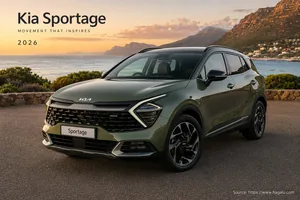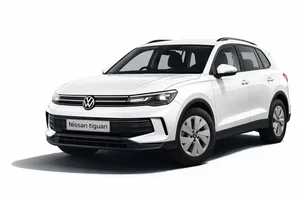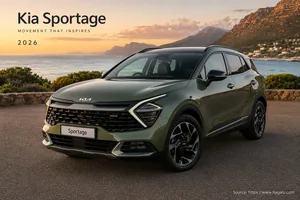
The KIA Sportage has maintained a consistent presence in South Africa since the early 2000s, but the fifth-generation NQ5 model represents a step-change so significant that it effectively resets the competitive reference points for every compact SUV priced above R650,000. Where previous Sportage generations were competent but conservative — the considered purchase when you needed a reliable family SUV without the Toyota RAV4's premium pricing — the NQ5 demands evaluation on its own terms and frequently comes out ahead. The exterior is the entry point of any Sportage conversation. KIA's design team has produced something genuinely striking rather than merely attractive. The Sportage's front fascia features a three-dimensional parametric grille that flows into the daytime running lights in a way that creates a face with no analogue in the segment. The sharp crease running along the vehicle's flank, the full-width LED rear light cluster and the clean, athletic roof profile create a vehicle that generates attention in showrooms and on roads. Park an NQ5 GT-Line next to a Toyota RAV4 GX on Cape Town's bougainvillea-draped Somerset Road or Johannesburg's Rivonia Road, and the Sportage draws more eyes. In a segment where the final purchase decision often involves emotional validation as much as rational specification comparison, design that generates genuine admiration is not irrelevant. South African Sportage variants are powered by either the 1.6-litre turbodiesel or the 1.6-litre turbocharged GDI petrol across the LX, EX, GT-Line, GT-Line Plus and GT-Line S grade structure. The diesel's low-rev torque architecture makes the Sportage a relaxed, fuel-efficient long-distance companion on South Africa's national roads — the N1, N3, N4, N7 and R62 routes that connect South Africa's cities and regions in ways that no other transport mode can replicate at the same cost or convenience. The turbo petrol serves buyers who prioritise performance-feel and the responsiveness of a high-output petrol drivetrain over the diesel's efficiency advantage. The interior is the Sportage's technical centrepiece and the feature that most decisively separates it from the previous generation. A panoramic curved display integrating a 12.3-inch digital instrument cluster and a 12.3-inch infotainment screen into a single sweeping arc is, without qualification, the most impressive dashboard architecture available in a compact SUV under R900,000 in South Africa. It is not visual theatre — the system's response speed, graphic quality and interface logic make it a daily-use pleasure that endures past the first week of ownership novelty. Physical climate control toggles retained below the display represent a sensible ergonomic decision that prioritises usability over screen real-estate maximisation. Meridian audio on GT-Line grade. The Meridian brand is associated with premium hi-fi and professional audio applications that place it several tiers above the generic brand-labelled systems that constitute most automotive audio. In the Sportage's cabin, the Meridian's sonic precision and wide-stage presentation is audible on SA public radio — Gauteng's 947, Cape Town's CapeTalk, KZN's East Coast Radio — in ways that make long commutes and road trips a different sensory experience. It is the kind of detail that Sportage GT-Line owners describe in conversation weeks and months after purchase. It is not a gimmick; it is a genuine quality step. The 64-colour ambient lighting system divides buyers between those who dismiss it as unnecessary and those who, once experienced, find it impossible to not appreciate. In South Africa's social driving culture — the weekend run to the Midlands Meander in KZN, the Namaqualand flower route drive in the Northern Cape, the evening scenic drive along Clarens in the Free State — the cabin atmosphere that ambient lighting creates is part of the experience. At night, approaching a Cape Town wine estate on the R310 after a harvest dinner, the Sportage's cabin feels like somewhere you want to be rather than a box you are occupying between destinations. Safety on GT-Line is comprehensive beyond category expectation. Forward collision avoidance, lane keeping assist, blind-spot collision warning, rear cross-traffic collision avoidance assist, safe exit warning, driver attention warning and high-beam assist form a suite that addresses the specific South African road risk factors rather than simply meeting minimum regulatory requirements. Safe exit warning — which prevents door opening if approaching traffic is detected — is specifically valuable at South Africa's urban intersections and narrow suburban streets where cyclist and pedestrian conflicts with opening car doors cause regular incidents. For families with children who open rear doors without looking, it is the kind of system that prevents the incident type that parents in South African cities dread most. Ride quality on the Sportage NQ5 is a deliberate engineering achievement in the South African context. South African roads present a suspension stress test that European testing cannot replicate — the corrugated gravel approaches to game lodges in Limpopo and Mpumalanga, the tar-chip roads of Western Cape wine estates, the potholed urban roads of South Africa's secondary cities, the concrete-joint crossings of Durban's beachfront promenade. The Sportage's suspension tune manages the conflicting demands of comfort over these irregular surfaces with the body control necessary for confident stability at 120km/h on smooth national roads. It is composed without being harsh, comfortable without being floaty — a balance that is more difficult to achieve than it sounds and that previous Korean SUV generations did not consistently manage. The competitive field at R662,995 to R823,995 is complex and honest assessment requires engaging with each rival. The Toyota RAV4 remains South Africa's compact SUV residual value benchmark — a structural advantage for buyers who change vehicles regularly. The Hyundai Tucson shares the Sportage's platform and technology at comparable pricing through Hyundai's parallel dealer network. The Mazda CX-5 is more dynamically rewarding on demanding roads. The VW Tiguan carries its badge premium regardless of specification comparison outcomes. Against all of them, the Sportage argues: superior technology at each price point comparison, a longer warranty than any European rival, and a design identity that has outgrown its brand's previous value-positioning. The Meridian audio alone would command a R50,000+ premium in a Mercedes-Benz GLA or Audi Q3. The panoramic curved display architecture is unavailable in the RAV4 at any grade. The 64-colour ambient system is a feature that BMW 3-Series customers consider standard and Sportage buyers get at substantially lower cost. Limitations are real. The 1.6T petrol at 8.0-8.5L/100km in mixed conditions is expensive at sustained South African fuel prices over meaningful annual mileage. Toyota's residual value advantage is a structural market reality that KIA has not yet overturned and will not in the near term. The body roll on demanding mountain passes is more present than a Mazda CX-5 — the Sportage is calibrated for comfort-first rather than dynamics-first. The curved display's impressive appearance can generate reflections in direct South African summer sunlight at certain angles. These limitations sit in the context of a product that genuinely advances what South African buyers can expect from a compact SUV at its price bracket. The NQ5 Sportage has not merely arrived as a competitive product — it has arrived as a reference product against which others in the segment are now measured. That is a different and more significant achievement. The Sportage's durability in South African conditions has been accumulated across the previous generation's substantial South African fleet — fourth-generation Sportage NQ5 predecessor models built a service history in South African conditions that informed the NQ5's development. KIA's South African engineering team has been involved in market-specific feedback during the NQ5 development cycle, and the suspension calibration, noise attenuation tuning and climate control system calibration reflect South Africa's specific thermal and road surface conditions rather than European baseline assumptions applied universally. The result is a vehicle that feels at home on South African roads in a way that sometimes surprises buyers expecting the compromises of a globally-developed product. The GT-Line S's position at R823,995 represents a pricing that KIA has set deliberately at the base of the Land Rover Discovery Sport and VW Tiguan R-Line range. At this intersection, the Sportage asks a buyer to choose between KIA's technology and warranty advantage and the established European brand premium. For buyers whose vehicle purchase decision is influenced by the social context of where their car parks — the business district parking garage, the golf club, the private school car park — the badge calculus favours European brands regardless of specification. For buyers who make the decision at their desk with a spreadsheet, the Sportage wins on almost every objective measure. The practical after-sales support for the Sportage NQ5's advanced electronics — the curved display, the ADAS sensors, the ambient lighting system, the Bose amplifier — depends on KIA South Africa's dealer technical training investment. KIA's training programme for the NQ5's advanced electronic systems has been rolled out to all KIA dealers with a service capacity appropriate for this vehicle, and the calibration equipment required for the ADAS sensors (front camera, radar modules, ultrasonic sensors) is now present at major KIA service centres. First-time buyers of electronically sophisticated vehicles from Korean brands sometimes worry about warranty support quality for complex systems — this concern is now less warranted than it was five years ago, when KIA's dealer technical capability was more variable. The Sportage's ambient lighting system has specific practical application beyond aesthetic ambience in South Africa's crime-conscious vehicle security culture. The system's ability to illuminate the cabin in any of 64 colours enables buyers to set a distinctive cabin light signature that is visible from outside the vehicle at night — making the vehicle's interior immediately recognisable to its owner approaching in a parking area and distinguishable from adjacent similar vehicles in dark parking bays where model identification from a distance is otherwise difficult. Some Sportage owners use the amber setting for this purpose specifically; others prefer the personal signature of a colour that their own vehicle uses as a consistent identity marker. It is a minor functional benefit attached to a primarily aesthetic feature, but in South Africa's parking security consciousness it is a detail that users appreciate practically. The Sportage NQ5's digital over-the-air (OTA) update capability for the infotainment and ADAS system software means that KIA South Africa can push functional improvements to in-service vehicles without requiring dealer workshop visits. KIA has deployed OTA updates to Sportage vehicles for navigation map data refreshes, ADAS calibration updates and infotainment software refinements since the NQ5's South African launch. This update capability means that a 2022 Sportage's ADAS functionality in 2026 reflects improvements developed after the vehicle's original delivery — a form of ongoing product development that previous vehicle generations could not provide. For buyers who keep their vehicles for extended ownership periods (five to seven years, consistent with the warranty term), the OTA capability extends the product's functional relevance across a longer ownership period than static-software competitors. The Sportage GT-Line's 19-inch alloy wheel specification — the largest standard wheel in its segment in South Africa — provides a specific visual and performance context that warrants examination. The larger wheel diameter creates a lower-profile tyre sidewall which transmits more road surface information to the steering and cabin than the smaller wheels fitted to lower Sportage grades. On Cape Town's Sea Point promenade road or the smooth asphalt of Johannesburg's William Nicol Drive, the result is a more communicative, responsive feeling steering that elevates the driving experience. On the broken surface of a Johannesburg northern suburbs municipal road with significant pothole and speed hump interruptions, the lower sidewall transmits more impact forces into the cabin — a comfort trade-off that buyers should factor into their grade selection if their local road surfaces are significantly imperfect. The Sportage's positioning within KIA South Africa's broader brand narrative is significant beyond its individual specification merits. The Sportage is the model most frequently pointed to when South African automotive journalists and consumers benchmark KIA's brand evolution — it is the vehicle that most tangibly embodies the transition from value-for-money Korean alternative to genuine premium aspirant. When a first-generation Sportage from 2002 is placed next to a fifth-generation GT-Line S from 2024, the transformation is not incremental but fundamental, and the Sportage's current commercial success in South Africa reflects buyers' willingness to accept this brand evolution as genuine rather than cosmetic. For South African buyers considering the Sportage as a vehicle they will use for extended periods — the seven-year warranty term and beyond — the reliability track record of the N5Q's engine and drivetrain components is a critical but difficult-to-assess variable at early model year. KIA's global quality control systems, the 1.6T-GDI engine's deployment across multiple KIA and Hyundai models internationally, and the 1.6D's heritage in South African Seltos and Tucson service all provide confidence that the Sportage's powertrain is not first-generation untested technology. The electronics — specifically the curved display, the heads-up display and the ADAS sensor array — represent the category where first-generation quality concern is most warranted, and where the warranty's comprehensive coverage of electronic systems is most directly relevant to buyer risk management.