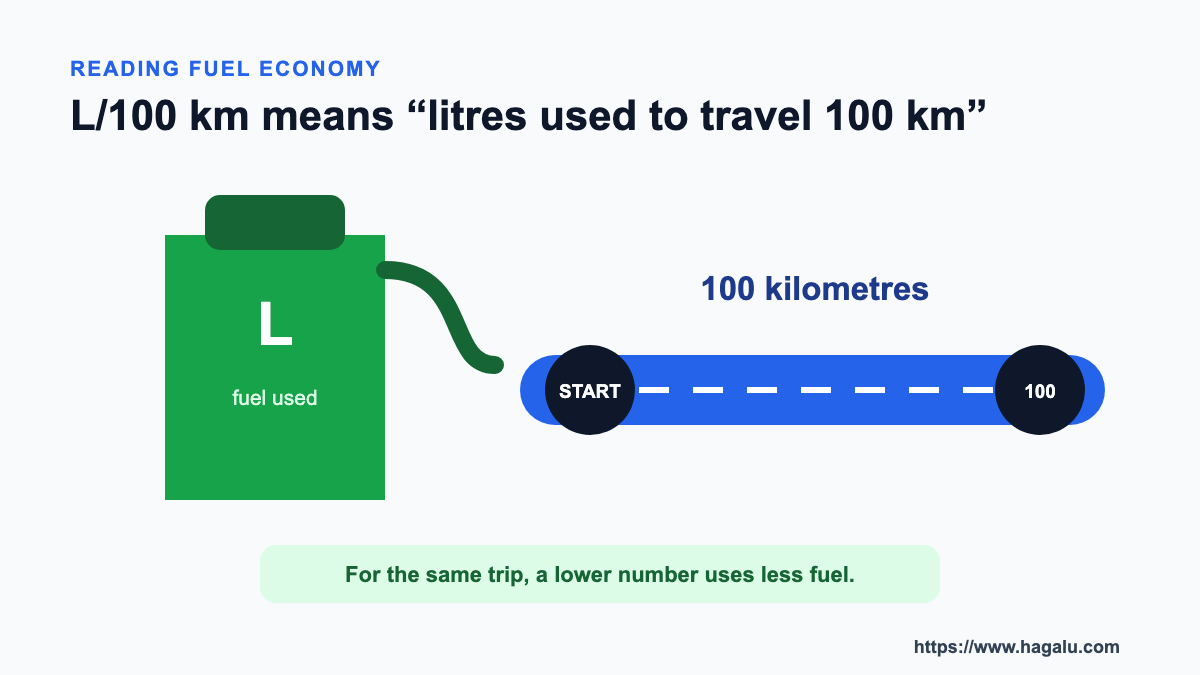
https://www.hagalu.comA lower L/100 km figure means less liquid fuel used over the same distance, all else equal.On a phone, swipe the diagram sideways to read it at a larger size.Open full-size image ·
Hagalu Editorial Studio ·
image usage termsStart with the decision
What you need to know first
Fuel economy is a high-intent question because the purchase price is only one part of a car's cost. Kenyan buyers can spend very different amounts depending on whether the car works mainly in stop-start Nairobi traffic, covers long highway distances, carries passengers or regularly climbs and descends outside town. A useful comparison therefore needs a clean unit and an explanation of its limits.
The ranking uses litres per 100 kilometres for conventional fuel-burning variants. Lower is better for the same route and fuel price, but the number is not a driving instruction. A compact hatchback may win the table and still be wrong for a family that needs seven seats, while a diesel SUV may use more fuel but carry a load more comfortably and travel farther between fills.
Live, checked catalogue
Lowest comparable liquid-fuel consumption
This list ranks qualifying Kenya petrol, diesel and non-plug-in hybrid variants using the recorded comparable consumption value. Battery-electric energy is kept separate because litres and kWh are different measures.
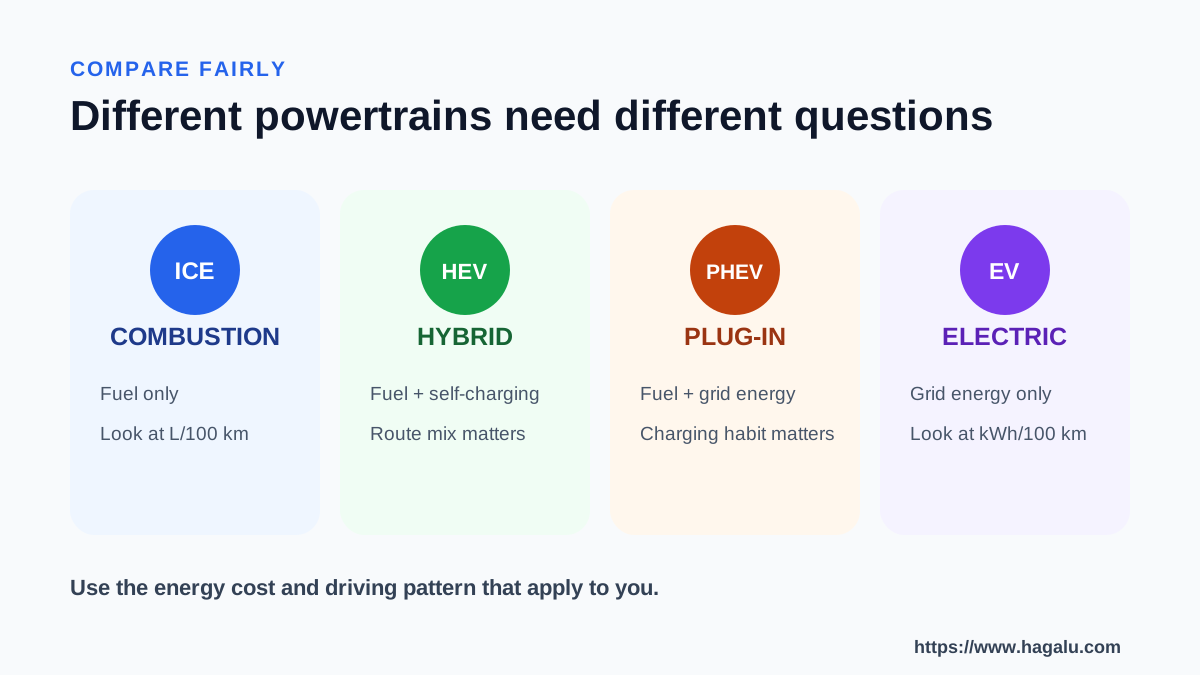
https://www.hagalu.comDo not rank petrol litres, hybrid litres and EV kWh on one unlabelled list.On a phone, swipe the diagram sideways to read it at a larger size.Open full-size image ·
Hagalu Editorial Studio ·
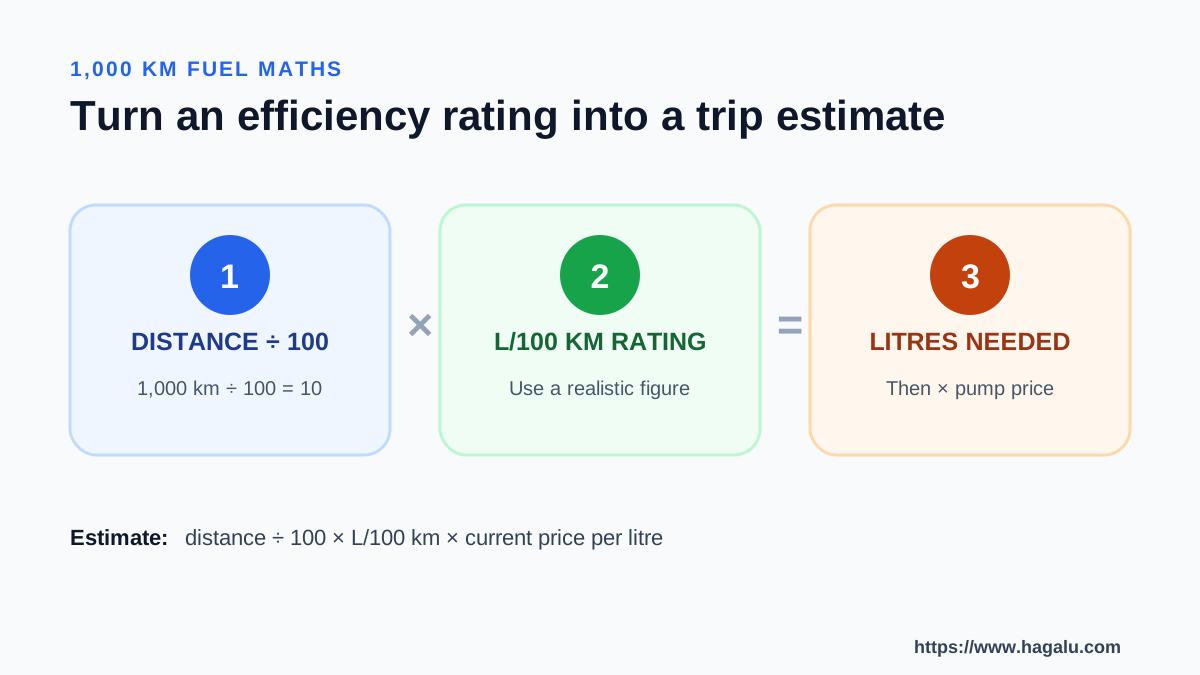
image usage termshttps://www.hagalu.comUse the published figure consistently, then leave room for traffic, load, hills and driving style.On a phone, swipe the diagram sideways to read it at a larger size.Open full-size image ·
Hagalu Editorial Studio ·
image usage termshttps://www.hagalu.comThe method is reusable; replace the practice price with the price you actually pay.On a phone, swipe the diagram sideways to read it at a larger size.Open full-size image ·
Hagalu Editorial Studio ·
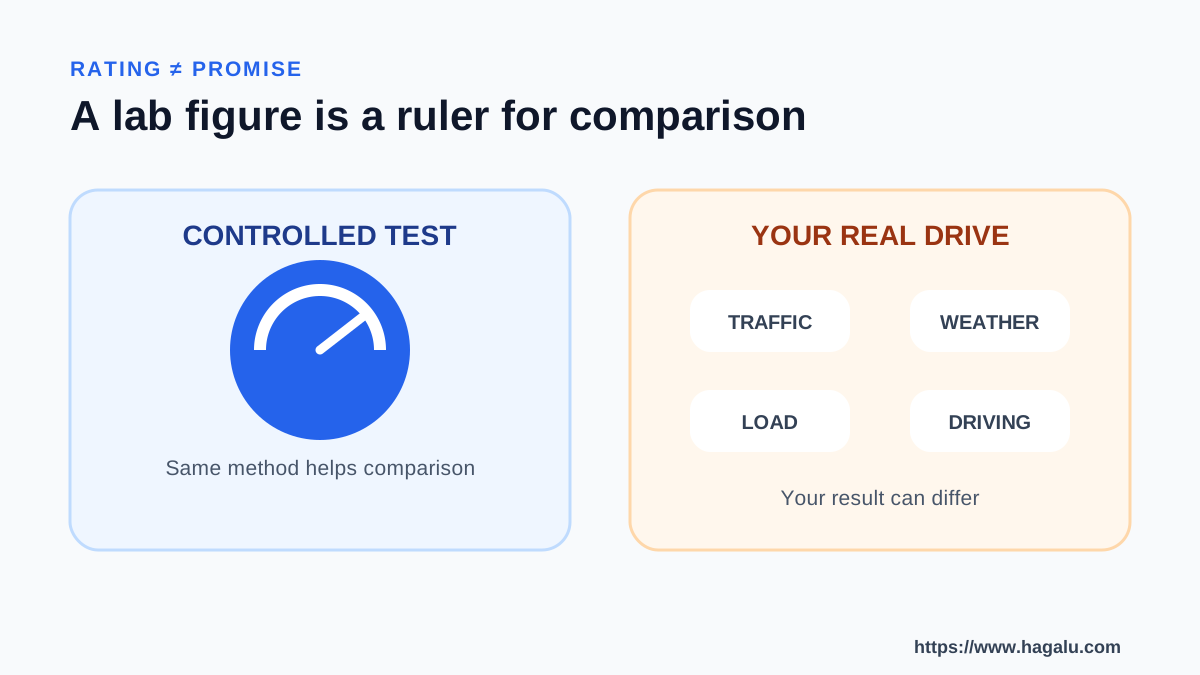
image usage termshttps://www.hagalu.comThe car matters, but tyres, traffic, load and speed can move the real number substantially.On a phone, swipe the diagram sideways to read it at a larger size.Open full-size image ·
Hagalu Editorial Studio ·
image usage terms
One unit first
L/100 km is easier to compare than a vague economy claim
L/100 km asks how many litres the vehicle uses over a fixed distance. If a car is listed at 5.0 L/100 km and another at 7.0 L/100 km, the first needs fewer litres for the same 100 kilometres under the same conditions. A km/l figure reverses the direction, so always check which one is being shown before deciding which number is better.
A claimed figure can be measured under a controlled test cycle. It is valuable when every candidate is reported consistently, but it is not a personalised forecast. Use it to narrow the shortlist and then calculate a cautious fuel budget with your own kilometres and a current price per litre.
Compare exact variants, not just model badges.
Keep petrol, diesel and self-charging hybrid rows labelled.
Do not put EV kWh/100 km into a liquid-fuel ranking.
Turn the number into your bill
Distance and fuel price decide the monthly result
For a simple planning estimate, divide your monthly kilometres by 100, multiply by the stored L/100 km figure and multiply again by the current price per litre you actually pay. Run the calculation for a low-distance month and a busy month. The difference is often more useful than arguing over a decimal point in a brochure.
A driver covering 2,000 kilometres in a month will feel a consumption gap much more than a driver covering 400 kilometres. A car that uses slightly more fuel but avoids a second vehicle, carries the work safely or has better support may still make more financial sense. Fuel is one line in the ownership decision, not the sole score.
Use your odometer or route estimate rather than a generic annual distance.
Update the fuel price when the market changes.
Add a margin for traffic, hills, load and air conditioning.
The road writes the final answer
Traffic, tyres and load can overwhelm a small headline advantage
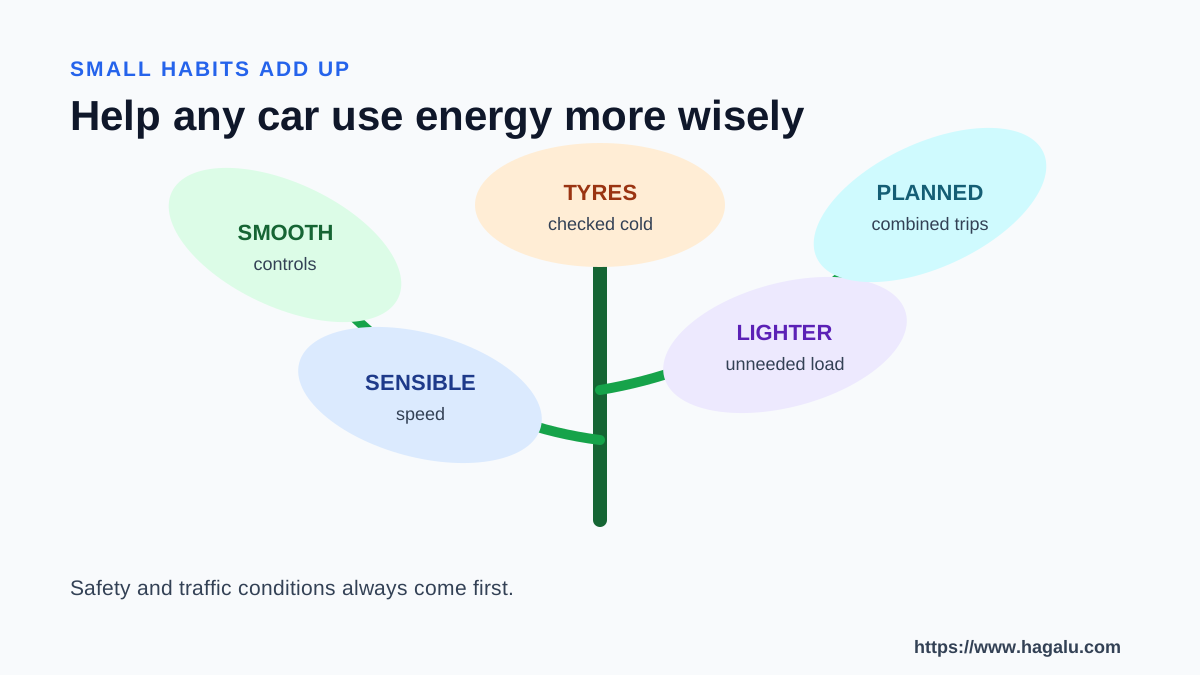
Short trips with cold starts, long idling and heavy traffic are hard on fuel use. So are underinflated tyres, roof loads, aggressive acceleration and carrying equipment that is not needed. On open roads, speed and wind can matter more than a driver expects. Smooth anticipation is often the cheapest efficiency upgrade available.
When the car is used for family or business work, do not remove the required capability simply to win a fuel table. A vehicle that is overloaded or driven outside its useful role can become less safe and less economical. Select a suitable size, maintain it correctly and then drive it gently enough for the engineering to help.
Check tyre pressure when the tyres are cold and follow the vehicle specification.
Remove permanent weight and roof equipment that the route does not need.
Record real fill-ups for a few tanks before changing cars over one estimate.
Take this with you
Fuel-use checks before choosing a Kenya car
Tick each item before deciding
Confirm the exact derivative and powertrain behind the consumption figure.
Write down monthly kilometres for town, highway and mixed use.
Use the current price per litre and a cautious traffic allowance.
Check tank size and service requirements for long-distance plans.
Compare fuel cost with insurance, tyres, service and purchase price.
No jargon test
Words on this page, made simple
Derivative
The exact version of a model—its engine, gearbox and equipment—not merely the badge on the boot.
ESC
Electronic stability control. It can brake individual wheels to help the car follow the driver's intended path during a skid.
ISOFIX
Built-in metal anchor points used by compatible child seats. The vehicle and child-seat manuals must still agree.
Payload
The combined weight the vehicle may carry, including people, bags and accessories.
Braked towing limit
The heaviest trailer the vehicle may tow when that trailer has its own working brakes.
Tow-ball limit
The most downward weight the trailer may press onto the vehicle's towbar connection.
Gross combination mass
The highest allowed total weight of the loaded vehicle and loaded trailer together.
PHEV
A plug-in hybrid: it has a battery that can be charged from an external plug as well as an engine.
Principal
The money borrowed before interest and finance fees are added.
Balloon payment
A large part of the debt deliberately left for the end of the finance agreement.
Annualise
Turn an irregular cost into a yearly amount, so monthly and occasional bills can be compared fairly.
How the list was built
Method, eligibility and limits
Only active priced Kenya variants with a parseable liquid-fuel consumption value enter the ranking.
The canonical comparison is L/100 km; km/l inputs are converted mathematically before ranking.
Battery EVs and identifiable plug-in charging use are not mixed into the liquid-fuel list.
One representative qualifying derivative is shown per model to avoid a trim-heavy list hiding the broader choice.
The first live card is the lowest comparable recorded liquid-fuel derivative in Hagalu's Kenya catalogue. Confirm the exact model, variant and current quote before treating it as your personal result.
Is a lower L/100 km number always better?
It is better for fuel use under comparable conditions, but not if the car cannot do the required job. Compare space, safety, road suitability and ownership cost alongside fuel use.
Why is my fuel use higher than the published figure?
Traffic, cold starts, hills, load, tyre pressure, air conditioning, speed and driving style can all increase real use. Record several real fill-ups before drawing a conclusion.
Should EVs be included in a fuel-efficiency ranking?
Not in a litres-per-100-kilometre list. EVs use kWh/100 km and need a separate electricity-price, charging-access and range comparison.
Evidence before excitement
Sources and checking method
Primary technical references checked 27 September 2026. Illustrations are conceptual, not photographs or specifications of a particular vehicle. Worked examples use explicitly stated assumptions, not current tariffs or quotations.
Toyota Kenya vehicle range — Kenyan Toyota model and derivative reference used alongside Hagalu's dated Kenya price records.
Ford Kenya vehicle range — Kenyan Ford range and derivative reference for Ranger and Everest buyer guidance.
Suzuki Kenya vehicle range — Kenyan Suzuki range reference for small cars, crossovers and utility vehicles.
Prices, equipment and availability can change after publication. Ranked model cards link their recorded vehicle source when one is available; the broader sources above explain market, legal or calculation context. Always verify the exact derivative in a current OEM document and written dealer quotation.