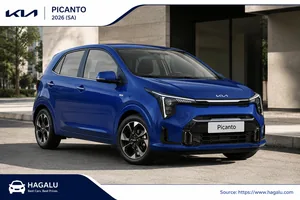
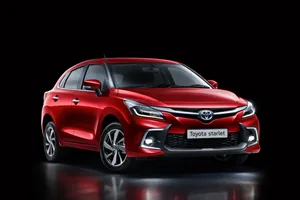
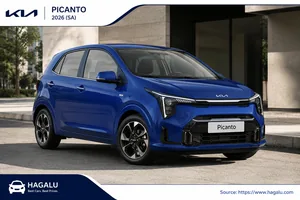
The KIA Picanto sits at the sharp end of South Africa's most competitive segment: the sub-compact hatchback market, where every rand is scrutinised, every litre of fuel matters and the battle between the Suzuki S-Presso, Renault Kiger and Toyota Starlet is fought with the intensity of a Soweto derby. Into this arena, KIA pitches a car that looks like it cost considerably more than it does, drives with a refinement that surprises first-timers and backs itself with a seven-year warranty that none of its direct rivals can match. The current Picanto generation landed in South Africa wearing a design language called Opposites United — sharp creases, a wide DRG grille face and available two-tone roof treatments that look genuinely contemporary next to segment peers. Park one next to a Suzuki S-Presso on Johannesburg's William Nicol Drive and the Picanto simply reads as the more expensive product, even when it is not. That perception matters in a country where a car is often a statement of arrival as much as a means of transportation. Two engine options cover the South African line-up. The entry-grade LS runs the 1.0-litre three-cylinder naturally aspirated unit — 998cc Kappa architecture producing 49kW and 95Nm. On paper those numbers seem modest. On Johannesburg's potholed side streets at 60km/h the 1.0-litre is entirely adequate — spry off the line, happy to spin to its 6,000rpm power peak and economical enough to deliver real-world consumption figures around 5.5 litres per 100km in urban stop-start, which at current Gauteng 95 Octane prices represents meaningful savings over a month. The 1.0 is available in LS guise with either a five-speed manual or four-speed automatic. Step up to the 1.2-litre four-cylinder Kappa unit and the picture brightens considerably. The 1.2 produces 62kW at 6,000rpm and 122Nm at 4,000rpm. The torque number is the one that counts — 122Nm means the Picanto actually feels brisk when you need to overtake a minibus taxi on the N3 between Durban and Pietermaritzburg, or merge onto the N1 South through Cape Town's southern suburbs without the nail-biting anxiety that afflicts truly underpowered city cars. The 1.2 fits across LX, EX and EX+ grades and mates to either a four-speed automatic or five-speed manual. Inside, KIA has resisted the temptation to fill the Picanto's compact cabin with fake materials that look good in a press photo but feel cheap eighteen months later. The dashboard architecture is clean, dominated by an 8-inch floating touchscreen on EX grade and above. Android Auto and Apple CarPlay come standard from LX onwards — a detail that matters enormously to South Africa's smartphone-dependent urban buyers, many of whom use Google Maps as their primary navigation tool and stream music over LTE rather than relying on built-in navigation systems that haven't been updated in four years. The EX+ pushes further: a 4.2-inch colour instrument cluster, wireless charging and a two-tone roof option create a car that reads as substantially more expensive than its R325,995 price tag. Wireless charging at sub-R330k is not a trick — it reflects KIA's global economies of scale deployed in a market where the feature is still rare at twice the price. The seats deserve specific mention. For a city car the Picanto's front buckets offer better lateral support than expected, with enough cushion depth to make the Johannesburg-to-Pretoria commute on the N14 a genuinely comfortable experience rather than the lower-back endurance test that some competitors serve up. Rear seat space is the Picanto's honest limitation: three adults across the back is possible for short distances, but anyone over 180cm will find legroom tight when the fronts are set for average-height occupants. As a four-seater or a genuine two-plus-two it works well. As a family-of-five vehicle, look at a Sonet instead. Boot space lands at 255 litres with the rear seats up — honest for the segment. The rear bench folds 60/40 to extend the load bay when needed, accommodating flat-pack furniture from Builder's Warehouse or weekly grocery runs from Pick n Pay with minimal drama. The loading sill height is low, which makes heavy bags genuinely manageable for shorter drivers and older buyers. Safety on the current Picanto has been quietly upgraded to a standard that embarrasses several segment rivals. Six airbags are standard across all grades — a figure that directly eclipses competitors who still offer two. ABS with electronic brake-force distribution, stability control and hill-start assist feature throughout the range. From EX grade, blind-spot collision warning and rear cross-traffic alert join the specification sheet. These are features that were unthinkable in sub-R300k hatchbacks just five years ago, and their standard inclusion on the Picanto is not a marketing embellishment but a genuine expression of KIA's safety philosophy applied consistently down the model hierarchy. The ride and handling balance is worth dwelling on at length. South African roads are not European roads — not even close. Johannesburg's suburbs are a mosaic of tarmac, tar chips, potholed municipality patches and speed bumps of varying aggression and gradient. Cape Town's Atlantic Seaboard mixes smooth tarmac with old cobblestoned back streets and dramatic concrete-over-sand expansion. Durban's beachfront blends smooth asphalt with concrete expansion joints from a drainage infrastructure that predates most current residents. The Picanto handles all of these with a softly tuned suspension that errs toward comfort rather than outright body control. There is body roll in corners, but it is predictable, communicative body roll — the kind that gives you grip limit warning rather than catching you out. Driven with the gentle respect a sub-compact deserves, the Picanto's chassis is satisfying for its purpose. The steering is light in the Picanto's urban natural habitat, which makes parking and low-speed manoeuvring effortless and makes it an accessible vehicle for a wide range of driver ages and abilities. It weights up adequately at freeway speed to feel stable rather than nervous, though it never achieves the communicative quality of a Volkswagen Polo or a Suzuki Baleno. The turning circle is tight enough to make U-turns on most suburban streets a single-movement exercise — a detail that city drivers accumulate genuine daily appreciation for. What makes the Picanto's value proposition compelling at a structural level is the warranty. Seven years or 150,000km — the longest standard warranty on any volume-selling car in South Africa at its price point. Combine that with a three-year/45,000km service plan and the total cost of ownership picture shifts dramatically. For a first-time buyer stretching to afford their first new car, the certainty that mechanical failures are covered for seven years is transformative. It removes one of the most anxiety-inducing financial risks of vehicle ownership in a country where unexpected repair bills regularly send households into debt spirals. The monthly installment on a R260,000 vehicle over 60 months at market interest rates is around R5,500-R6,000. Knowing that for seven years after the final payment, the drivetrain is still covered is the kind of financial peace of mind that has no simple monetary equivalent. Competitors deserve honest consideration rather than dismissal. The Suzuki S-Presso costs marginally less and offers better interior height but is narrower, less refined and carries a shorter warranty. The Toyota Starlet is a strong competitor with Toyota's reliability mythology — and that mythology has real substance in South Africa's used-car market — but is less generously equipped at comparable price points and offers only two airbags on base grades. The Renault Kiger adds a small crossover stance but is available only with CVT, which some buyers find disconnected from the driving experience they want for a daily city car. The Volkswagen Polo Vivo remains the emotional favourite for aspirational buyers who want a German badge and will sacrifice specification to get it, but it offers less standard equipment for comparable money and a shorter warranty. At R236,995 to R325,995 depending on variant and transmission choice, the Picanto offers the best combination of warranty coverage, standard safety equipment, infotainment generosity and design sophistication in its segment. That is not a marketing claim — it is a cold assessment of what each rival actually delivers for equivalent money. There are real limitations that honest buyers should understand. The 1.0-litre engine is genuinely strained on Johannesburg's elevated freeways at cruise speeds above 120km/h, where it sits at high revs and creates cabin noise that fatigues over long distances. The N3 between Durban and Johannesburg in a 1.0-litre Picanto is a slow, noisy commitment that even the most economical buyer will not repeat willingly. The four-speed automatic is a generation behind modern CVT or dual-clutch units in terms of efficiency, smoothness and fuel economy. The small wheel size on base variants can feel skittish over sharp road imperfections that larger wheels absorb without drama. And the rear seat is a genuine constraint for anyone expecting Golf-class accommodation. But compromises in this segment are measured against a price ceiling that does not permit perfection, and the Picanto allocates its budget more intelligently than most. It prioritises what South African buyers use daily — a comfortable front seat, a good touchscreen with wireless connectivity, reliable climate control, adequate engine performance for urban use and the financial certainty of the industry's best warranty — and does not waste money on irrelevancies. The recommendation is the Picanto 1.2 EX automatic if budget permits: the step from 1.0 to 1.2 makes a palpable real-world difference on actual South African roads, and the EX's infotainment and safety equipment additions justify their price premium over the LX. The EX+ is the pick for buyers who want wireless charging and the colour cluster display without moving to a larger vehicle. The LS 1.0 Manual remains the arithmetic champion for pure monthly installment minimisation, and its five-speed gearbox is genuinely pleasant to operate — one of the better-shifting manuals in the sub-compact class, with a light clutch and short throws that make city driving tactilely engaging rather than a physical chore. KIA South Africa has supported the Picanto with a dealer network now spanning all nine provinces, and parts availability has improved materially over the past decade as KIA's South African sales volumes have grown. The brand's rise from niche Korean alternative to mainstream consideration is reflected in used-car residual values that have improved year on year. A well-maintained Picanto with full service history holds its value reasonably well — better than older Korean brand perceptions would suggest, and competitive with Suzuki in the private used market. In a country where the cost of transport consumes a disproportionate share of household income for the majority of the population, the Picanto makes a coherent, honest case. It is not the cheapest car you can buy. It is close to the best-value package available at its price point, and in South Africa those two things are very different considerations. The cheapest car costs you more over time. The Picanto costs you appropriately and gives you more than you expect. That distinction earns it the segment's closest thing to a straightforward recommendation. Understanding the Picanto's position in South African society requires acknowledging the specific financial realities of its buyer. The National Credit Regulator's data consistently shows that vehicle finance in South Africa carries some of the highest default risk of any consumer credit category, driven by the intersection of high interest rates, stretched household budgets and the financial shock of unexpected repair costs. The Picanto's seven-year warranty directly addresses this risk profile in a way that no financial product can match — it is not insurance (which still requires excess payments and assessments) but a manufacturer undertaking that reduces the probability of the triggering event. For a buyer whose monthly vehicle finance payment consumes 25-30 percent of net household income, the warranty is not merely reassuring — it is structurally important to the ownership proposition's viability. The Picanto's resale trajectory in South Africa has improved meaningfully over the past five years, tracking the broader improvement in KIA brand perception that has followed the brand's design transformation and its consistent delivery of the warranty promise. Dealers report fewer instances of warranty disputes and better buyer satisfaction scores than a decade ago. The used-car market for well-maintained Picantos with full service history reflects this improvement — three-year-old EX and EX+ variants retain a higher percentage of original purchase price than the equivalent generation of entry Suzuki S-Pressos, and are approaching Volkswagen Polo Vivo parity in some metro used-car markets. The service plan mechanics deserve clarity for buyers making purchase decisions. The three-year/45,000km service plan covers scheduled services at KIA authorised dealers at 15,000km or 12-month intervals. Consumables — tyres, brake pads, wiper blades — are excluded, as they are in all South African manufacturer service plans. The schedule maintenance items — engine oil, filters, spark plugs at appropriate intervals, timing belt inspection — are covered. At KIA's current labour rates and Genuine Parts pricing, a Picanto service at a KIA dealer runs approximately R2,500-R3,500 per service for the 1.2-litre engine. Three services over the plan period represent R7,500-R10,500 of covered maintenance — a meaningful financial benefit that is not captured in purchase-price comparisons between the Picanto and rivals without service plan inclusions. Colour selection is worth a final word. The Picanto's colour palette is reasonably expressive for its segment and price point. The Chili Red generates genuine visual impact on the street and photographs well on social media — a consideration that is not frivolous for a vehicle whose target buyer is often social-media active and for whom the vehicle's photogenic quality has real social currency. The Horizon Blue and Gravity Blue metallic options provide the premium metallic finish that elevates the Picanto's street presence beyond base specification. The two-tone options on EX+ — contrasting roof in black against body colour — are the specification that most effectively closes the visual gap between the Picanto and compact hatchbacks selling for R100,000 more. For buyers who care about how their car looks and who have the budget for EX+ specification, the two-tone configuration is the recommendation without reservation.
 1 / 5
1 / 5